Interface between nonmagnetic insulators may be ferromagnetic and conducting
DOI: 10.1063/1.2754590
In the past few decades, researchers have focused much attention on complex oxides—oxide compounds in which the electrons interact strongly with one another and with the lattice. Such compounds exhibit a fascinating range of properties: ferromagnetism, ferroelectricity, high-temperature superconductivity, colossal magnetoresistance, and spin-glass behaviors. Not surprisingly, these compounds are being explored for myriad applications.
Interfaces between complex-oxide materials may yield even richer behavior than is found in bulk. Perhaps the interfaces exhibit phases that don’t exist in either of the constituent compounds. Just look at the wide variety of electronic devices that arise from the merging of semiconductors: One striking example is the quantum Hall effect seen in the 2D electron gas formed at a gallium arsenide–aluminum gallium arsenide heterojunction.
Like semiconductors, many complex oxides are closely lattice-matched to one another and lend themselves to epitaxial growth. Only in the past decade, however, have experimenters honed the techniques to grow high-quality oxide crystals and fabricate atomically abrupt and uniform surfaces.
One particular complex-oxide interface has recently shown some promise of fulfilling the high expectations. That is the interface between lanthanum aluminate (LaAlO3 or LAO) and strontium titanate (SrTiO3 or STO). Although both are insulators in their bulk form, Akira Ohtomo and Harold Hwang found two years ago that the interface between them was conducting. The electron carriers had a very high mobility, 1 m2/(V-s), with a scattering rate comparable to that of gallium arsenide. 1 Ohtomo is at Tohoku University and Hwang is at the University of Tokyo.
Now it seems that the LAO/STO heterojunction might be ferromagnetic as well as metallic, even though neither of the constituent compounds is magnetic. This month a team from the University of Twente in the Netherlands reported evidence for such magnetic behavior as a large negative magnetoresistance at the LAO/STO junction and, below 0.3 K, hysteresis in its sheet resistance—that is, resistance in a 2D plane. 2 Twente’s Alexander Brinkman acknowledges that more evidence may be needed to nail down the existence and nature of ferromagnetism. Still, observes Andrew Millis of Columbia University, it’s exciting just to see some type of ferromagnetic signature at the interface when none is seen in the bulk.
The findings of conductivity and ferromagnetism are not without some reservations. The largest question concerns the origin of the charge and spin carriers. Does the conductivity arise from an intrinsic effect, specifically electronic rearrangement at the surfaces? That’s the most interesting possibility. Or does it stem more mundanely from an extrinsic effect, the most likely being the appearance of oxygen vacancies in the crystals? By altering the growth conditions, experimenters are learning how to minimize the oxygen vacancies and still see the effects of electronic rearrangements. Hwang asserts that most researchers now believe that both effects can be in play, with one or the other being more important depending on growth circumstances.
Electronic reconstruction
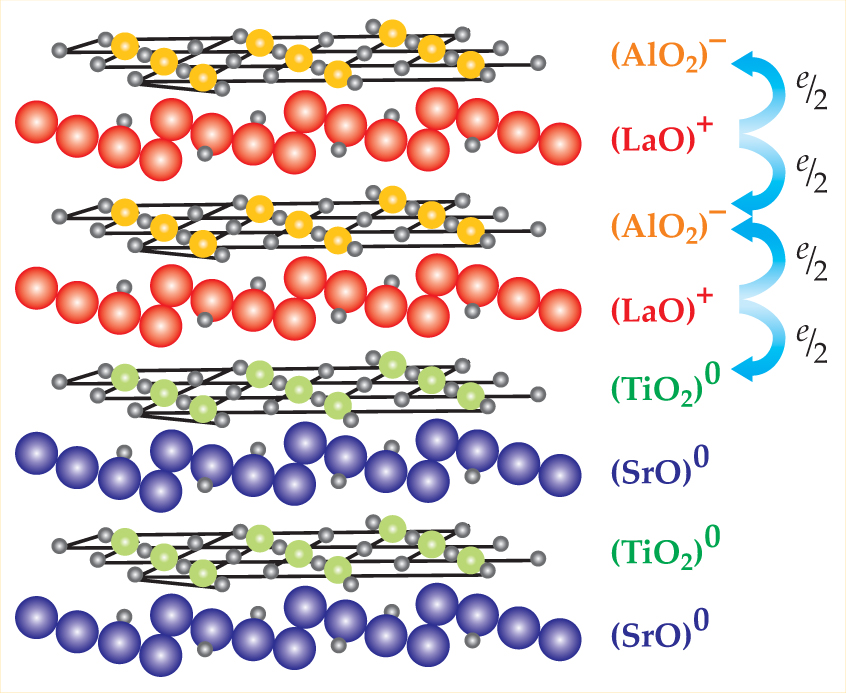
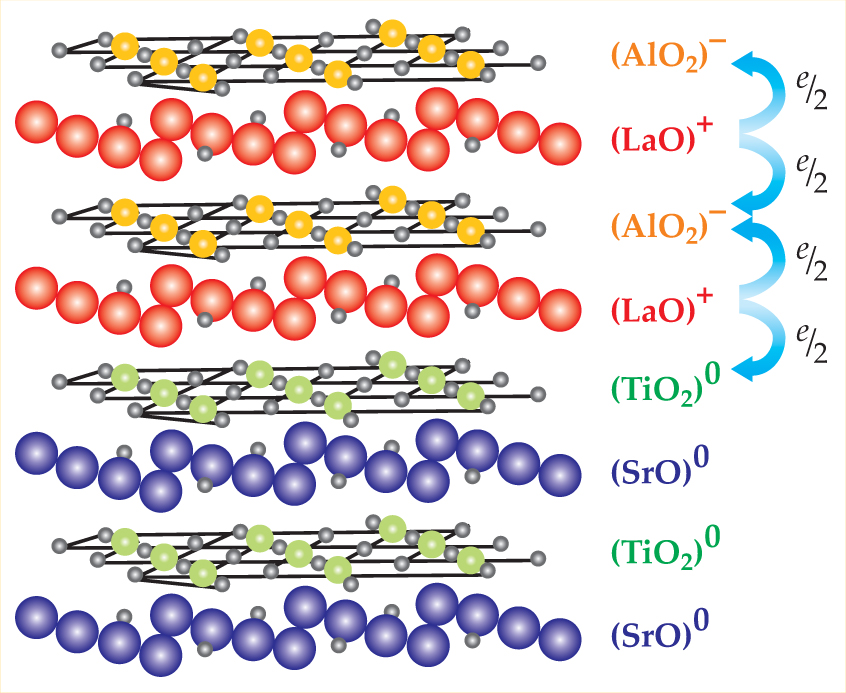
How can the electrons, which are localized in the constituent insulators, gain mobility at the interface? Akey factor is the electric field that is created when you terminate a complex oxide crystal along a (001) plane. To understand the origin of this field, consider the structure of the compounds that make up the apparent metallic ferromagnet: STO and LAO. Each one is a type of oxide known as a perovskite, having the general form ABO3, where A and B are cations. In perovskites, (001) planes of AO alternate with planes of BO2. As illustrated in figure 1, the layers of STO are both neutral. But in LAO, positively charged planes of LaO alternate with negatively charged planes of AlO2. The lanthanum ions are sharing their electrons with the aluminum ions in the adjacent layers.

Figure 1. Layered structure of the interface between lanthanum aluminate and strontium titanate, showing the alternating planes of atoms. La, Al, Sr, Ti, and O atoms are shown as orange, yellow, purple, green, and gray, respectively. Arrows labeled e/2 indicate the charge transfer between LaO and AlO2 layers because of ionic bonding. When the LaO layer is grown atop the originally neutral TiO2 layer, there is a net charge transfer of e/2 per unit cell to that layer.
(Adapted from refs. 3 and 10.)
If you try to terminate the LAO crystal with a plane of LaO on top, an electric field will point out of this plane. Nature won’t tolerate such a polar discontinuity. 3 For an isolated crystal of LAO, one can in theory solve the problem by removing half an electron per unit cell from the top LaO layer and adding that charge to the AlO2 layer on the bottom of the crystal. In practice, however, the material solves the problem in different ways. The surface may roughen as pyramids form there, so that other crystal facets than the problematic (001) plane present themselves to the outside. Or the ions might rearrange themselves on the surface to compensate for the charge imbalance.
What happens at the interface when you try to grow a positively charged plane of LaO on top of the neutral TiO2 layer of STO? To screen the charge from the LaO layer, some of the cations might shift position, or oxygen vacancies might form at the interface. It’s also possible, however, for the electrons to rearrange themselves there. For example, electrons might be transferred from the LaO layer to the TiO2 layer, with a net addition of half an electron, e/2, per unit cell. Some of these electrons might enter the previously unoccupied d shell of the Ti atoms, changing their valence from 4+ to 3+ and giving them local moments because of the unpaired d-shell electrons. (Ti, like most transition metals, can have several different valences.) This charge transfer is what gives rise to the possibility of both conductive and ferromagnetic behavior.
To grow the LAO/STO interfaces, experimenters use single crystals of STO as a substrate and etch atomically flat terraces on top of that, terminating in a TiO2 layer. The LAO layers are deposited on this substrate by pulsed laser deposition in a low-pressure background of oxygen. Atomic force microscopy can confirm that the step-and-terrace structure of the substrate has been maintained as the LAO film is deposited.
In their 2004 experiment, Ohtomo and Hwang found that the charge carriers at the LaO/TiO2 interface were negative, as expected from either the polar discontinuity or the presence of oxygen vacancies, and had high mobility. By contrast, the reverse interface, between AlO2 and SrO layers, was insulating. No experiment has yet found any conductance at this interface, although it is notoriously difficult to grow films with SrO as the top layer of the STO crystal.
Hwang and his colleagues have also found conductivity at the interface of STO with a Mott insulator, LaTiO3 (LTO). 4 Mott insulators are compounds that might be conductors except that the Coulomb repulsion between electrons prevents them from hopping.
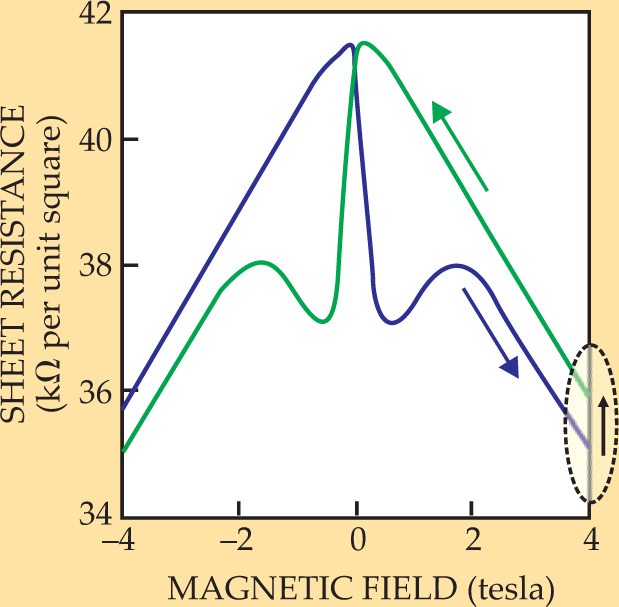
In their study of magnetic effects in LAO/STO, the University of Twente group, led by David Blank and Hans Hilgenkamp, chose samples grown under conditions that minimize the occurrence of oxygen vacancies. The magnetoresistance and the hysteresis measured in the experiment are shown in figure 2. Although one expects such a butterfly shape for ferromagnetic hysteresis, lead author Brinkman admits that he and his colleagues do not understand why this curve develops a local minimum just on either side of zero magnetic field. Moreover, they can only speculate on why the peaks in the hysteresis occur on the wrong side of zero: You’d expect to see the resistance drop after, rather than before, the sign of the field changes.

Figure 2. Magnetic dependence of the electrical resistance seen at an interface between lanthanum aluminate and strontium titanate. Arrows indicate data taken as the magnetic field is being raised or lowered. Measurements continued to higher fields are not shown, as suggested by the dashed circle. The butterfly-shaped hysteresis loop suggests the presence of ferromagnetism.
(Adapted from ref. 2.)
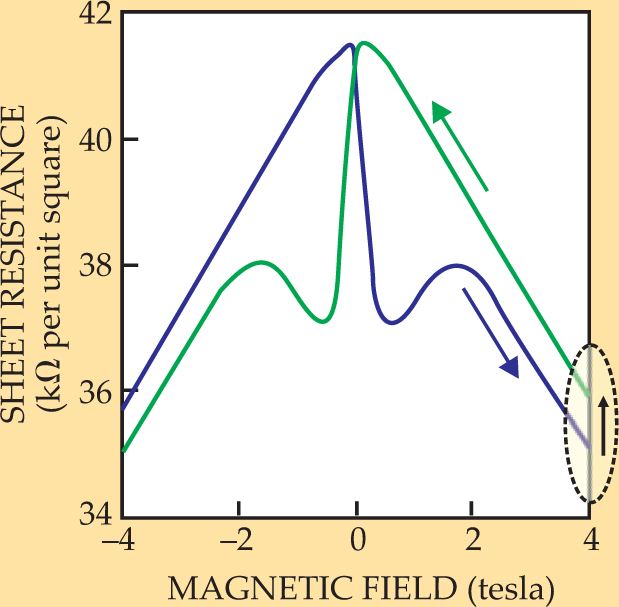
James Eckstein of the University of Illinois notes that while the shape of the magnetoresistive hysteresis is unusual, the fact that it exists suggests the switching of the direction of some magnetic order. This raises several questions: Where are the oriented spins, are they itinerant or localized, and what role might the interface play in localization?
Two theoretical groups have modeled the electronic structure of complex oxide interface with methods that account for the strong interactions between electrons. Rossitza Pentcheva (University of Munich) and Warren Pickett (University of California, Davis) modeled the LAO/STO interface. 5 Their results are consistent with the experimental findings of conductivity and ferromagnetism at the interface between LaO and TiO2 layers and with insulating behavior at the AlO2/SrO junction. Using a different approach, Satoshi Okamoto (Columbia), Millis, and Nicola Spaldin (University of California, Santa Barbara) studied the interface of STO with the Mott insulator, LTO. 6 They predict the interface to be ferromagnetic and conducting, with an electron density distribution that agrees well with measurements. 4
Oxygen vacancies?
The debate over oxygen vacancies has raged ever since the first report of a high-mobility electron gas at the LAO/STO interface. If the electric discontinuity at the interface can be largely screened by the electrons arising from oxygen vacancies, there may be no need for electrons to rearrange themselves. Before this concern arose, experimenters had been growing interfacial films under relatively low partial pressures of oxygen. Now, however, they are increasing oxygen pressures to minimize the contributions of oxygen vacancies to any observed conductance at the interface.
Brinkman and his Twente collaborators found that the sheet resistance increased by about seven orders of magnitude when the partial pressure was raised from 10−6 mbar to above 10−3 mbar. The interface was still a conductor but not a great one. The Twente team chose to look for magnetic effects in the higher-resistance samples to maximize the likelihood that the behavior they observed was due to the polar discontinuity and not to oxygen vacancies.
Gertjan Koster and colleagues at Stanford University, the University of Twente, and North Carolina State University point out that the intrinsic doping caused by the polar discontinuity cannot give rise to a charge density any higher than that equivalent to e/2 per unit cell. 7 When Koster and his team annealed their interfaces at increasingly higher temperatures, the sheet carrier density converged to a fixed value, below that corresponding to e/2.
Hwang certainly agrees that any carrier density higher than e/2 per unit cell implies another mechanism besides the polar discontinuity. On the other hand, he points out that if oxygen vacancies dominated, one should see some conductance at the interface between SrO and AlO2 planes. Instead, all measurements to date have shown it to be insulating.
Jochen Mannhart and coworkers from the University of Augsburg and the Pennsylvania State University, using samples grown at relatively high oxygen pressures, found that one needs a minimum thickness of three unit cells of LAO deposited on the STO substrate before the interface will conduct electricity. 8 Such a steplike dependence of interface conductance on thickness of the LAO film is inconsistent with the presence of oxygen vacancies in significant numbers. Mannhart and coworkers were making a high-mobility transistor from the 2D electron gas at the STO/LAO interface. By applying a gate voltage to an initially insulating interface with just three unit cells of LAO, they could switch to a conducting state and back again.
For a different slant on the oxygen vacancy question, Alex Kalabukhov and his coworkers at Chalmers University of Technology in Göteborg, Sweden, studied the interface of STO with potassium tantalate (KTaO3 or KTO). 9 In particular, they looked at an interface that was expected to have positive carriers if the dominant mechanism was the polar discontinuity. Hall measurements indicate that the charge carriers are negative; the result suggests the presence of oxygen vacancies.
Better characterization of the heterostructures can certainly help researchers understand what is going on at the interface, and a number of groups are working on such measurements. Techniques such as scanning transmission-electron microscopy can give clear pictures of the positions of the cations. As for the oxygen vacancies, current techniques to detect them are indirect and not yet capable of seeing vacancies below a certain density threshold. 10 It would also be nice to measure the charge distribution around the interface and, perhaps, to determine where the spins are. Are they indeed associated with the Ti3+ ions?
Strontium titanate was once touted as a substitute for diamond in jewelry, but it eventually lost out to other competitors. Perhaps the new interest in oxide interfaces gives a brighter shine to its future.
References
1. A. Ohtomo, H. Y. Hwang, Nature 427, 423 (2004). https://doi.org/10.1038/nature02308
2. A. Brinkman, M. Huijben, M. van Zalk, J. Huijben, U. Zeitler, J. C. Maan, W. G. van der Wiel, G. Rijnders, D. H. A. Blank, H. Hilgenkamp, Nat. Mater. (in press).
3. H. Y. Hwang, Science 313, 1895 (2006). https://doi.org/10.1126/science.1133138
4. A. Ohtomo, D. A. Muller, J. L. Grazul, H. Y. Hwang, Nature 419, 378 (2002). https://doi.org/10.1038/nature00977
5. R. Pentcheva, W. E. Pickett, Phys. Rev. B 74, 035112 (2006). https://doi.org/10.1103/PhysRevB.74.035112
6. S. Okamoto, A. J. Millis, N. A. Spaldin, Phys. Rev. Lett. 97, 056802 (2006). https://doi.org/10.1103/PhysRevLett.97.056802
7. W. Siemons, G. Koster, H. Yamamoto, W. A. Harrison, G. Lucovsky, T. H. Geballe, D. H. A. Blank, M. R. Beasley, Phys. Rev. Lett. 98, 196802 (2007). https://doi.org/10.1103/PhysRevLett.98.196802
8. S. Thiel, G. Hammerl, A. Schmehl, C. W. Schneider, J. Mannhart, Science 313, 1942 (2006). See also M. Huijben et al., Nat. Mater. 5, 556 (2006). https://doi.org/10.1126/science.1131091
9. A. Kalabukhov, R. Gunnarsson, T. Claeson, D. Winkler, http://arxiv.org/abs/0704.1050 .
10. N. Nakagawa, H. Y. Hwang, D. A. Muller, Nat. Mater. 5, 204 (2006). https://doi.org/10.1038/nmat1569