Institute nurtures African math and science graduate students
DOI: 10.1063/1.2930726
“Oh my God, I didn’t dream to have a good opportunity like this,” says Esra Khaleel, a physics student from the conflict-plagued region of Darfur in the Sudan. Last year Khaleel left a nonpaying national service position at the Sudan Atomic Energy Commission to attend the African Institute for Mathematical Sciences (AIMS) outside of Cape Town, South Africa, which runs a graduate-level education program and paid all of her travel and study expenses. Khaleel is now completing research on the structure of nuclei in high spin states with the physics department at the University of Cape Town and the iThemba Laboratory for Accelerator Based Sciences, a national facility near Cape Town that houses a 200-MeV cyclotron and a 5-MeV van de Graaff electrostatic accelerator.
Since AIMS was founded in 2003 by University of Cambridge cosmologist Neil Turok, 160 students from more than 30 African countries have graduated from its nine-month diploma-granting program and the majority have gone on to pursue master’s and doctoral degrees in science-related fields. In 2005 the African Union designated AIMS as the hub for the creation of AMI-Net, an initiative chaired by Turok to set up a network of 10–15 mathematical institutes across Africa. This February, Turok won the 2008 TED (Technology, Entertainment, Design) Prize for his achievements in cosmology and his educational activism in Africa. Since then Turok has received more than $2 million in financial pledges—most of it to provide scholarships for AIMS students and some to set up AMI-Net.
A strong family
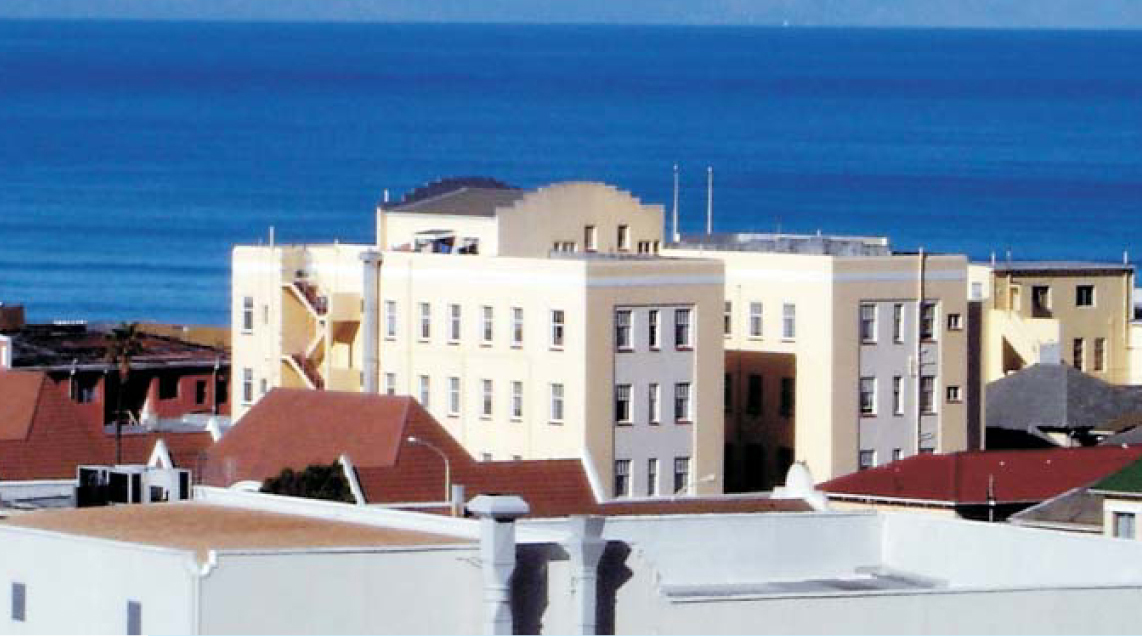
A refurbished seaside hotel doubles as the living quarters and lecture halls for an average of 50 AIMS students and their international lecturers each year. Together, often for 16 hours each day, they solve math problems, practice computational techniques, and learn English. “We share our knowledge and we help each other,” says Khaleel. “We have become a very strong family.” After mastering those basic skills, each student chooses courses that will lead to a concentration in pure mathematics, applied mathematics, or physics. “About 30% of our students this year are doing physics,” says AIMS director Fritz Hahne.
On successful completion of a research thesis, AIMS students are awarded a diploma and receive special consideration by the graduate programs at six partner universities. “My biggest challenge was convincing my parents that AIMS was a good institute,” says Zimbabwe native Tendai Mugwagwa, who was part of the inaugural class, “but their confidence was boosted by the links AIMS had to Cambridge University, Oxford University, and Université Paris–Sud 11 [in France].”
Prominent scientists, including Stephen Hawking, Nobel laureates David Gross and George Smoot, and NASA administrator Michael Griffin, will attend the opening of the AIMS mathematical modeling research center this month. The new center will host postdocs and visiting researchers and will collaborate with regional universities and laboratories. “We will focus on projects in biomathematics, financial mathematics, astrophysics, and cosmology, but we plan to broaden the research to areas such as resource management, water, energy, and biological materials,” says Hahne. AIMS is also planning an entrepreneurship training program to help students develop and implement wealth-creating projects. “I’m surprised by how fast things are moving,” says Mugwagwa, who is completing her PhD in theoretical immunology at Utrecht University in the Netherlands. “When we came [in 2003], the books were still in boxes and there were leaks in the roof, but now everyone knows about AIMS.”
“Source of bright people”
“The biggest contribution we can make towards addressing poverty is ensuring that our people are skilled and that they have a good foundation in math and science,” says Nhlanhla Nyide, science communications director for South Africa’s Department of Science and Technology. The DST is emphasizing graduate education in a 10-year innovation plan it rolled out this year, which, among other things, calls for doubling the number of science, engineering, and technology PhD graduates from South African universities by 2018. Centers such as AIMS and the new South African theoretical physics institute (see box below), both supported by the DST, will be essential to that effort, says Nyide. “If we let only the developed countries do the basic research, we would just be basically committing suicide because we will always have to rely on them for new knowledge.”
Although AIMS has introduced more visiting black African students to the South African physics community, it has a poor record of attracting black South African students to its program, says Nithaya Chetty, president of the South African Institute of Physics. “There are no South African students around,” says Hahne. “The few are being sought by industry and other businesses because there is such a huge skills shortage from the historically disadvantaged communities.” Elementary- and high-school math and science education is a problem that needs “very serious attention,” says Chetty, “[but] the challenge we face is that we’ve got to simultaneously address our needs and aspirations at multiple levels of the education system.”
“It’s about seeing Africa as a source of bright people, and not just as a problem,” says Turok, whose parents were imprisoned in South Africa for resisting apartheid when he was three years old. Last year Turok told the AIMS incoming class that the next Albert Einstein can and should come from Africa. That idea, he says, came from a discussion he had with the granddaughter of physics Nobelist Max Born; she noted the number of fundamental contributions made by Jewish scientists in the 20th century after they were permitted full participation in European universities starting in the late 1800s. “We as African students just need good learning facilities,” says Ibrahim Nsanzineza, an AIMS student from Rwanda. “Poverty is the only challenge we face in becoming African Einsteins. Otherwise we have everything else needed to become so.”

The African Institute for Mathematical Sciences campus in the seaside Cape Town suburb of Muizenberg, South Africa.
AIMS


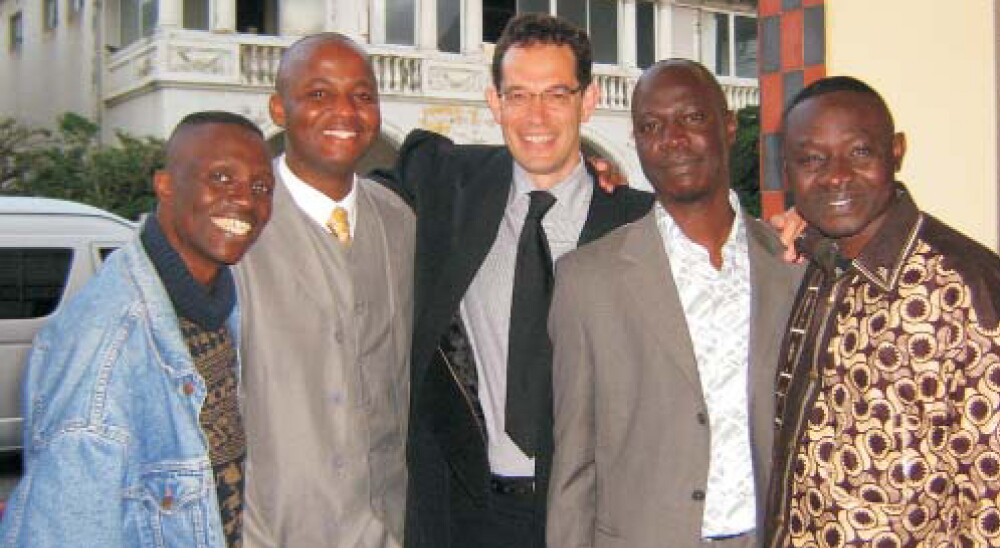
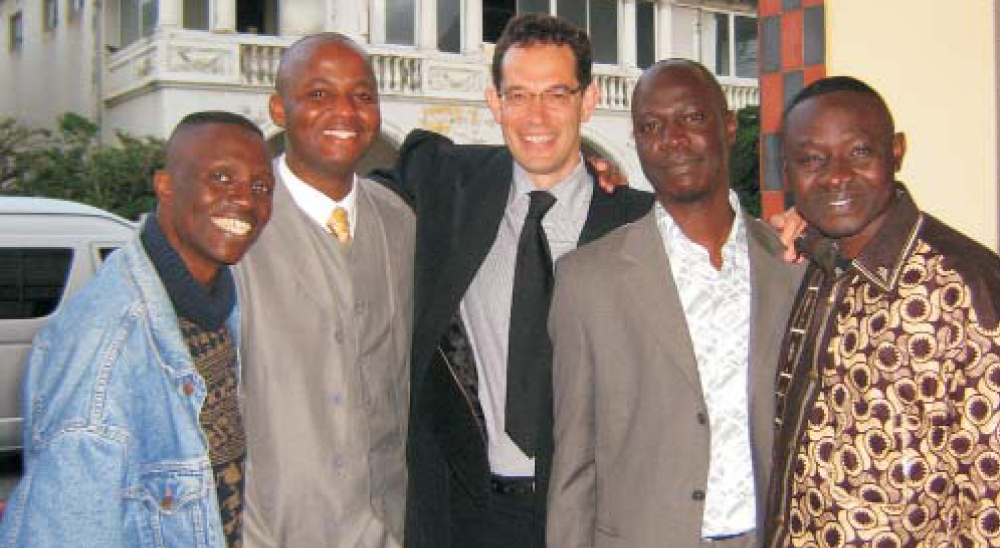
Neil Turok (center), founder and chair of the African Institute for Mathematical Sciences, with some of the institute’s students. From left to right are Guy Lusilao-Zodi, Jules Baruani, Johnny Lokake, and Tony Nzundu.
JULES BARUANI