Inertial-Confinement Fusion Driven by Pulsed Power Yields Thermonuclear Neutrons
DOI: 10.1063/1.1603065
A group at Sandia National Laboratories in Albuquerque, New Mexico, has announced the first yield of thermonuclear neutrons from an inertial-confinement fusion scheme that does not involve lasers. At the April meeting of the American Physical Society in Philadelphia, Ramon Leeper reported that he and his colleagues had performed an experiment at Sandia’s pulsed-power “Z Machine” (see
Thermonuclear weapons are powered by the fusion of deuterons with tritium nuclei. For almost half a century now, physicists have been seeking to harness DT fusion for the production of electric power. But the creation of a confined DT plasma hot and dense enough to ignite a self-sustaining burn remains an elusive goal.
The fusion reaction
is much easier to ignite than are its less exothermic DD analogs
Therefore, the quest for a first-generation thermonuclear reactor concentrates on DT fuel. But, because tritium is inconveniently radioactive, pure deuterium serves as a surrogate in the Sandia experiments and, indeed, in most fusion experiments far from ignition conditions. The DD reaction’s modest yield of thermonuclear neutrons, when the plasma gets hot enough, has considerable diagnostic value. And demonstrating their production is regarded as a milestone, albeit an early one, on the road to ignition.
The thermonuclear reactor schemes under active investigation fall into two broad classes: inertial confinement fusion (ICF) and magnetic confinement fusion (MCF). Among ICF schemes, the greatest progress thus far has been made with powerful pulsed lasers imploding peppercorn-sized capsules of thermonuclear fuel. Laser ICF experiments at Lawrence Livermore National Laboratory and the University of Rochester have long since yielded thermonuclear neutrons. Indeed, Livermore’s National Ignition Facility (NIF), scheduled for completion in 2008, is designed to achieve ignition a few years later with an array of 192 lasers focused on a 2-mm capsule of frozen DT. (See
The Sandia Z Machine program explores alternatives to laser-driven ICF that would make more direct—and therefore presumably more efficient—use of pulsed electric power. Beyond the challenge of achieving ignition, efficiency is crucial for a power reactor. The yield of thermonuclear energy must, after all, exceed the energy cost of igniting and confining the fuel.
In any of the ICF reactor technologies under consideration, a new fuel capsule would be ignited every second or so. Between ignitions, something like a hundred megajoules of electric energy would be accumulated from the power grid at a leisurely pace. (A megajoule is roughly the chemical energy of a jelly doughnut.) But then, the stored energy must be converted into a terawatt pulse of some sort that implodes the fuel capsule in nanoseconds. Laser ICF involves a rather inefficient intermediate step: The pulsed electric power must pump the lasers that drive the implosion. Existing high-power pulsed lasers convert electrical input energy to light with an efficiency of only a fraction of 1%.
The Z Machine
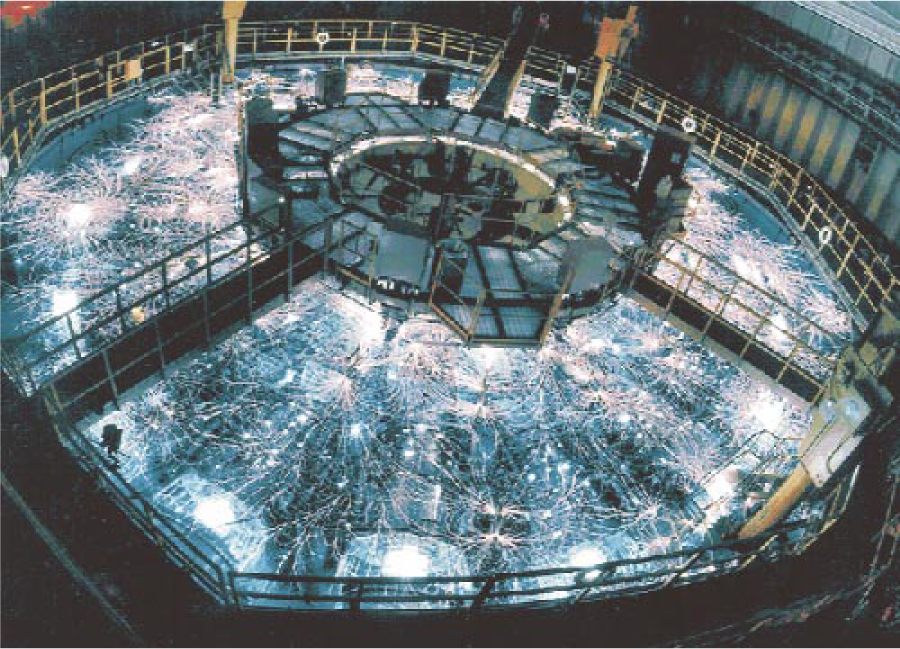
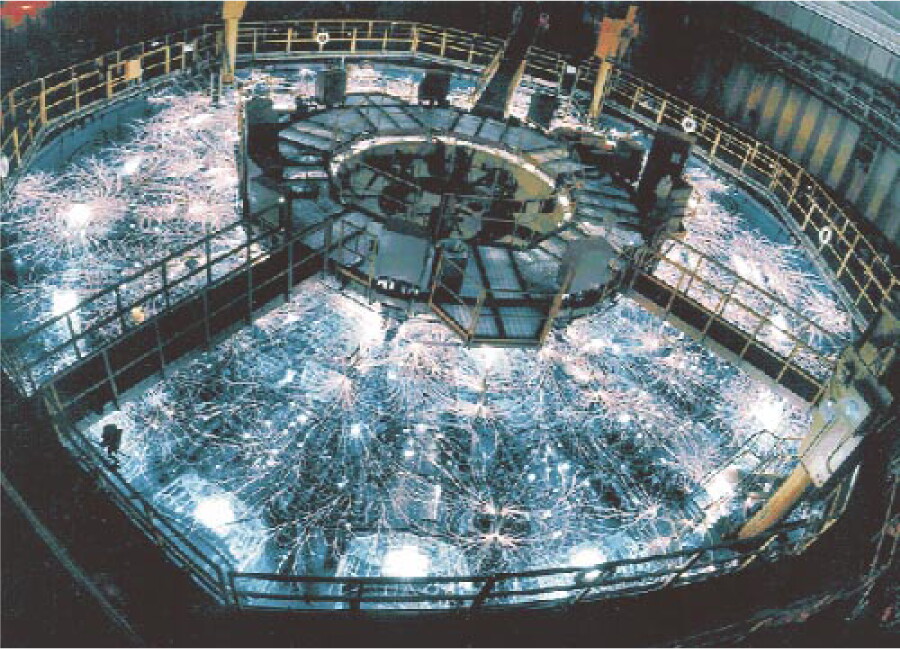
In the Sandia pulsed-power experiments, the application of the input electrical energy to the fuel capsule is more direct and, arguably, more low-tech. The Z Machine is the latest of the large pulse-compression facilities that have been used to investigate various ICF schemes at Sandia since the late 1970s. The wheel-like 30-meter-diameter machine accumulates electrical energy in capacitor banks on its rim and then, by means of ultrafast switching and pulse-compressing transmission lines arrayed like spokes, delivers the energy to the hub in 100-ns, 40-TW pulses, to the accompaniment of thunderous noise and much sparking (see figure 1). Time compression begins with 36 so-called Marx generators, each one a bank of capacitors connected in parallel to store energy at low voltage and then rapidly reconnected in series to discharge at much higher voltage.

Figure 1. The Z Machine at Sandia National Laboratories is a pulsed-power facility, 30 m in diameter, that compresses 10 megajoules of stored electrical energy into 100-ns multiterawatt pulses delivered to an experimental target chamber at its center. The spectacular sparking that accompanies machine shots is due to some power leakage from ultrafast switches in the water that insulates the pulse-compressing transmission lines.
R. MONTOYA/SANDIA NATIONAL LABORATORIES
The present machine is an upgrade of the Particle Beam Fusion Accelerator II, which was designed to accelerate and focus pulsed beams of lithium and other light ions onto a fuel capsule at the center. But, after much effort, light-ion beams proved to be too difficult to produce and focus.
The machine’s present name reflects the replacement of pulsed particle beams by the so-called z-pinch implosion of fuel capsules in Sandia’s ongoing quest to approach the density and temperature necessary for DT ignition. The term z pinch comes originally from tokamak-like MCF devices for which it was hoped that the attractive Lorentz forces in a current-carrying plasma would suffice to confine the plasma by squeezing it toward the
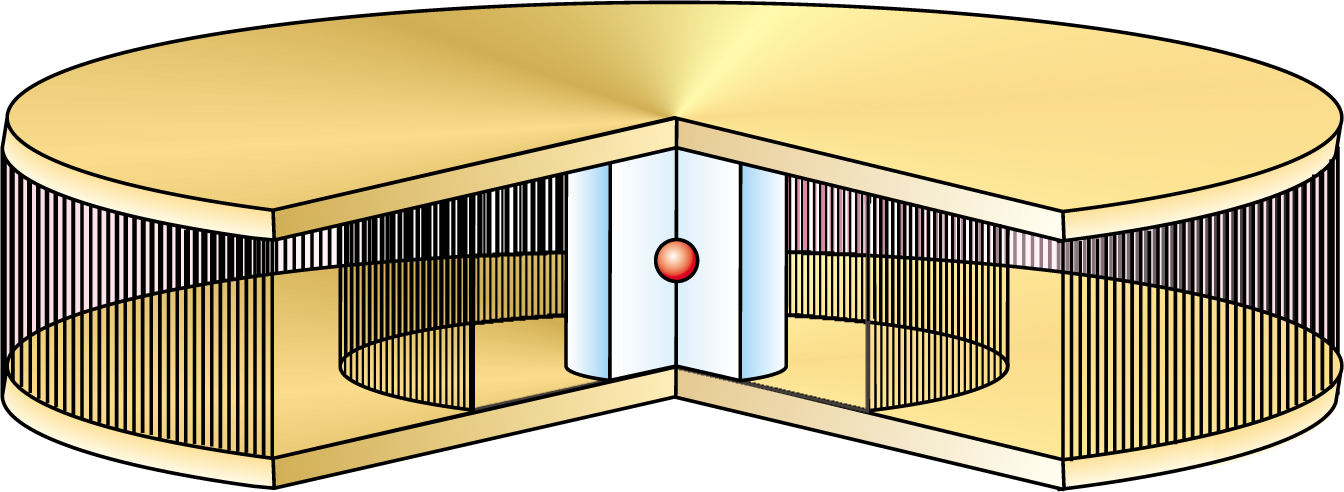
But in the present Z Machine experiments, the z pinch originates in the enormous Lorentz force experienced by several hundred fine, closely spaced tungsten wires, cylindrically arrayed around a column of foam that embeds the 2-mm-diameter fuel capsule, when the wire array is suddenly subjected to a 20-megampere current pulse (see figure 2). The powerful 100-ns current pulse vaporizes the wires as it impels them toward the central

Figure 2. The z-pinch inertial-confinement fusion target, 40 mm in diameter at the hub of the Z Machine, is called a dynamic hohlraum. A 100-ns megampere current pulse is driven between gold electrodes through a concentric array of 360 fine tungsten wires surrounding a 6-mm-diameter foam column in which sits a 2-mm capsule of deuterium gas. The 40-TW pulse vaporizes the wires and drives the resulting wall of tungsten vapor into the foam, generating the intense x-ray flux that implodes the capsule in less than 10 ns.
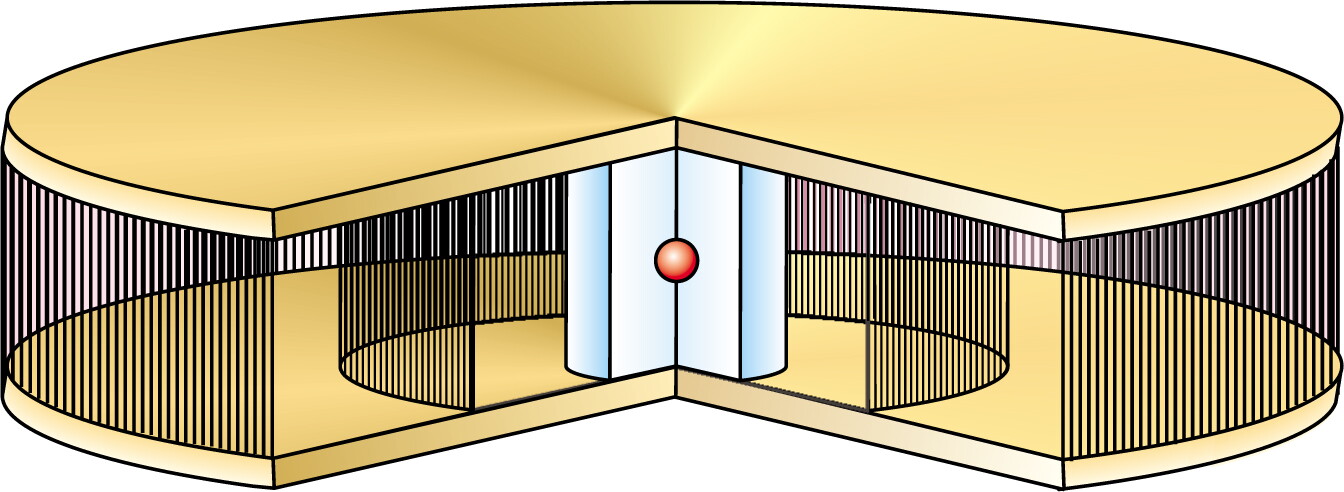
The shock wave heats the foam enough to generate x rays. It is these x rays that compress and heat the deuterium capsule well before the shock wave itself reaches the center. The x-ray pulse is, in effect, the final time-compression stage of the Z Machine’s power pulse. It delivers its power to the capsule and implodes it in less than 10 ns.
Dynamic hohlraum
The Sandia z-pinch, like the NIF, is an example of “indirect-drive” ICF. Rather than directly slamming the capsule, the driver—be it laser or particle beams, or an electrical power pulse—generates an x-ray pulse that ultimately drives the implosion. In indirect-drive laser schemes, the x rays are produced by laser heating of the heavy-metal inner wall of a small cavity that surrounds the fuel capsule. The cavity performs two other crucial functions. It symmetrizes the radiation impinging on the capsule, so that its compression is adequately isotropic. And the multiple reflection of the x rays off the wall yields something like a fivefold enhancement of the radiant energy flux inside the cavity.
These ICF cavities, which also play a role in thermonuclear weapons diagnostics, are called “hohlraums,” after the German word for cavity. In the Sandia experiment, the inrushing wall of highly reflective tungsten vapor, called a dynamic hohlraum, serves largely the same functions as the fixed wall of a conventional hohlraum.
The dynamic-hohlraum idea has been around since the early 1980s. But only recently has the Sandia group succeeded in using it to create an x-ray flux intense enough to implode and diagnose ICF capsules. 1 Much of this diagnosis is provided by a little argon mixed in with the 24 atmospheres of deuterium gas. When the argon gets hot enough, its x-ray emission lets the group monitor electron temperature and density, and even the shape of the capsule as it is squeezed toward implosion. The relative heights of x-ray lines corresponding to different ionization states measure an electron temperature exceeding 1 keV (about 107 K) just before implosion, and their Stark-broadened widths measure a density of 2 × 10²³ electrons/cm3. The result is a deuterium ion temperature that approaches 5 keV—enough to generate an observable yield of thermonuclear neutrons. 2
“By comparing the time evolution of the argon x-ray emission with model simulations,” says team leader James Bailey, “we learn how to improve the hohlraum design. We now reach blackbody radiation temperatures above 200 eV in the dynamic hohlraum.”
“But the isotropy still needs work,” says team member Steven Slutz. In the early stages of the x-ray pulse, the capsule’s equatorial region sees a much hotter radiation field than do its polar precincts. That’s because the top and bottom gold electrodes that complete the hohlraum are still much cooler, at first, than the tungsten vapor. The result, as imaged by the argon x rays, is a football-shaped capsule that, just before implosion, is about twice as tall as it is wide.
Slutz and coworkers are studying various schemes for slowing down the equatorial heating of the capsule to make its compression more isotropic. Ignition of a DT capsule—still a long way off—will require (in addition to an ion temperature of something like 10 keV) squeezing the gas to hundreds of times liquid density with a compression that departs from spherical symmetry by no more than a few percent. 3
Thermonuclear neutrons
The neutron yield of the z-pinch experiment was monitored by time-of-flight scintillation counters that measured neutron velocities and by activation detectors that measured the total neutron yield integrated over time. The energy distribution of neutrons from thermonuclear DD fusion peaks at 2.45 MeV, and its width increases with the ion temperature.
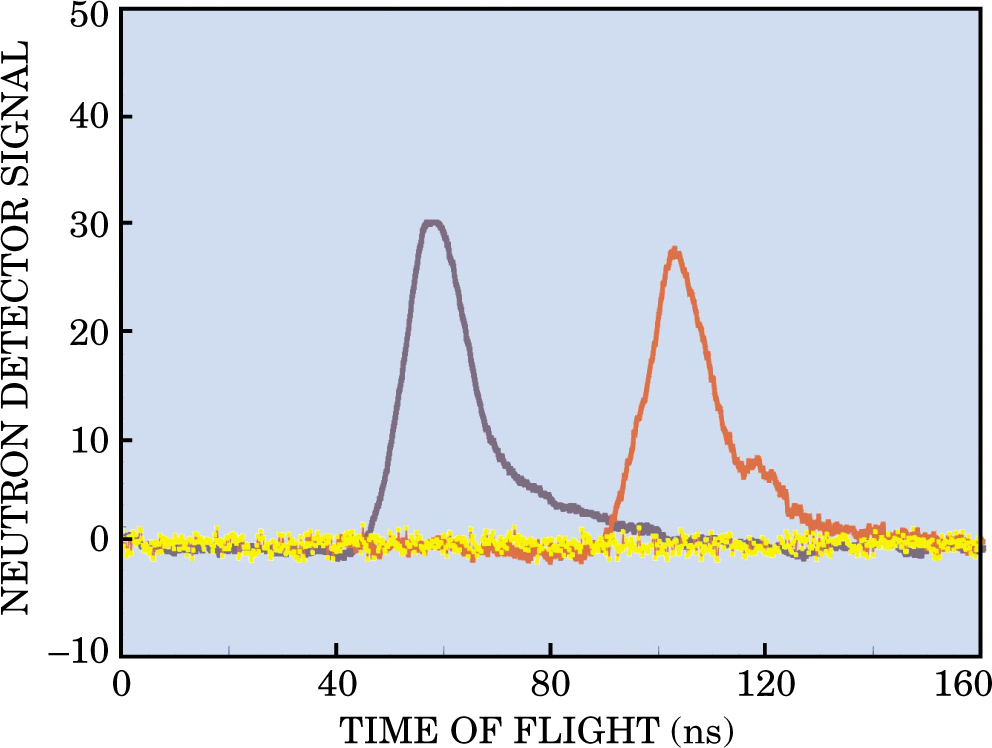
Figure 3 shows the time delay between the neutron signals at two counters whose distances from the imploding capsule differ by 98 cm. The delay yields a peak neutron energy of 2.46 ± 0.15 MeV, and the distribution has the expected shape for a thermonuclear burn plus some scattering in the experiment’s shielding. Furthermore, the measured total neutron yield, (3.0 ± 1.3) × 1010, was in reasonable agreement with computer simulations of the imploding deuterium capsule. So were the argon spectral measurements.

Figure 3. Time delay between neutron signals seen by two counters—one (red) 98 cm farther from the imploding deuterium capsule than the other (blue)—yields a neutron kinetic energy of 2.46 ± 0.15 MeV, as one would expect for thermonuclear fusion in deuterium. The yellow trace was recorded for shots in which a small admixture of xenon kept the ion temperature too low for thermonuclear fusion.
(Courtesy of Carlos Ruiz, Sandia National Labs.)
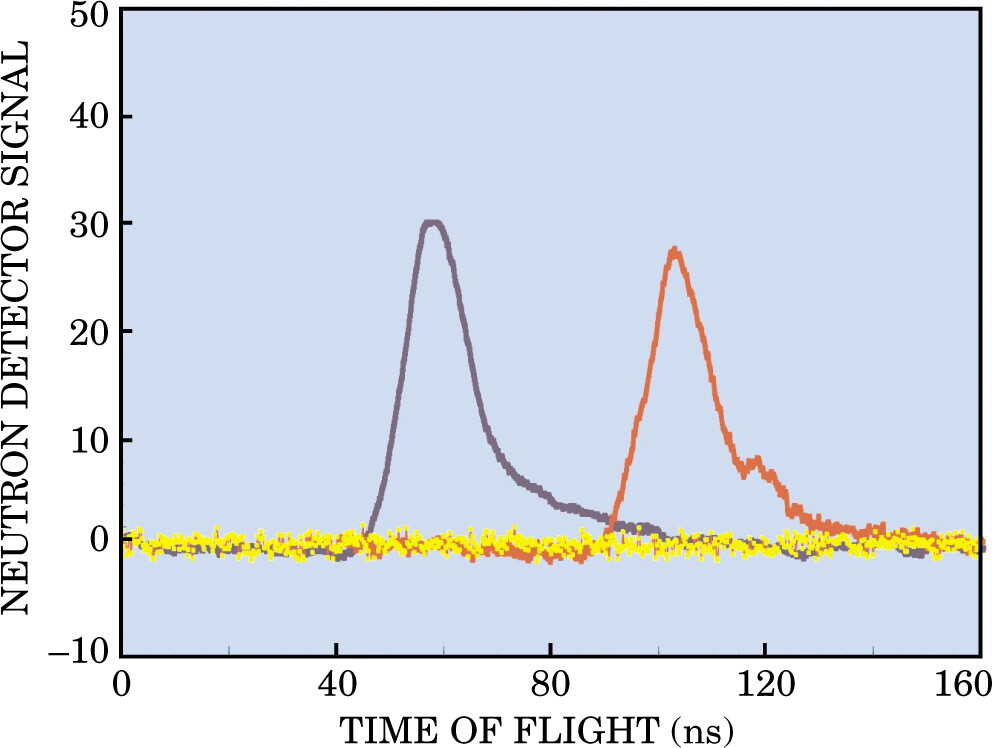
Nonetheless, it is important to distinguish carefully between a true thermonuclear neutron yield—that is, fusion events in which thermal kinetic energy overcomes the DD Coulomb repulsion—from uninteresting “ion-beam” fusion events attributable to the kinetic energy of deuterons accelerated toward the hohlraum’s bottom electrode. To that end, the group looked for a telltale enhancement of the neutron yield in the downward direction. And they looked for a neutron yield from a z-pinch shot (the yellow trace in figure 3) in which the capsule was spiked with enough xenon to keep the ion temperature well below threshold for significant thermonuclear fusion. The negative results of both tests convinced the group that any non-thermonuclear contribution to the neutron yield was negligible.
Scaling up the dynamic-hohlraum pulsed-power technology to the requirements for a useful reactor raises many questions yet to be confronted. That’s also true, of course, for all the other fusion-power schemes. At the Z Machine, the fuel capsule has to sit much closer to the machine’s hardware than it does at the NIF. It’s not a problem in a laboratory, where experimental shots are few and far between. But for a power plant, this crowding raises the problem of excessive neutron activation. And there’s the problem of damage to the transmission lines at high repetition rates.
With regard to energy efficiency, the Z Machine, an experimental facility still far from any reactor design, delivers to the hohlraum about 15% percent of the energy it takes from the electric grid. For laser ICF, it seems possible to build high-power diode-driven lasers with efficiencies as high as 10%, but they might be prohibitively expensive. High capital cost is also a challenge for yet another ICF alternative: heavy-ion beams.
“It’s much too early to declare a winner in the quest for a useful ICF technology,” says Thomas Mehlhorn, head of Sandia’s dynamic-hohlraum program, “but at least we’re now in the game.”
References
1. J. Bailey et al., Phys. Rev. Lett. 89, 095004 (2002) https://doi.org/10.1103/PhysRevLett.89.095004 .
2. J. Bailey et al., http://arXiv.org/abs/physics/0306039 .
3. S. Slutz et al., Phys. Plasmas 10, 1875 (2003) https://doi.org/10.1063/1.1565117 .