Industrial Physics Forum to Present Outlook for Nanotech Funding, Research
DOI: 10.1063/1.2117830
Want the inside scoop on federal funding for nanotechnology? Ever wonder just what measurements mean to industry? Or perhaps you’d like to know more about NIST—what it does, and how.
The answers to these and many other questions will be provided during this November’s three-day 2005 Industrial Physics Forum (http://www.aip.org/ipf ), a must-attend if you’re interested in the application of physics to industry. Other highlights of the forum include talks on the newest physics advances, sessions on the latest developments in measurement science, and a tour of NIST research labs.
This year the annual forum, which is presented by the American Institute of Physics and sponsored by AIP Corporate Associates and NIST, is slated for Sunday, 6 November, through Tuesday, 8 November, at NIST headquarters in Gaithersburg, Maryland. Ricking things off on 6 November is “The Public Case for Science: The Scientist as Citizen.” This pre-conference workshop addresses the longstanding and ever-increasing need for scientists to build public support for science and technology in order to get funding—and provides some pointers on exactly how to do it. The workshop runs from 8:00am to 4:15pm and will be held at the Hilton Gaithersburg Hotel.
As host of the forum, NIST is the focus for the 7 November session. David Seiler, chief of NIST’s semiconductor electronics division, will moderate the day’s five-part main panel, “Advancing Infrastructure for Innovation.”
Infrastructure for innovation means an environment that fosters and enables innovation and invention, Seiler explains, and that makes it possible to observe and measure what you’re doing. “To keep innovating, we need to measure more accurately,” Seiler says. “We need to be able to count more accurately, see smaller things, record faster events.” This session will focus on NIST’s ongoing efforts to develop finer and more accurate measurements and standards, and on why the agency’s work is important to the nation and particularly to the nation’s economy.
Session talks include “Public Safety and Security,” “Bio-systems and Health,” “Nanotechnology at NIST,” “Enabling the Future: Innovation, Trade, and Security,” and “Road-mapping America’s Measurement Needs … and Standards Challenges for the Next Decade.”
Attendees will also learn from the session how to collaborate with NIST, which is part of the US Department of Commerce, so that they might take advantage of both the agency’s broad multidisciplinary expertise and its unique research facilities, Seiler says.
William D. Phillips, winner of the 1997 Nobel Prize in Physics and a NIST scientist, is the keynote speaker at the evening’s reception and dinner banquet.
Government’s role in nanotech
The second-day session on 8 November, moderated by Clayton Teague, director of the National Nanotechnology Coordinating Office, will address “Government’s Role in Stimulating Nanotechnology for Industry.” Seiler says the panel’s five talks—by high-level federal agency officials—present a rare opportunity to learn exactly where hundreds of millions of federal research funding dollars are slated to go.
The talks include “Nanotechnology and Keynote Opportunities,” with Arden Bement, director of NSF; “Nanotechnology at NSF,” with Mihail Roco, NSF’s senior adviser for nanotechnology; “The National Institutes of Health and Nanomedicine,” with Anna Barker, deputy director of NIH’s National Cancer Institute; “The US Department of Energy and Nanotechnology,” with Patricia Dehmer, DOE’s associate director of science for basic energy sciences; and “Nanotechnology at the Defense Advanced Research Projects Agency,” with John Zolper, director of DARPA’s micro-systems technology office.
“These are powerful agencies that fund industrial and academic research,” Seiler says. “These officials will discuss how government research in nanotechnology makes a difference, what these programs are doing now, what they’re planning, how what they’re doing impacts industry now and in the future.”
Wrapping up the day is the “Frontiers in Physics” session, which Seiler describes as “the latest, greatest things that are going on in physics.” Topics and speakers are “Cassini-Huygens: Lifting Titan’s Veil,” with Ralph Lorenz, an assistant research scientist in the University of Arizona’s department of planetary sciences; “Stop Light,” with Ronald Walsworth, a senior lecturer at the Harvard—Smithsonian Center for Astrophysics; “Spin Hall Effect,” with David Awschalom, professor of physics at the University of California, Santa Barbara; and “Life Has Evolved to Evolve,” with Michael Deem, John W. Cox Professor of Biochemical and Genetic Engineering and professor of physics and astronomy at Rice University.
For more information and to register, visit http://www.aip.org/ca/2005/05mtg.html .

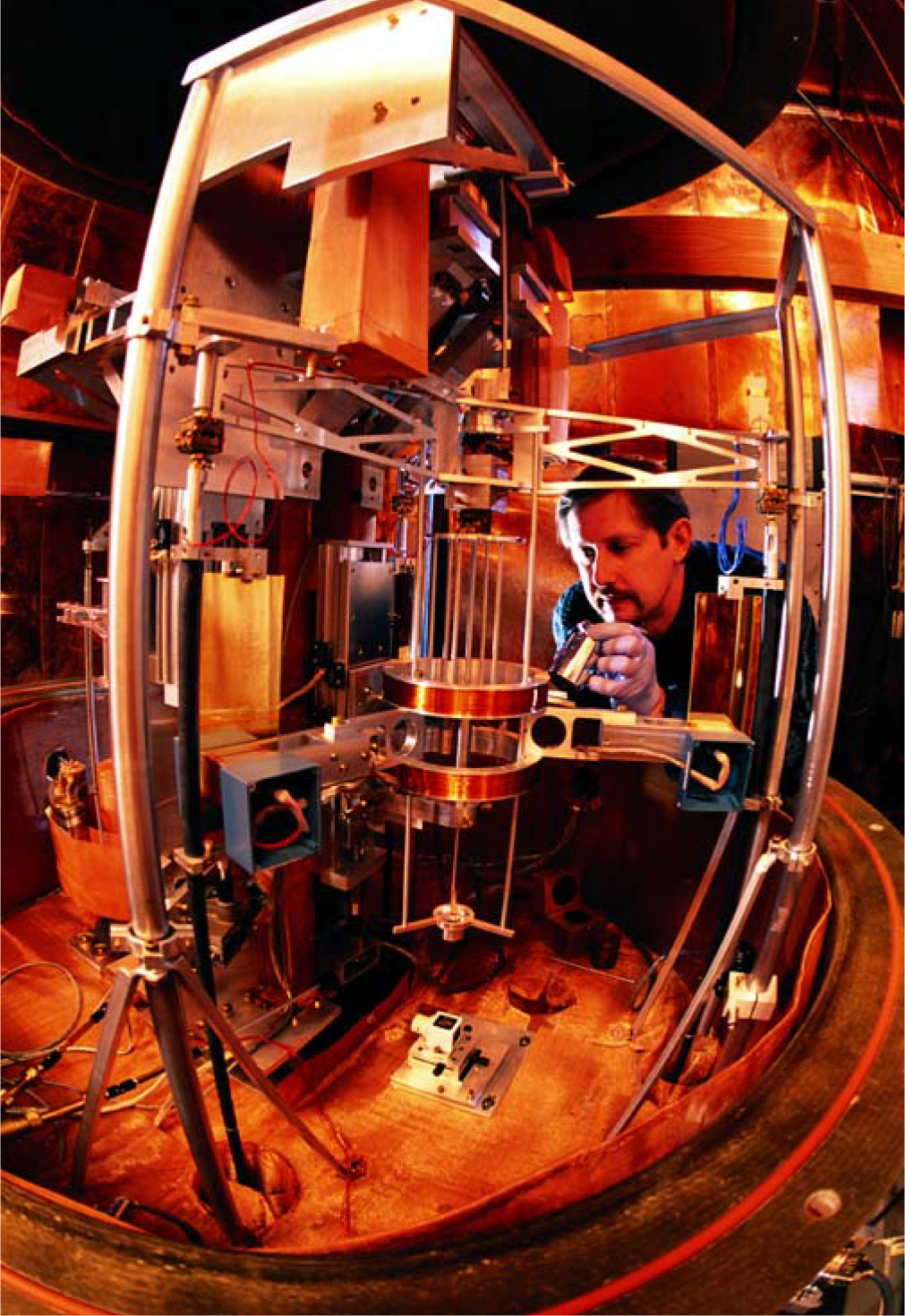
NIST physicist Richard Steiner positions a mass standard at an agency lab designed to help redefine the kilogram in terms of current and voltage.
© ROBERT RATHE