Industrial Physics Forum Focuses on Innovation
DOI: 10.1063/1.2169437
Scientists from across the country got an in-depth look in early November at NIST’s research and laboratories in Gaithersburg, Maryland, as the institute hosted two days of lectures and tours as part of the 2005 Industrial Physics Forum. Titled “Advancing Infrastructure for Innovation,” the forum included talks on such topics as NIST’s role in measuring the economic impact of technological innovation and the institute’s participation in setting standards for equipment used in homeland security.
The meeting, sponsored by the corporate associates of the American Institute of Physics, also focused on nanotechnology and included presentations on a wide range of nanotech projects being developed at NIST, NSF, and the departments of Defense and Energy. The tours of NIST’s labs included facilities where scientists are working on optical tweezers, quantum computers, and nanomagnetics.
Details of NIST’s investigation of the burning and collapse of the World Trade Center towers after the September 11th terrorist attacks were presented by William Grosshandler, chief of NIST’s fire research division. Grosshandler said that the lessons learned from the World Trade Center attacks can make future buildings stronger and easier to evacuate in the event of explosions and fires.
The 2006 forum will be held 13–14 November in San Francisco in conjunction with the AVS Science and Technology Society’s international symposium.

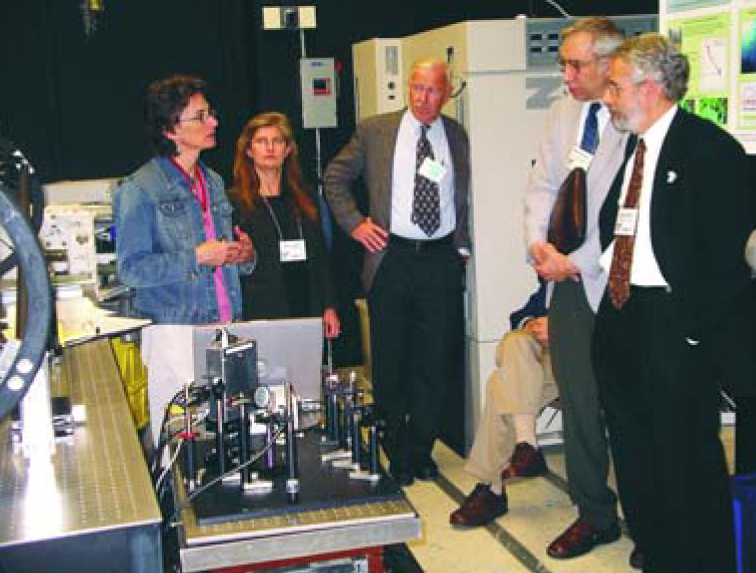
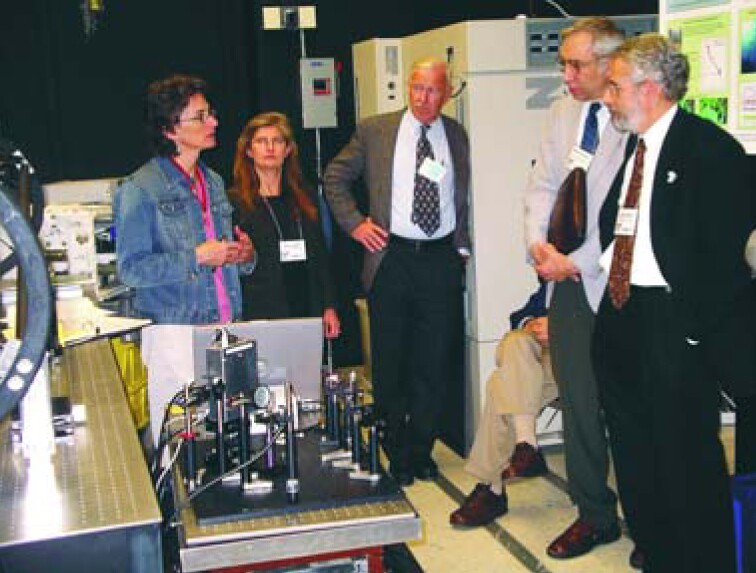
NIST scientist Carol Johnson shows forum participants her work on a tunable rainbow light source that allows better calibration of satellites doing climate-change-related measurements.
JIM DAWSON
More about the authors
Jim Dawson, American Center for Physics, One Physics Ellipse, College Park, Maryland 20740-3842, US .