Hot fire, cool soil
DOI: 10.1063/PT.3.2002
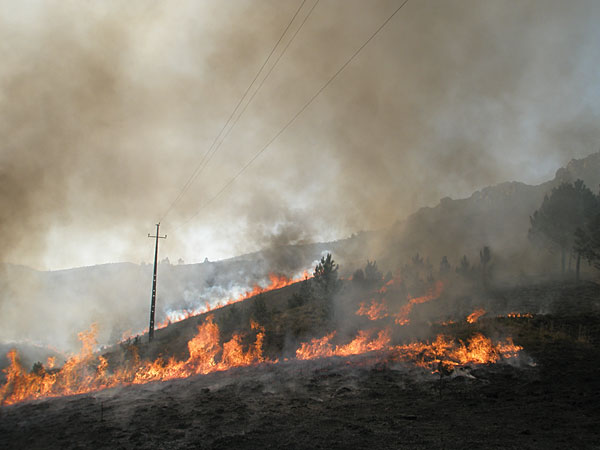
Wildfires around the planet burn an average of 3.7 million km2 of vegetation annually and can leave landscapes scorched, barren, and vulnerable to erosion and flooding. According to the literature, the more vegetative fuel, the more intense the fire, the hotter the soil, and the more severe the damage to fragile roots, seeds, and microbes. But that understanding is based on laboratory studies and prescribed burns in small fields. An experiment led by Cornell University’s Cathelijne Stoof, who at the time was working at Wageningen University in the Netherlands, now provides evidence that in more heterogeneous conditions the opposite may occur—the hotter the fire, the cooler the soil. To study the effects of landscape and fire dynamics on soil temperature, the group mapped a 0.1-km2 shrub-covered watershed in Portugal, installed 52 thermocouples throughout the region, and then set it ablaze. Although the most thickly vegetated areas burned at temperatures as high as 800 °C, topsoil in those areas remained below 100 °C. The soil temperature remained low, the researchers argue, because large air-temperature gradients increased the upward transport of heat and dense vegetation contained the most moisture. Dry, sparsely vegetated areas that burned less intensely, in contrast, suffered the greatest damage; their soil reached more than 300 °C in places. Managers of fire-prone ecosystems could use the results to decide how, where, and when to set off controlled burns. (C. R. Stoof et al., Geophys. Res. Lett., in press, doi:10.1002/grl.50299 .)