Honeybee stingers have a mind of their own

With a stinger just a couple millimeters long, a honeybee can ward off animals that outweigh it by several orders of magnitude. One secret to the stinger’s successful defense lies in its autonomy: The stinger keeps working even after the bee tears away, an ultimately fatal sacrifice made to protect the hive. Much like your leg involuntarily jerks during a reflex test because of circuits in the peripheral nervous system, a stinger, once embedded, uses signals from a cluster of neurons to continuously pump venom while drilling deeper into the skin.

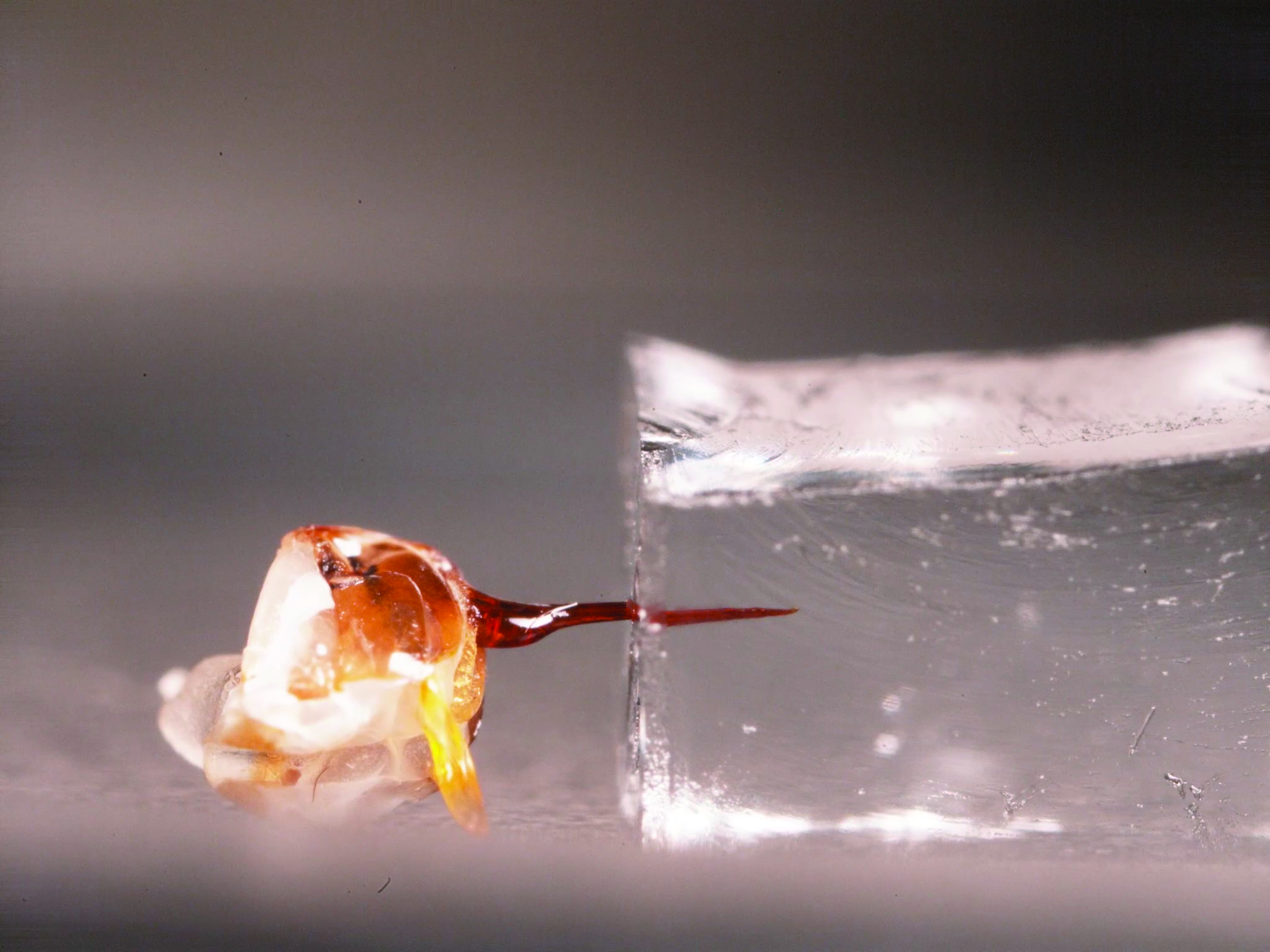
Researchers used a clear gel that mimics the properties of skin to observe the automated venom pumping of honeybee stingers.
(Image courtesy of Fiorella Ramirez-Esquivel and Ajay Narendra.)

Using micro–computed tomography, scanning electron microscopy, and high-speed videography, Fiorella Ramirez-Esquivel, a postdoc at Macquarie University in Sydney, Australia, and colleagues have revealed the surprisingly complex pumping mechanism behind the stinger’s prowess as a defense weapon. 1 To capture videos of stinging in action, the researchers inserted stingers into a clear gel that mimics the elasticity of human skin.
The stinger’s point consists of two side-by-side lancets. Inside each is a valve that acts as a piston, pulling venom from a bulb above and pumping it into the skin, as shown in the video. As the valves pass each other, the retracting piston compresses to make room for the advancing one. This alternating stroke drives the stinger deeper while barbs on its outer surface anchor the stinger in the tissue. The deformation of the valves enables continuous pumping while also creating a seal that minimizes backflow.
In addition to the venom delivery system, the stinger contains muscles; a venom sac that feeds into the bulb; multiple glands, including ones that emit pheromones to recruit other bees to the scene; and a cluster of neurons that control the whole apparatus.
“The stinger is a lot more complicated than we originally realized,” Ramirez-Esquivel says. “There is so much packed into such a teeny tiny package.”
To further visualize the pumping kinematics, the researchers built a scaled model of the bulb and valves. Finding the right material for the valves proved especially challenging—they needed to be flexible enough to deform and slide past each other but rigid enough to spring back to their original shape and push fluid down. They also needed low-enough friction to not get stuck. To replicate the valves, the team used an artificial polymer. “The material properties of those valves are really interesting, and something that definitely merits more work,” Ramirez-Esquivel says.
The stinger’s collapsible double pistons are unique in the natural world, as most biological pumps rely on peristalsis—the contraction and relaxation of muscles. The researchers hope that the stinger’s architecture inspires the design of artificial pumps that are capable of delivering a continuous fluid flow and that could advance the development of medical equipment and microfluidic technologies.

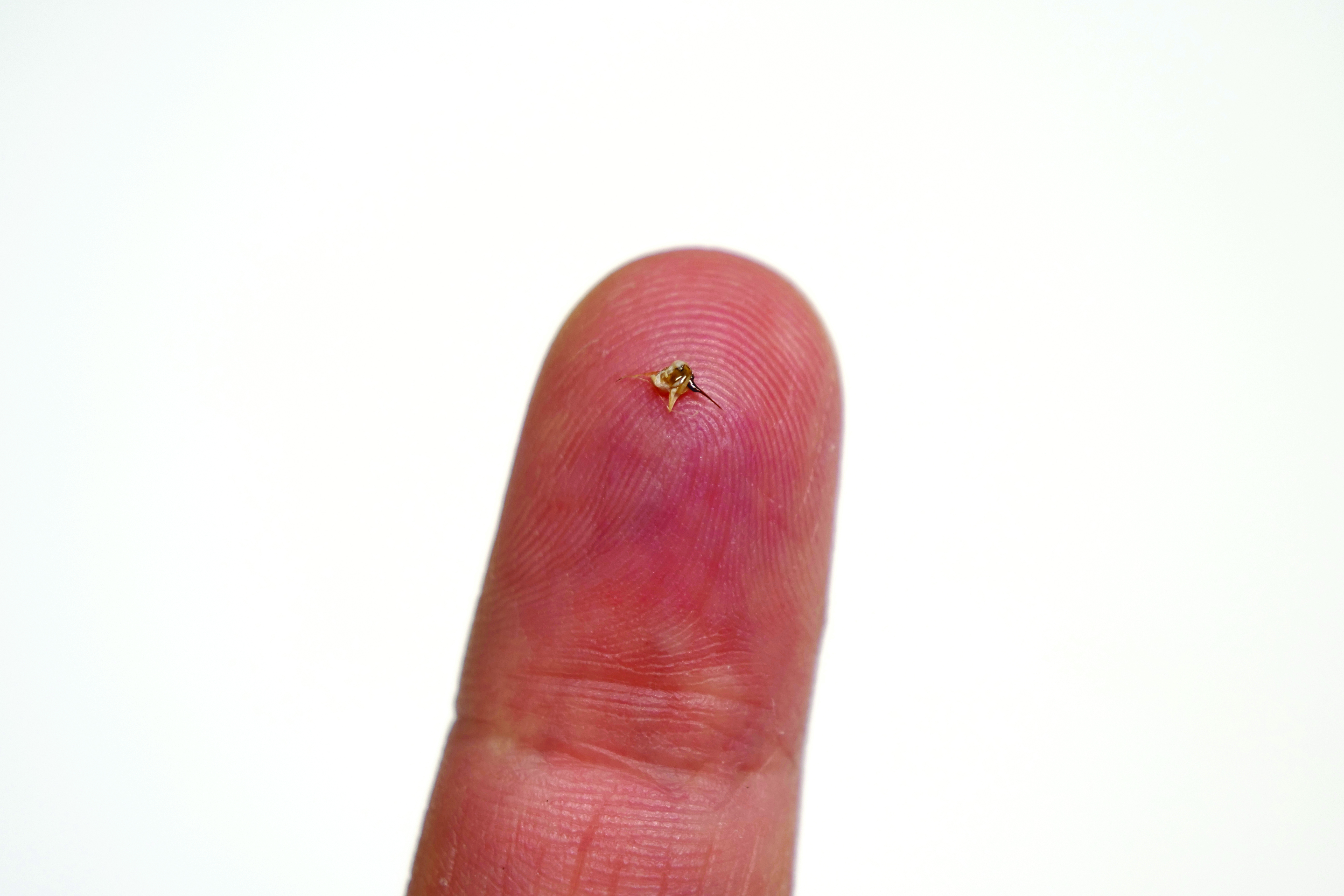
A detached honeybee stinger packs a complex pumping system into a small package.
(Image courtesy of Fiorella Ramirez-Esquivel.)

Reference
1. F. Ramirez-Esquivel et al., “The honey bee stinger: An unusual pump with collapsible double pistons ,” Proc. Natl. Acad. Sci. USA 123, e2603916123 (2026).