Gravitational patterns reveal a tumultuous lunar past
DOI: 10.1063/pt.owpl.dsqh
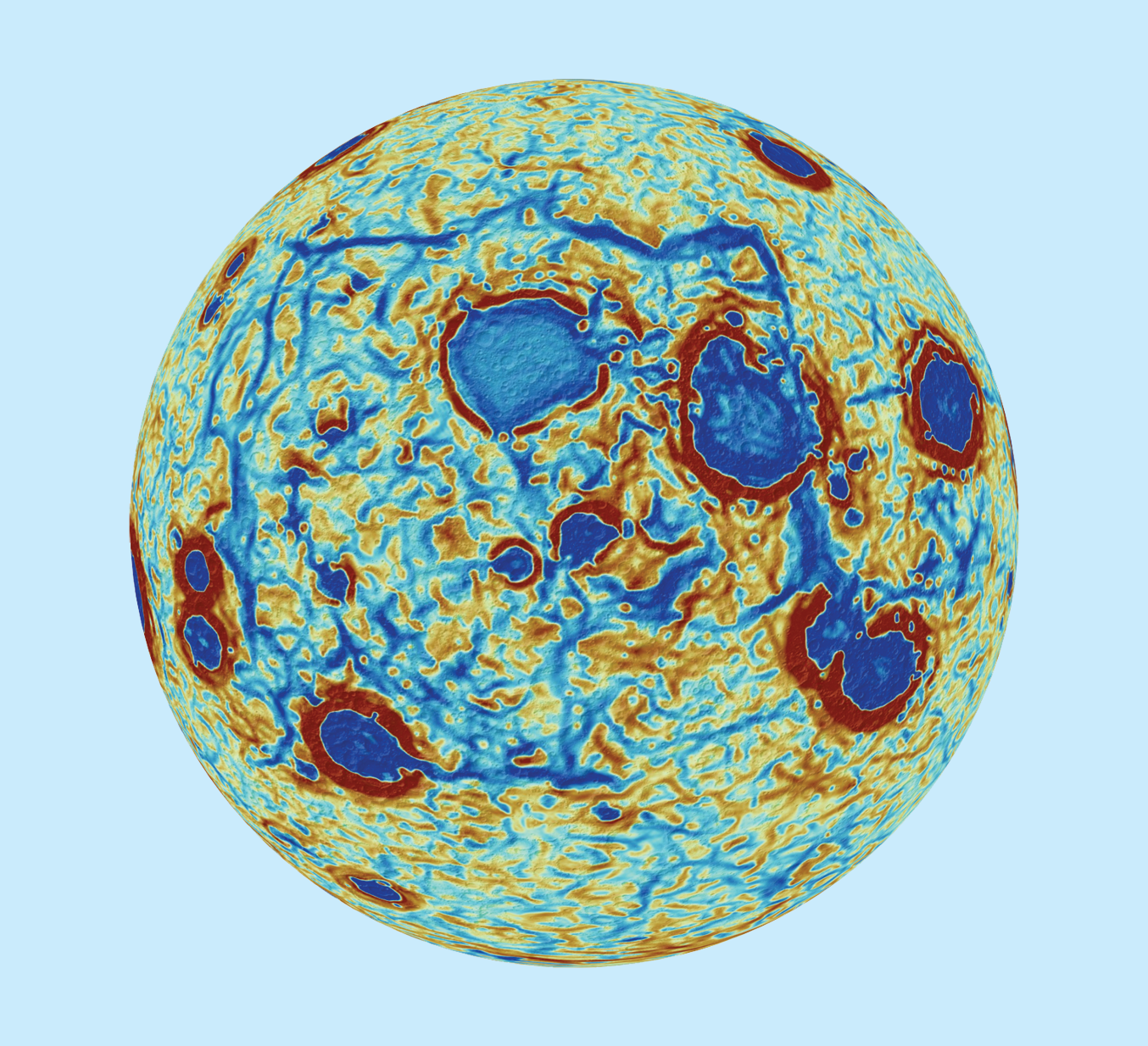
Twin spacecraft orbited the Moon on a three-month mission in 2012. Together, the two satellites of NASA’s GRAIL (Gravity Recovery and Interior Laboratory) mission mapped the Moon’s gravitational field to better learn about its internal structure. The extraordinarily detailed map that the mission produced contained mostly what the GRAIL scientists expected to find: Gravity is stronger above the mountains and weaker above the craters. Yet when they removed the topographical contributions, what remained were strangely linear features
1
stretching up to roughly 500 km, as seen by the blue lines in figure
Figure 1.

The gravitational field of the near side of the Moon. The map shows the gravitational strength (stronger in blue) after the contributions from the surface features are removed. Rough circles (blue) of gravitational gradients correspond to the craters of the region, but the strange, linear anomalies don’t have a visual counterpart. Rather, they are the signatures of dense material beneath the surface. The presence of titanium-rich materials sinking below the surface can be explained by the overturning of the mantle early in lunar history. (Courtesy of Adrien Broquet/University of Arizona.)

Now a research team led by Jeff Andrews-Hanna (University of Arizona) has explained what was causing the patterns. Building on work by Nan Zhang (Peking University) and colleagues, Andrews-Hanna and his group have demonstrated that dense, titanium-rich materials below the surface could shape the gravitational field. 2 Their simulations and data, together with Zhang’s geophysical analysis, provide evidence of the Moon’s mantle overturning—that is, denser materials at the top migrating to lower depths—and when the event occurred during the Moon’s early formation.
A molten past
The Moon was born after another celestial body collided with a young Earth approximately 4.5 billion years ago. The debris coalesced to form a Moon that was largely molten, with a magma ocean in which the elements were well mixed. The prevailing theory is that the ocean cooled and crystallized to form the lunar mantle and crust. The last minerals to solidify likely contained metals such as titanium. They would’ve crystallized into the densest material higher in the mantle, counterintuitively than less dense materials that had already sunk. Because of that unstable arrangement, scientists suspect that the Moon’s mantle overturned as the titanium-rich materials sank lower. Yet physical evidence of the event and its timing has been hard to come by.
But there’s more than one lunar mystery: If the mantle did overturn, the event cannot explain the Moon’s geophysical asymmetries. A combination of Apollo samples and reflectance data from previous lunar studies has shown that the near side of the Moon has higher quantities of titanium and other elements that are rare on the Moon. In 2022 Zhang and colleagues used numerical simulations to try to understand why. They hypothesized that a migration of materials throughout the interior was triggered by the giant impact that formed the largest lunar crater.
That crater, the South Pole–Aitken impact basin, is on the far side of the Moon. Zhang and colleagues modeled impact parameters, such as the velocity and impact angle of the projectile, to obtain the most accurate simulation of the impact event and compared simulation results with the current topography of the impact basin. 3 The group then investigated the effect that the impact would have had on the mantle’s convection and the distribution of ilmenite, a titanium–iron oxide found in high concentrations on the near side of the Moon.
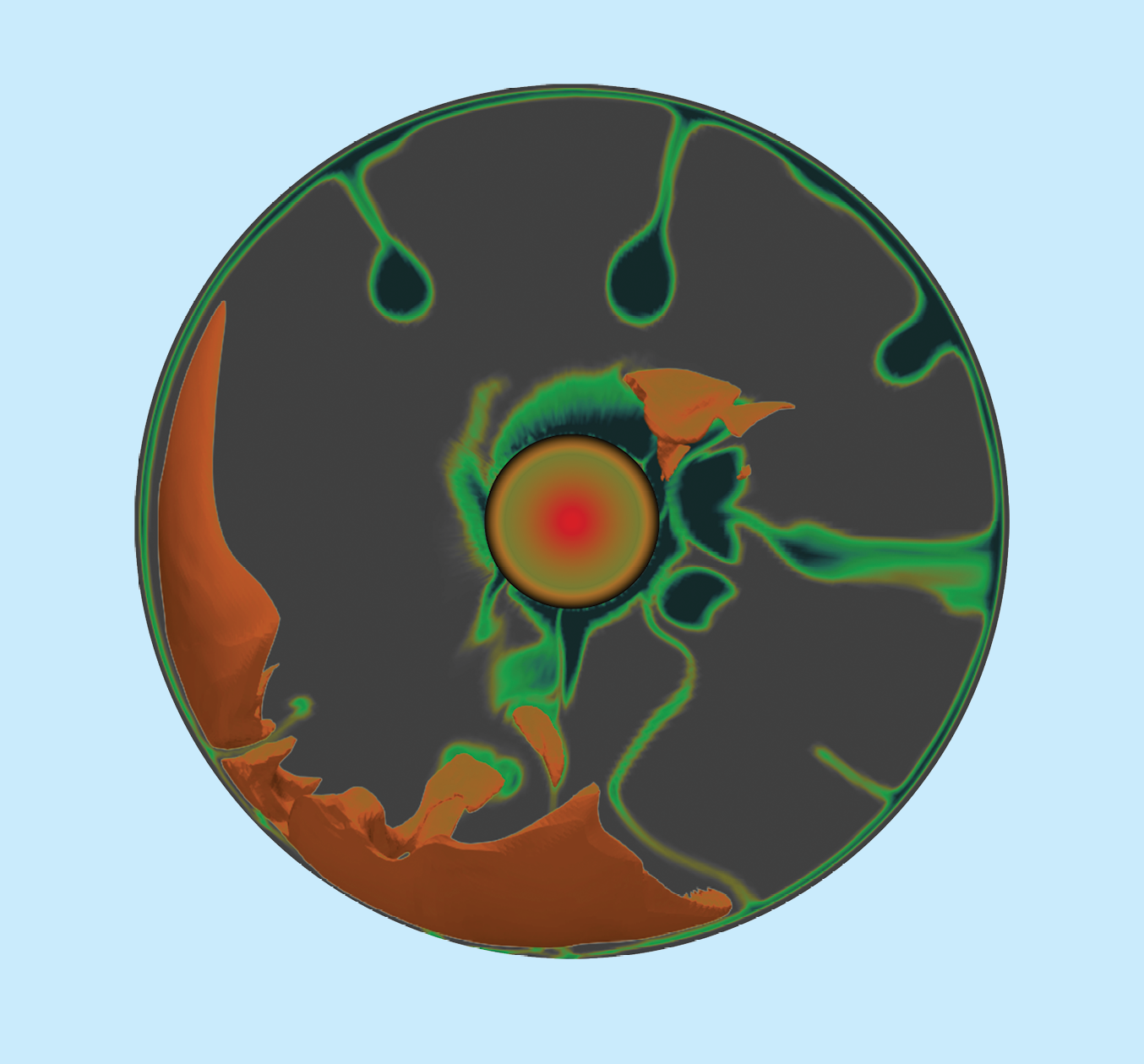
Ilmenite is less viscous than other material in the lunar mantle, and it would’ve been pushed by the force of the impact toward the near side of the Moon—opposite the impact. Zhang and his group use numerical simulations to conclude that the impact not only formed the largest lunar crater but instigated thermal upwellings, shown in figure
Figure 2.

Dense, titanium-rich materials (green) sank from the surface to the deep mantle shortly after the Moon’s formation. A cross section showing Nan Zhang’s simulation of the overturning event illustrates the effect of a large impact at the bottom left, which created temperature anomalies (brown) and downwellings of titanium-rich materials. Some remnants of the dense material are expected to be preserved throughout the Moon’s geologic evolution; they appear as straight lines in the measured gravitational gradients seen in figure

The simulations show that after the ilmenite migrated to the near side, it formed sheet-like slabs and then sank deeper into the mantle during the overturning. The modeled abundance of titanium oxide after the vertical integration shows patterns of straight lines along the surface.
Connecting the lines
The pattern caught the eye of Andrews-Hanna, who had been part of the GRAIL team. He recognized that the simulation’s straight lines may be connected to the linear anomalies seen in the gravity map of the same region. Some of the lines in the GRAIL data appear to form a border around the Ocean of Storms—a large, dark region on the near side of the Moon that appears on the left when viewed from the Northern Hemisphere.
When GRAIL scientists mapped the gravity of the region, they removed the effect of topographical surface features to try and learn about the Moon’s interior. Topography accounts for 98% of lunar gravity, and regions of dense material below the surface are correlated to surface features. But the lines around the Ocean of Storms didn’t have an obvious connection to the topography.
Andrews-Hanna and his research group collaborated with Zhang to investigate whether the titanium oxides could be influencing the gravity and leading to the strange patterns. At the University of Arizona, Weigang Liang and Adrien Broquet simulated different geometries, depths, and densities of the titanium-rich material to determine the geophysical scenario most consistent with the GRAIL data. They also worked from the opposite direction, using the GRAIL gravity data to calculate the most likely mass and density of the subsurface material. Reassuringly, the two independent approaches provided consistent results. Sheet-like slabs of dense, titanium-rich material could create the linear signatures seen in the GRAIL data.
The cohesion between the results lends credence to the theory of the lunar mantle overturning. The simulations demonstrate how a giant impact could have created thermal instabilities that caused an asymmetry in the distribution of materials such as titanium oxides. The slabs that sank into the mantle appear as the pattern of linear anomalies in the gravitational map.
Moreover, Andrews-Hanna and his team used the relationships between the gravity anomalies in the Ocean of Storms and impact basins of known ages in the region to show that the overturning event would’ve happened at least 4.2 billion years ago, merely a few hundred million years after the Moon was formed. In a few locations on the surface, it is especially clear that a physical sign of a sinking ilmenite slab was overwritten by an impact crater, which showed that the crater formed after the overturning of the lunar mantle.
The new work led by Andrews-Hanna provides the first connection between an observable piece of data and the overturning of the lunar mantle, a defining event in the Moon’s history. The limits on the time frame have allowed the team to begin reexamining older lunar theories in light of the new parameters to better understand the timeline of the Moon’s formation. As part of NASA’s Artemis program, astronauts are scheduled to land at the rim of the South Pole–Aitken impact basin in late 2026. The plan is for them to collect samples from the impact that triggered the overturning, which may provide more data to fill in details of the lunar formation timeline.
References
1. J. C. Andrews-Hanna et al., Nature 514, 68 (2014). https://doi.org/10.1038/nature13697
2. W. Liang et al., Nat. Geosci. 17, 361 (2024). https://doi.org/10.1038/s41561-024-01408-2
3. N. Zhang et al., Nat. Geosci. 15, 37 (2022). https://doi.org/10.1038/s41561-021-00872-4