Gravitational microlensing reveals the lightest exoplanet yet found
DOI: 10.1063/1.2207028
Since 1995, almost 200 extrasolar planets have made themselves known by spectral Doppler oscillation as they tug their host stars to and fro. In the last two years, a very different technique—gravitational microlensing—has revealed only three planets. But the most recent microlensing discovery makes clear the special advantages of that technique for finding Earth-like planets. In January, a worldwide collaboration of three microlensing groups—PLANET, OGLE, and MOA—reported 1 the discovery of a planet of roughly 5.5 Earth masses (M ⊕) circling a red-dwarf star with an orbital radius of about 2.6 astronomical units (1 AU is Earth’s orbital radius). It’s the lightest extrasolar planet ever discovered.
The great majority of the planets found by the Doppler method have been Jupiter-like gas giants, two or three orders of magnitude heavier than Earth. That’s because the amplitude of the telltale Doppler oscillation of the host star’s spectrum increases as the mass of the planet that’s making it wobble. The technique also favors planets much closer to their hosts than 1 AU; the Doppler oscillation amplitude increases with proximity, and close-in planets, with orbital periods of days or weeks rather than years, can be discerned in comparably brief observations.
Even before the recent announcement of the 5.5-M ⊕ planet, simulations had suggested that microlensing could reveal planets substantially lighter than Earth. 2 Furthermore, for typical microlensing events within our galaxy, the technique is most sensitive for planets orbiting a few AU from their stars. Hence the fond hope that microlensing would soon discover Earth-like planets. It’s not just a matter of loneliness or geochauvinism. Discovering the relative abundance of gas giants and Earth-like rocky planets around different kinds of stars is important for testing theories of planet formation.
Gravitational microlensing
The deflection of light by gravitation is a central feature of general relativity. The historic 1919 solar-eclipse observation of the deflection of starlight by the Sun made Albert Einstein and his theory famous. In 1936 he pointed out that the image of a stellar source perfectly aligned behind a foreground star of mass M would be distorted by gravitational lensing into a ring of angular radius
where G is the gravitational constant and D S and D L are the observer’s distances from the background source and the foreground lensing star. If the alignment is less than perfect or if the foreground object is more complicated than a lone star, the distorted image of the background object can take a variety of shapes (see the article by Leon Koopmans and Roger Blandford in Physics Today, June 2004, page 45 .)
Such distorted images are common when the sources are distant galaxies and the lenses are massive foreground galaxy clusters. But when the background object is effectively a point star and ϑ E, the angular radius of the so-called Einstein ring, is too small to be resolved by a telescope, one sees only magnification brightening, rather than distortion, of the source as the lensing object passes in front of it. That’s called microlensing. It’s what happens, for example, when the source star is in the Milky Way’s central bulge and the intervening lens star is about half as far away. In that case, ϑ E is less than a milliarcsecond, far below the resolution of any existing telescope.
Microlensing has been exploited for more than a decade to survey the population of red-dwarf stars in the galactic disk. These very abundant stars are too faint to be seen outside their immediate neighborhoods. But a distant red dwarf can announce itself, and its mass, by microlensing if it chances to pass close to an observer’s line of sight to a bright star in the galactic bulge.
Looking for planets
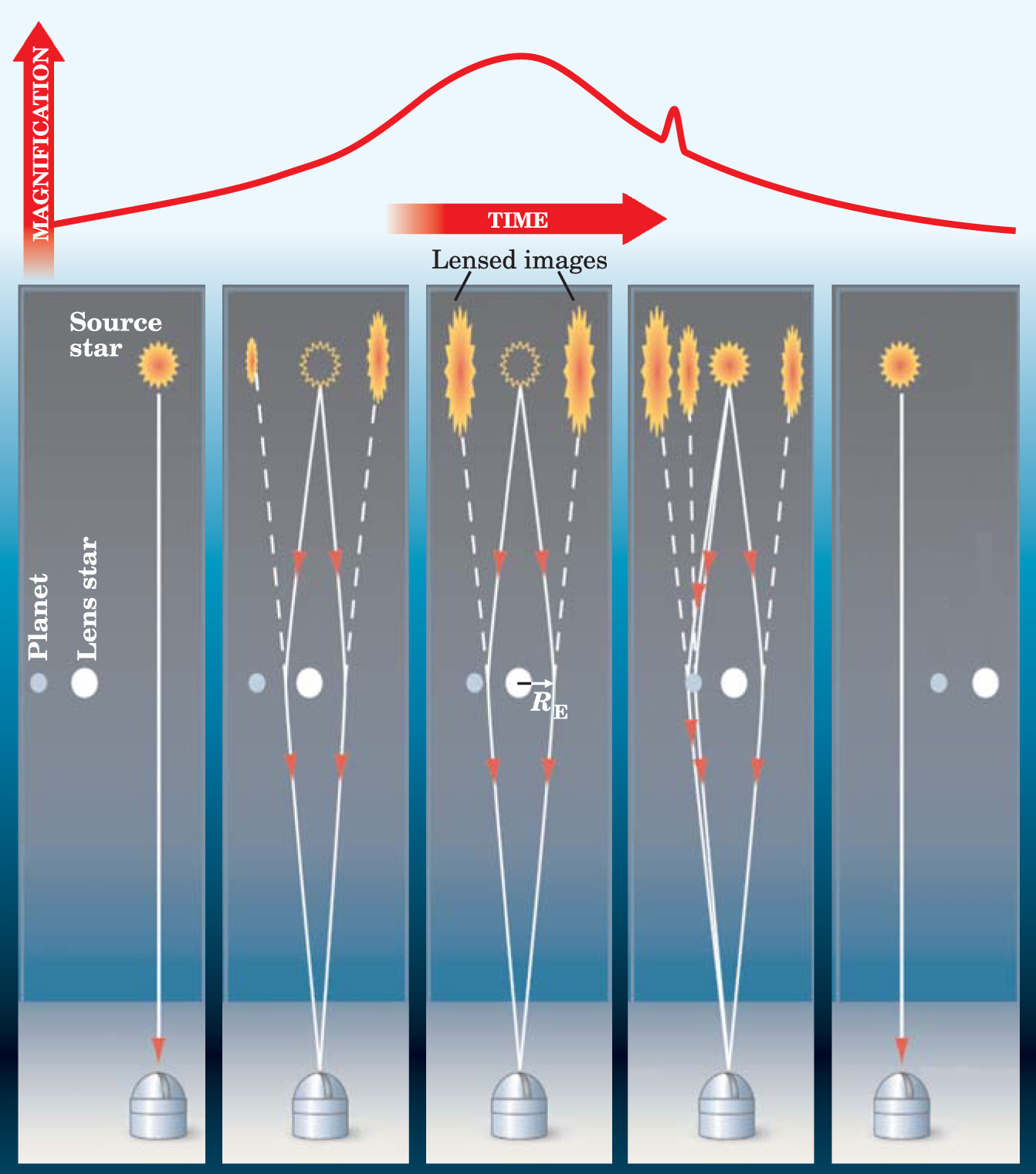
In 1991, Princeton University astrophysicist Bohdan Paczynski and his student Shude Mao pointed out that such microlensing events could potentially reveal a planet orbiting the foreground lensing star at a distance comparable to the “Einstein radius” R E given by D L ϑ E. Such a planetary companion, they argued, could introduce observable structure into the otherwise smooth, bell-shaped light curve of source-star brightening and dimming over several weeks as the lensing star passes in front of it (see figure 1).

Figure 1. Finding planets by microlensing. Gravitational lensing by a foreground star passing near the sightline to a much brighter background star distorts the latter’s image. If the Einstein radius R E, the characteristic parameter of the lensing event (indicated in the middle panel), is too small to resolve, the only lensing manifestation is a light curve (red) of brightening and waning as the passing lens star magnifies the source star. A planet accompanying the lensing star at a distance comparable to R E can show itself as a brief bump on the light curve.
(Adapted from David Bennett’s website: www.nd.edu/~bennett/moa53-ogle235.)

Paczynski and Andrzej Udalski (University of Warsaw) founded the OGLE group, which has been monitoring bright stars in the galactic bulge for microlensing events since the early 1990s with the modest 1.3-meter Warsaw telescope in the Chilean Andes. OGLE records the same large star field night after night. By electronically subtracting each night’s image from the subsequent image, one can promptly identify the rare star that’s getting brighter. In the last few years, MOA, a Japan–New Zealand collaboration with a telescope in New Zealand’s Southern Alps, has been doing much the same.
Once-a-day monitoring is adequate for simple microlensing events; the light curves are many weeks wide. But the blips that disclose planetary companions typically last for less than a day. Therefore, because round-the-clock monitoring requires a worldwide network of telescopes, OGLE and MOA announce their new finds to collaborations like PLANET, a network headed by Jean-Phillipe Beaulieu (Paris Institute of Astrophysics), with telescopes in Australia, Hawaii, Chile, and South Africa.
OGLE finds about 500 microlensing events per year, and MOA another 50 or so. Early in the microlensed star’s brightening phase, the telescope networks are alerted to the most promising incipient light curves—those that indicate a very bright source star or particularly high peak magnification. For three years now, collaboration between OGLE, MOA, and several networks has been in high gear. In that time, the collaboration has reported evidence of three planets. The first two were Jupiter-mass objects orbiting their stars at a few AU, not unlike many discovered by the Doppler method. 3
The Doppler method estimates orbital radius directly from the orbital period manifested by the Doppler oscillation. But deducing planetary and host-star parameters from a microlensing event requires model fits to the overall light curve and its telltale planetary bump. Determining planetary orbits in that way is less precise. But, unlike the Doppler method, it doesn’t require continuous observation for the better part of a full orbital period—which can take decades.
Jackpot
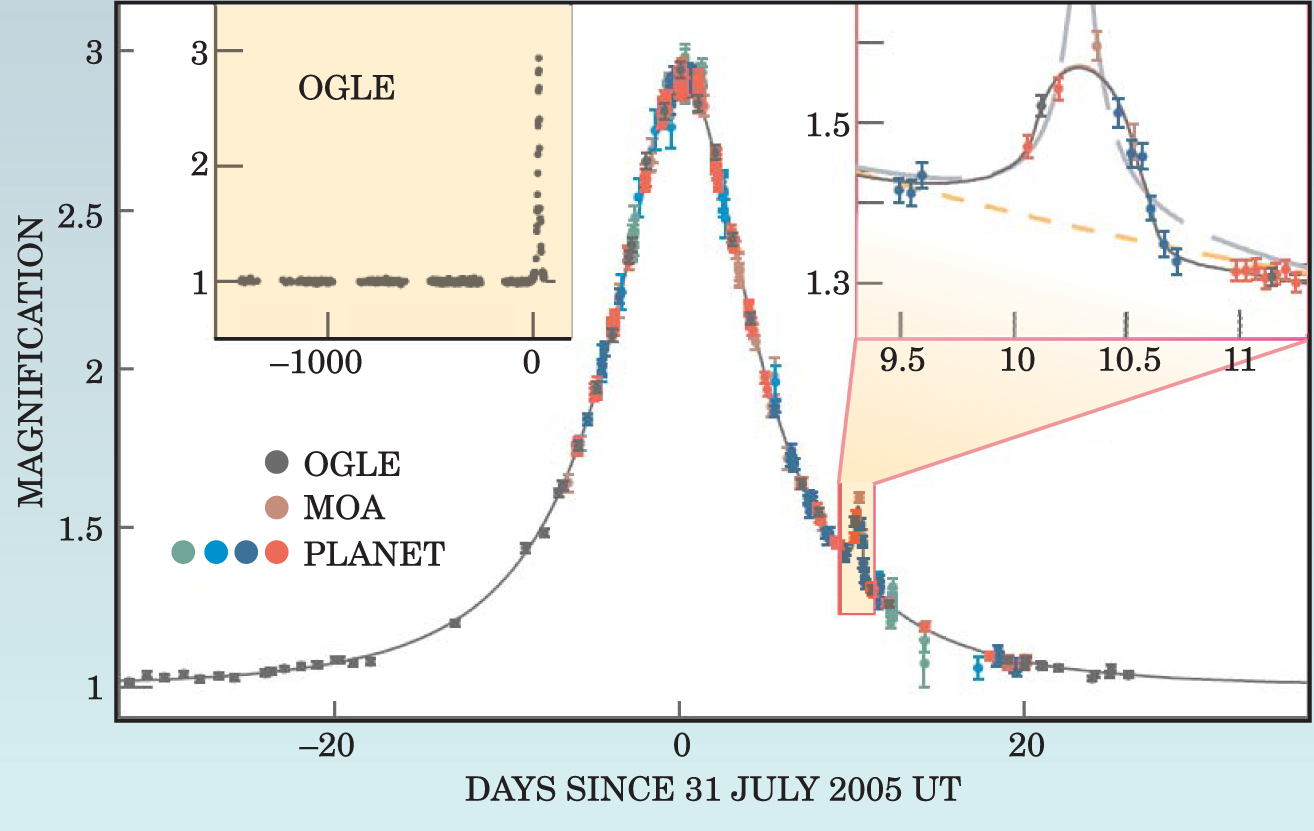
In mid-July of last year, PLANET and MOA were alerted by OGLE to yet another microlensing event. As shown in figure 2, OGLE had been monitoring a relatively bright giant star in the galactic bulge for almost four years before the star began to brighten early in July. On 31 July, its light curve peaked at three times the star’s normal brightness.

Figure 2. On 10 August 2005, a brief bump (detail in right inset) on the waning light curve of a microlensed bright star in the Milky Way’s central bulge revealed the existence of a planet accompanying the faint lensing star. The OGLE team had been monitoring the bright star without incident for almost four years (left inset) when it began brightening last July. OGLE joined forces with MOA and the worldwide network of PLANET telescopes to measure in detail the light curve and any planetary bump it might manifest. The best fit to the bump (solid curve in inset) yields a planetary mass of 5.5 Earth masses and an orbital radius 2.6 times Earth’s. The gray dashed curve is a much poorer fit that assumes a binary star system with no planet.
(Adapted from ref. 1.)
The jackpot came 10 days later, when the collaboration recorded a bump interrupting the smoothly waning light curve for less than a day. The best fit to the main light curve yields a lensing-star mass of 0.22 solar masses. That’s typical for red dwarfs, the most common stars in the galaxy. The curve that fits the little excursion best (see the expanded inset in figure 2) yields a planet of approximate mass 5.5 M ⊕ (with large, asymmetric error bars), whose orbital radius is about 1.6 R E. The only competing fit to the bump assumes that the lens is a binary-star system with two objects of stellar mass and no planet. That alternative, indicated by the gray dashed curve in the inset, “is strongly rejected by the data,” says Beaulieu.
Microlensing is most sensitive to planets with orbital radii near 1 Einstein radius. Translating 1.6 R E into an explicit distance requires estimating the observer’s distance from the lensing and source stars. Knowing the lensing light curve, the spectral type and brightness of the source star, and the celestial direction of the event relative to the galactic center, the collaboration got rough estimates for D S and D L from a standard model of the distribution of stars in the Milky Way. 4 The best resulting estimate is that the source star, at about 26 000 light-years, is just a little beyond the galactic center, and that the lensing star, about 4500 light-years closer to us, is still inside the galaxy’s central bulge.
Those distance estimates yield the best estimate of 2.6 AU for the newly discovered planet’s orbital radius. Together with the low luminosity of its red-dwarf parent, that orbital distance suggests a surface temperature of about 50 K. Hardly a habitable place. “But the fact that one in three of the planets found by this exciting new method is so light,” says planetary theorist Douglas Lin (University of California, Santa Cruz), “suggests that terrestrial planets are common, and that we might soon find one with a more hospitable climate.”
Planets big and small
What is the population ratio of jovian to terrestrial planets in the galaxy? Just like the Doppler method, microlensing is biased in favor of heavier planets. The discovery paper argues that a jovian planet is about 50 times easier to find by microlensing than is a 5-M ⊕ one. So, one might argue that the 2:1 score to date in favor of gas giants implies a great preponderance of much smaller rocky planets.
But the statistics of small samples are treacherous. And in any case, the Doppler and microlensing groups have been looking at disparate populations. Doppler works best for bright nearby stars. In fact, the Doppler teams have undertaken to look for planets around every solar-type star within 150 light-years of the Sun. Thus far, they’ve found gas giants around roughly 10% of all the Sunlike stars they’ve monitored. They also look occasionally at nearby red-dwarf stars. And around one of them, Paul Butler’s team recently found the lightest planet (7.5 M ⊕) ever discovered by the Doppler method. 5 Two years ago, Butler and company found a 21-M ⊕ planet orbiting another local red dwarf.
It’s presumed that dwarf stars, born with skimpier circumstellar disks than those of larger stars, are less likely to produce gas giants. The microlensing teams find mostly red dwarfs simply because their population dominance makes them the most likely foreground lenses for bright stars in the galactic bulge. Finding a planet a few AU from its host requires that the observer’s distance from such a lensing duo be of order 104 light-years. A source-star distance of 2D L is optimal for microlensing. At such galactic distances, following up a planet discovery with direct imaging must await a future generation of very big space telescopes. Unlike Doppler monitoring of nearby stars, microlensing is, for the present, “a one-shot deal,” as Lin puts it.
The provenance of gas giants and its effect on the abundance of smaller rocky planets are matters of some dispute among theorists. Lin supports the majority view that gas giants form gradually, starting with the accretion of a rocky core from disk material until the core becomes massive enough to begin pulling in a gigantic mantle of gas. This scenario suggests that “failed Jupiters,” manifesting themselves as smaller rocky or icy planets, may strongly outnumber the gas giants. “It’s still early days,” says Lin, “but the microlensing data suggest that many more dwarf stars have Earth-mass planets than have gas giants.”
The alternative disk-instability model favored by theorist Alan Boss (Carnegie Institution of Washington) posits a more abrupt formation of full-grown gas giants when circumstellar disks become gravitationally unstable. The model assumes that rocky planets do form by accretion of solid material, but closer in, well away from the region of gravitational instability. It does not predict that either terrestrial or jovian planets predominate. “I don’t think this wonderful new discovery tells us much yet about the relative abundance of rocky planets and gas giants, or about how gas giants form,” says Boss. “The one clear lesson from it and recent Doppler discoveries is the existence of a new class of middleweight planets with masses from about 5 to 25 M ⊕. And we won’t know if they’re terrestrial or Neptune-like ice giants until we can see a nearby one transiting in front of its star.”
At press time, a microlensing collaboration headed by Andrew Gould (Ohio State University) has announced 6 the discovery, in another OGLE event, of a 13-M ⊕ planet orbiting a star at a radius of about 3 AU.
References
1. J.-P. Beaulieu et al., Nature 439, 437 (2006) https://doi.org/10.1038/nature04441 .
2. D. Bennett, S. Rhie, Astrophys. J. 574, 985 (2002) https://doi.org/10.1086/340977 .
3. I. A. Bond et al., Astrophys. J. 606, L155 (2004) https://doi.org/10.1086/420928 .;
A. Udalski et al., Astrophys. J. 628, L109 (2005) https://doi.org/10.1086/432795 .4. M. Dominik, http://arXiv.org/abs/astro-ph/0507540 .
5. E. J. Rivera et al., http://arXiv.org/abs/astro-ph/0510508 .
6. A. Gould et al., http://arXiv.org/abs/astro-ph/0603276 .