Globetrotting summer “camp” aims to fuse condensed matter and culture
DOI: 10.1063/PT.3.2112
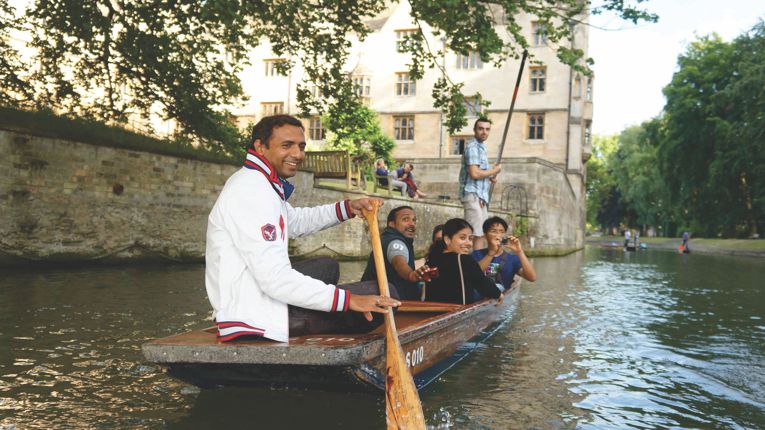
When does the leisurely activity of punting on the UK’s River Cam turn into an experiment to simulate the nonequilibrium dynamics of microscopic rod-like colloidal particles? When the participants are also attendees of a summer school that seeks to educate them on the latest in complex materials research and immerse them in the local culture.
“[We’re] bringing together top scientists as speakers and early-career scientists as future leaders in the research fields at the interface of condensed-matter physics, materials science, and optics and photonics,” says Ivan Smalyukh, a condensed-matter physicist at the University of Colorado Boulder. Smalyukh is also cofounder and coordinator of the Inter-Continental Advanced Materials and Photonics Summer School (I-CAMP), which held its fifth annual session for 10 days in June and July at the University of Cambridge. Europe is the fifth continent to take a turn at hosting I-CAMP. Previous stops were in Asia (China), Australia, South America (cohosted by Uruguay and Argentina), and North America (the US); next year’s I-CAMP will be in Cape Town, South Africa.
But plans for 2015 are up in the air. In July the director of the NSF Division of Materials Research announced that funding for the International Materials Institutes program would be discontinued in 2014. The five existing institutes are based at US institutions and act as hubs for US and international materials research centers. The International Institute for Complex Adaptive Matter at the University of California, Davis, is I-CAMP’s principal sponsor.
Crystallizing collaborations
This year’s I-CAMP drew 110 graduate students and postdocs—35 of them attended remotely via a live Web broadcast—from 36 countries, plus 65 invited speakers. The technical program focused on the mathematics, physics, and applications of liquid crystals. Topics in previous years were photovoltaics, emergent light–matter phenomena, nonlinear optical materials, and renewable energy and biophotonic materials. The topic for I-CAMP 2014 is topology in soft matter and optics.
The academic part of I-CAMP consists of daytime lectures, panel discussions, and forums, followed on some evenings by traditional poster sessions. Invited experts lecture on background information, recent breakthroughs, novel approaches, and their own work. To gauge students’ understanding in real time, the two most recent I-CAMPs introduced electronic “clickers,” which the students used to respond to multiple-choice questions posed by lecturers.
Michael Tuchband, a graduate student at the University of Colorado Boulder, credits his I-CAMP 2013 experience with helping him “see how my work was related to the work of others in the field.” He was one of four students to receive cash prizes and free membership from SPIE, the international society for optics and photonics, for their poster presentations; Tuchband’s was on a freeze-fracture transmission electron microscopy technique for studying liquid crystals and other materials.
Outside of formal technical instruction, the Cambridge I-CAMP participants toured the historic campus and visited other landmarks nearby. The cultural education component is the primary reason that I-CAMP moves around, says Smalyukh. The University of Colorado Boulder physics professor cites the evening excursions as an example of how the school seeks to cultivate international research collaborations; other means include a session for exchanging ideas on how to conduct science outreach and a Facebook group page that serves as a venue for both formal virtual poster sessions and informal personal and career updates. Smalyukh says I-CAMP alumni “often collaborate and publish together and are very active on the Facebook group pages long after the summer school ends.”
Soft interactions
There are tentative plans to continue the intercontinental tour in India in 2015, says Smalyukh, followed in subsequent years by tours in countries not previously visited. But those plans depend heavily on finding ways to fill the gap that will be left when the International Institute for Complex Adaptive Matter loses its NSF funding. The institute’s annual contribution to I-CAMP is $40 000. Depending on the summer school’s location and duration, which is typically three weeks, the total budget can run between $100 000 and $200 000, says Smalyukh. Without the NSF funding, which partially covers transportation and lodging for US-based invited speakers and some US students, “our ability to support [them] would suffer significantly,” he says.
“We are exploring other mechanisms at NSF to provide continuing, or at least bridging, support,” and organizers may approach other research-funding foundations, says Daniel Cox, the institute’s codirector and a physicist at the University of California, Davis. “We understand the difficult choices that must be made,” says Cox, who blames sequestration, the federal-budget-shrinking measure, for the NSF decision. But the “big [scientific] problems are simply too large to be solved by any one individual, department, institution, discipline, or country. Moreover, [the I-CAMP approach has shown that] engaging individuals from diverse cultures continually brings fresh perspectives and prioritization to the approaches to research problem solving. These soft interactions also help to reinforce a peaceful international community.”

Punting on the River Cam and other such cultural experiences are programmed into the Inter-Continental Advanced Materials and Photonics Summer School. From left to right are Maheshkumar Varia (India); Dharmendra Pratap Singh (India); Luka Cmok (Slovenia, partially hidden); Mamatha Nagaraj (UK); Michael Tuchband (US, standing); and Muhammad Akmal Kamarudin (Malaysia).
MELIKE KARAKUŞ