Gamma-ray telescopes show origins of cosmic rays
DOI: 10.1063/1.3293402
The spectrum of cosmic-ray protons hitting the top of Earth’s atmosphere falls smoothly with increasing energy E about like E −2.7 over six orders of magnitude from 109 eV to 1015 eV. It has long been assumed that the protons (and the small contingent of heavier ions) that constitute 99% of the CR flux are accelerated to such high energies in the expanding shock waves of supernova (SN) remnants in our own galaxy. (For higher energies, one has to invoke much grander accelerators like actively accreting black holes in the nuclei of distant galaxies.)
The SN acceleration scheme, originally suggested by Enrico Fermi, involves cumulative acceleration of charged particles in repeated traversals of the remnant’s shock front. From x-ray and γ-ray telescope data, it’s known that electrons are indeed accelerated in nearby SN remnants. But electrons account for only about 1% of the CR flux. And until now, convincing evidence of the presumed connection between supernovae and the acceleration of CR hadrons (protons and ions) has been lacking.
Because the trajectories of all but the most energetic charged particles are scrambled by the Milky Way’s hodgepodge of magnetic fields, one learns nothing about the source of a CR of energy less than 1019 eV from its arrival direction. A promising probe of CR sources, immune to magnetic scrambling, would be the γs from the decays of neutral pions created in collisions between hadronic CRs and gas close to the acceleration source. And, indeed, the diffuse γ emission from the Milky Way’s disk is attributed to such pion decays. But for observers inside the galaxy looking at the disk edge-on, it’s been impossible to localize CR sources to regions rich in SN remnants.
Therefore in recent years astrophysicists have been hoping to verify the CR–SN connection by looking for γ emission from nearby “starburst galaxies”—galaxies with regions of prodigious ongoing star formation at much higher rates than anything seen nowadays in the staid Milky Way. Because of their large populations of very massive, short-lived stars, starburst regions harbor extraordinary numbers of young SN remnants, and their local gas densities are very high. This combination would seem to make starburst galaxies promising places to look for pion-decay γs from CR collisions. But that emission was predicted to be too faint for the previous generation of orbiting and ground-based γ telescopes to detect, even from the nearest starburst galaxies.
Fermi’s first year
Now at last, a new generation of γ telescopes has revealed the predicted emission from two starburst galaxies—M82 and NGC 253—only about 12 million light-years away. Launched in June 2008, NASA’s Fermi Gamma-ray Space Telescope has far better sensitivity, angular resolution, and sky coverage than its predecessors. As Fermi sweeps the entire sky every three hours, it records the energies and directions of γs from 20 MeV to 300 GeV.
Over its first full year of observing, Fermi has recorded excesses over background of fewer than a thousand γs arriving from the directions of M82 and NGC 253. Still, after careful analysis of backgrounds and the instrument’s angular resolution, a Fermi team coordinated by Keith Bechtol of SLAC has concluded that those small excesses constitute statistically robust detections of steady-state γ emission between 200 MeV and 20 GeV from the two nearest starburst galaxies. 1
The same two galaxies have also been under scrutiny for TeV (1012 eV) γs by Cherenkov-telescope arrays on the ground. Instead of detecting high-energy γs directly, Cherenkov telescopes image the narrow cone of Cherenkov light reaching the ground from the shower of charged particles initiated when a TeV γ strikes the atmosphere (see Physics Today, January 2005, page 19 ). Because such high-energy γs are rare and the arrays have very narrow fields of view, the Cherenkov teams have had to make do with even skimpier statistics than the Fermi team.
The two-year-old VERITAS array of four Cherenkov telescopes at the Whipple Observatory in Arizona has harvested an excess of only 91 γs above background in 140 hours of staring directly at M82. But that suffices, says team leader Wystan Benbow (Harvard–Smithsonian Center for Astrophysics), to provide a 5-standard-deviation detection of TeV γ emission from that galaxy in the northern sky. 2 In the southern sky, the HESS array in Namibia, three years older than VERITAS, has been monitoring NGC 253, whose star-formation rate is only about half that of M82. Led by Werner Hofmann of the Max Planck Institute for Nuclear Physics in Heidelberg, the HESS team reports 3 a 5-standard-deviation signal of γ emission above 200 GeV from NGC 253.
The first ever
The M82 and NGC 253 observations by Fermi and the Cherenkov arrays are the first detections ever made of steady-state γ emission from “ordinary” galaxies other than our own and the Large Magellanic Cloud (LMC), a close-in satellite of the Milky Way. “Ordinary” here means a galaxy without an active galactic nucleus (AGN)—a voraciously accreting supermassive black hole that powers gargantuan jets of charged particles and radiation. Until now, most of the many γ-luminous galaxies seen by Fermi and other detectors have been “blazars”—AGNs with jets that happen to be pointing toward us.
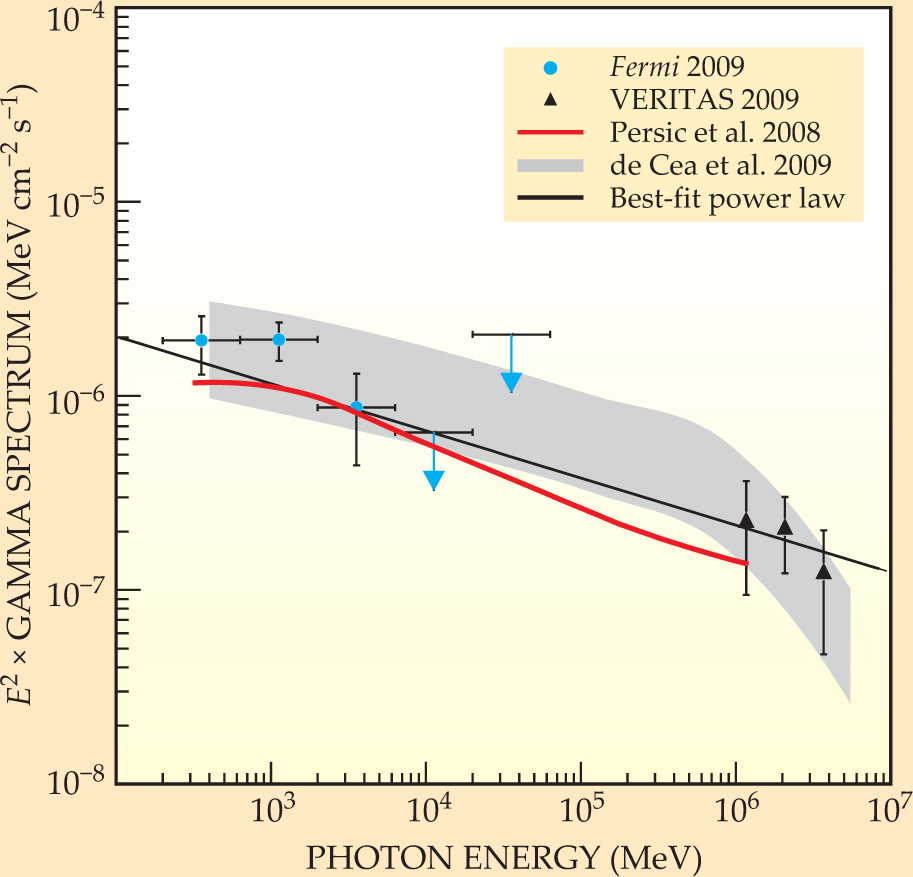
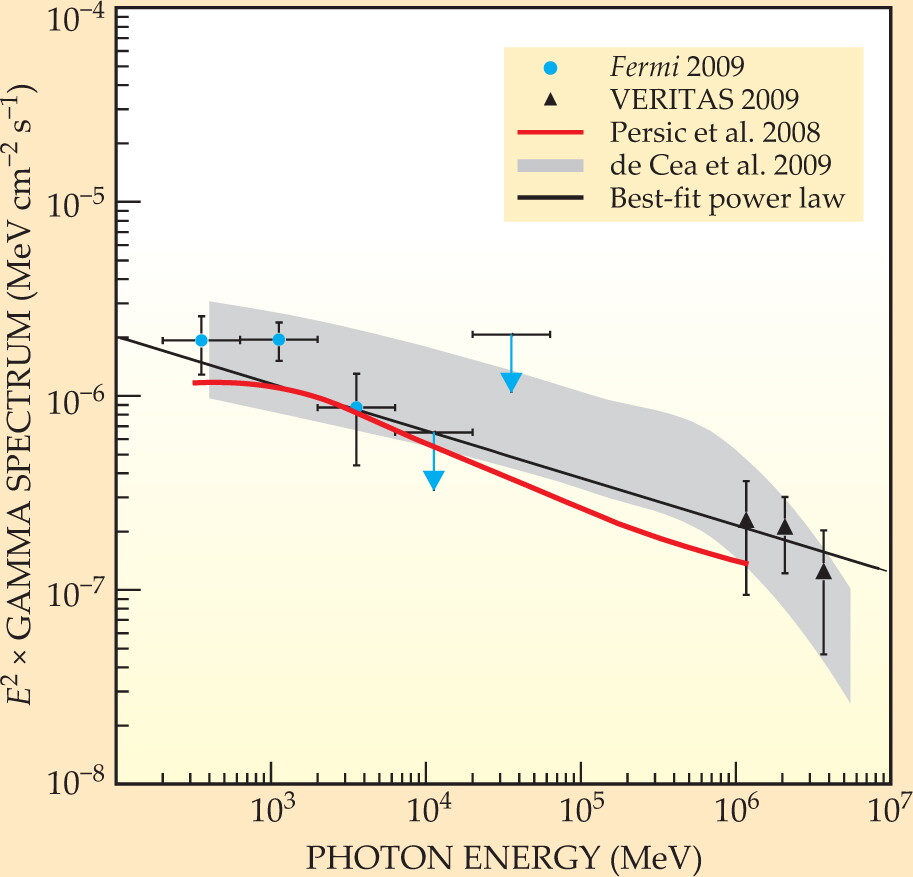
Figure 1 shows M82’s γ spectrum as measured over four orders of magnitude in energy by Fermi and VERITAS. The best power-law fit (E −2.2) makes good sense if one attributes most of the γ emission to the decay of pions produced in ambient-gas collisions of protons and ions accelerated in SN remnants. But one also wants to get the absolute normalization right. The detailed theoretical predictions 4 shown in the figure do that quite well. In addition to the pion-decay γs, they also consider the lesser contributions of CR electrons to the γ flux by bremsstrahlung and Compton upscattering of ambient photons.

Figure 1. Gamma-ray spectrum of the starburst galaxy M82 measured by the Fermi and VERITAS telescopes
(Adapted from ref. 1.)
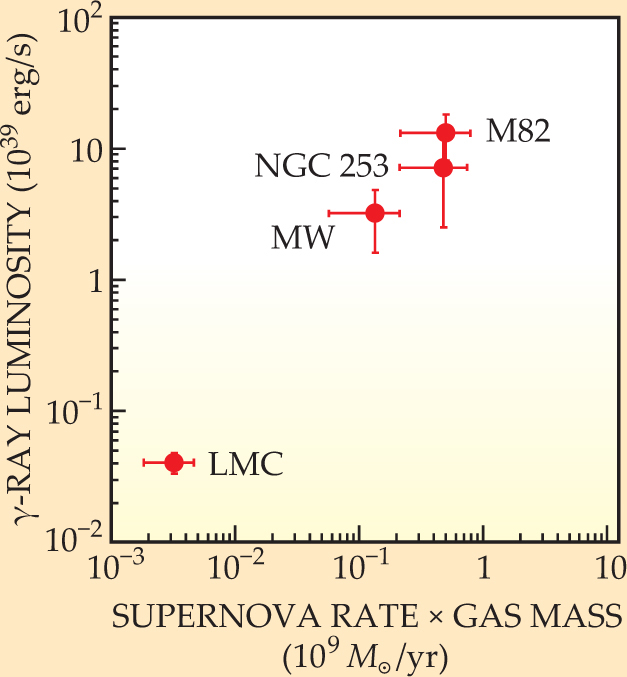
The SN-remnant scenario implies that a galaxy’s luminosity in γs should scale roughly like the rate at which it produces supernovae times its total mass of gas. And indeed that’s what is seen in figure 2, which compares the γ luminosities of the two starburst galaxies with those of the more quiescent Milky Way and LMC. The starburst galaxies exceed the Milky Way’s meager SN output of a few per century by an order of magnitude, and the gas in their star-forming cores is extremely dense.

Figure 2. Gamma-ray luminosity (for energies between 100 MeV and 5 GeV) versus supernova rate times total gas mass (in solar masses M ☉) for four galaxies: the Large Magellanic Cloud, the Milky Way, NGC 253, and M82.
(Adapted from ref. 1.)

Mapping the LMC
Small and staid though it may be, the LMC offers several important advantages in the search for CR origins: It’s very close by, we see it almost face-on, and it harbors a localized region of vigorous star formation—called 30 Doradus—more active than any neighborhood in the Milky Way. Fermi’s angular resolution is not nearly good enough to localize γ emission to known starburst regions within M82 and NGC 253 from a distance of 12 Mly. But it can do just that in the LMC, a mere 150 kly away.
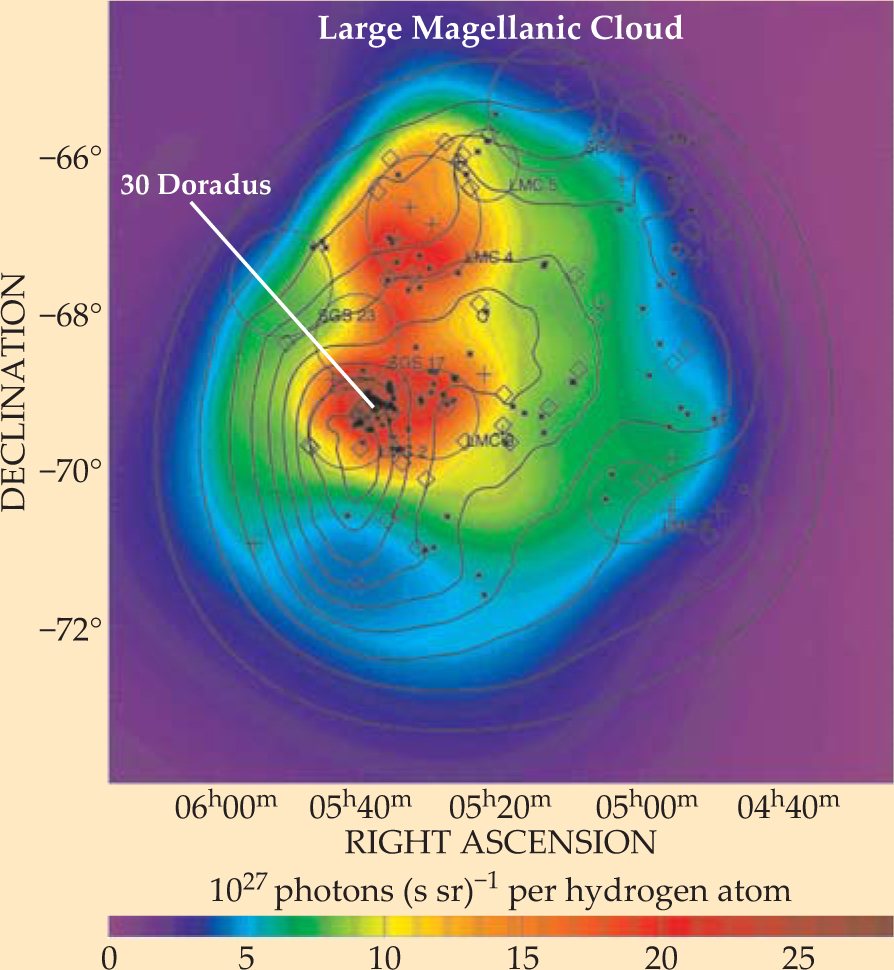
Figure 3 is a map of the LMC’s γ luminosity produced by a Fermi team led by Jürgen Knödlseder of the Center for the Study of Space Radiation in Toulouse, France. 5 Contour lines indicate hydrogen gas density, symbols mark the locations of known SN remnants and other stellar evidence of active star formation, and colors indicate γ luminosity divided by local gas density. All three indicators peak at 30 Doradus, a starburst region about 400 ly across.

Figure 3. Luminosity map of the Large Magellanic Cloud from Fermi telescope data for γs with energy above 100 MeV. Contour lines indicate density of hydrogen gas and colors indicate local γ emission per hydrogen gas atom. Symbols show already known stellar evidence of recent star formation: supernova remnants, Wolf–Rayet stars, and radio pulsars. All three indicators peak in the active star-forming region 30 Doradus.
(Adapted from ref. 5.)
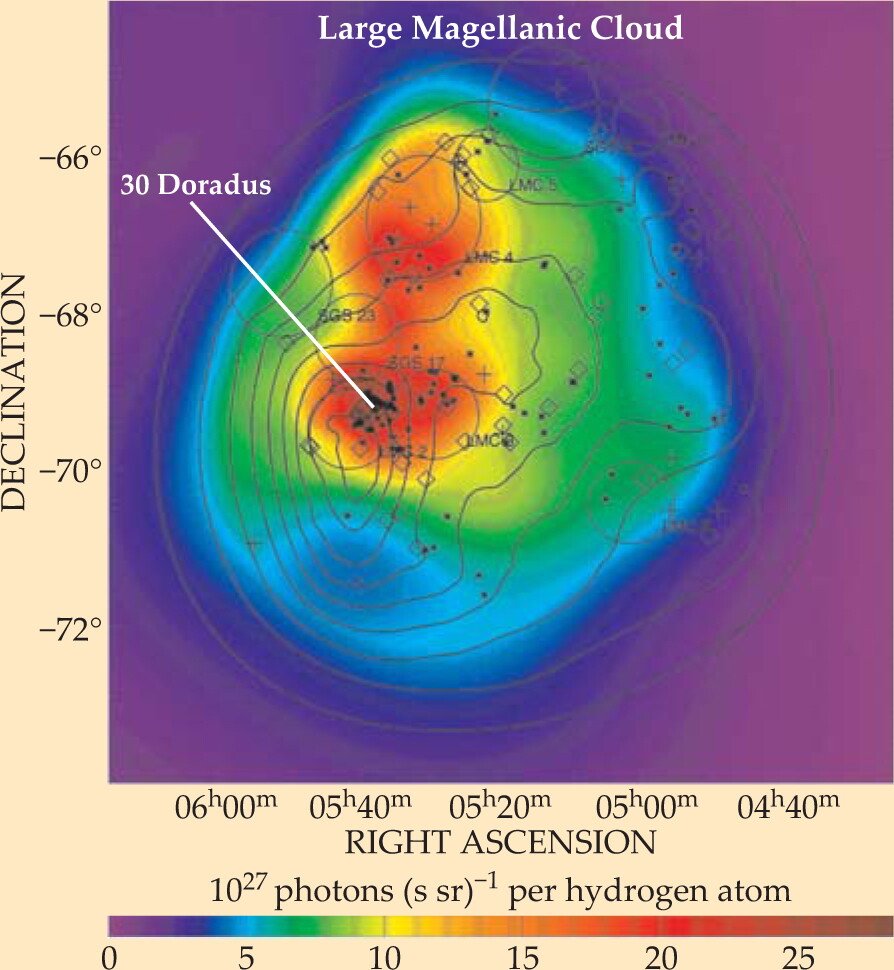
That’s what’s expected if the CRs are produced in SN remnants and then show themselves by colliding with gas. Strictly speaking, the LMC map—and the starburst-galaxy results—tie the CRs only to star-forming regions and not specifically to SN remnants. It could therefore be that Wolf–Rayet stars—massive young stars in prolonged windy death throes—which also abound in such regions, play a role in CR acceleration. But stellar winds don’t release enough energy to account for more than a small fraction of CRs. It’s estimated that fully 10% of the kinetic energy released in SN explosions ends up in CRs.
The only surprise, says Knödlseder, is that the γ luminosity tracks the star formation so well. “It implies a mean diffusion length [L d] of only about 400 light-years from where the CR was created to where it collides and makes pions.” Indirect evidence from the Milky Way disk’s diffuse γ emission suggests a significantly longer L d.
Because CR collisions with even the densest interstellar gas are few and far between, L d depends much more on the twists of local magnetic fields than on gas density. In fact, many hadronic CRs manage to leak out of their natal galaxies without ever making a pion. “So we have to imagine that the magnetic-fields near 30 Doradus are particularly intricate,” says Knödlseder, “or rethink the evidence from the Milky Way’s disk.”
To the extent that hadronic CRs don’t escape before making pions, a galaxy’s γ luminosity becomes a calorimetric measure of its CR energy. The γ observations indicate that starburst cores of M82 and NGC 253 have CR energy densities a hundred times that at the Milky Way’s center. “That difference reflects a similar disparity in supernova rates,” says theorist Massimo Persic (National Institute for Astrophysics, Trieste, Italy). “The correlation suggests that supernova remnants in very different environments share a common, perhaps universal, efficiency for accelerating cosmic rays.”
References
1. A. A. Abdo et al., http://arxiv.org/abs/0911.5327 .
2. V. A. Acciari et al., Nature 462, 770 (2009). https://doi.org/10.1038/nature08557
3. F. Acero et al., http://arxiv.org/abs/0909.4651 .
4. M. Persic et al., Astron. Astrophys. 486, 143 (2008); https://doi.org/10.1051/0004-6361:200809525
E. de Cea del Pozo et al., Astrophys. J. 698, 1054 (2009). https://doi.org/10.1088/0004-637X/698/2/10545. A. A. Abdo et al., Astron. Astrophys. (in press).