Florence fetes Galileo
DOI: 10.1063/1.3156324

It’s no surprise that Florence, Italy, where Galileo lived much of his life, is hosting many activities in celebration of one of its most famous sons during the International Year of Astronomy 2009, which marks 400 years since Galileo first pointed a telescope at the night sky.
The city’s Institute and Museum of the History of Science has created two major exhibitions. One—Galileo, the Medici and the Age of Astronomy—opened in April at Philadelphia’s Franklin Institute as part of the IYA event “100 Hours of Astronomy” (see Physics Today, April 2009, page 20 ) and will be on display through early September. The other, in Florence from March through August, is Galileo: Images of the Universe from Antiquity to the Telescope. That show’s curator, Paolo Galluzzi, describes it as including “items of both science and art to tell the story of how man looked at the sky from the Egyptians to Galileo’s age.” It’s at a temporary site because the museum is under renovation until later this year, when it will reopen as Museo Galileo. It holds the largest collection of original Galileo artifacts, including two telescopes, an objective lens, and home-built instruments.
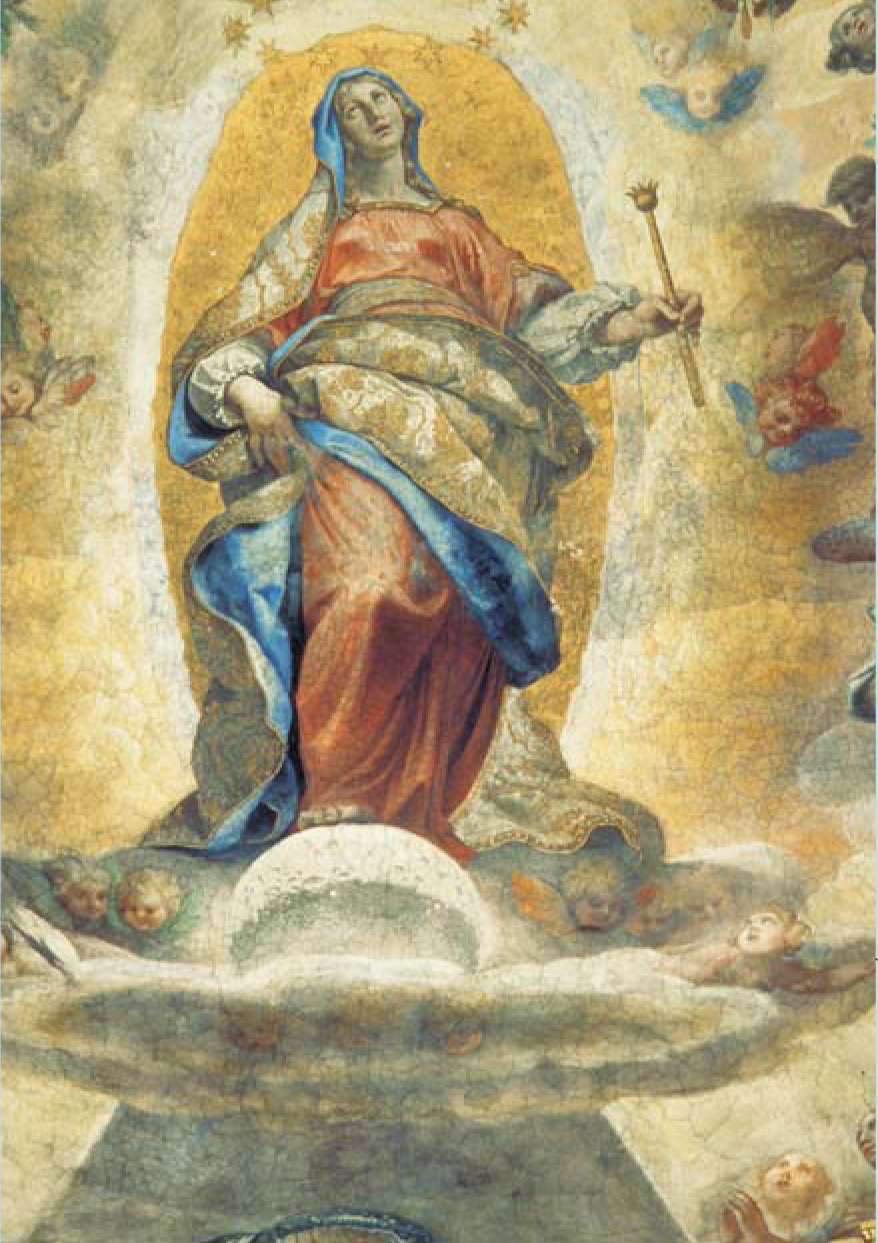
About 80 km away in Pisa, Galileo’s birthplace, an exhibition titled The Telescope and the Brush looks at “how interested Galileo was in art, and how much his discoveries influenced art,” says Galluzzi. As examples, Galluzzi points to a painting by Peter Paul Rubens of the myth of Saturn devouring his child. “He portrayed Saturn made of three bodies, exactly as Galileo described them,” says Galluzzi. And in a 1612 painting of the immaculate conception (at left) by Ludovico Cigoli, “for the first time, immediately after Galileo’s discoveries, the Virgin is standing on a crescent Moon that was a Galilean Moon, with mountains and valleys.”
An international conference held in Florence in late May re-examined Galileo’s conflicts with the Roman Catholic Church in terms of history, philosophy, and theology. Topics ranged from the views of various popes through the ages to Galileo as seen during the Nazi time. Other activities include filming the sky with a replica of Galileo’s telescope.
In Florence, says Galluzzi, “Galileo is a very important piece of our tradition, not only in science but also in literature—he is one of the greatest writers of Italian literature. And he was a very good musician, so there are also musical events devoted to Galileo and to the polyphonic approach to music. He was a universal person.” The IYA activities, he adds, have gotten “a very warm reception. People are enthusiastic.”

ARCHIVIO FOTOGRAFICO DELL’ISTITUTO E MUSEO DI STORIA DELLA SCIENZA, FIRENZE

More about the authors
Toni Feder, tfeder@aip.org