Experiment closes in on a second critical point of water

Water may be ubiquitous, but it’s not conventional. Many properties of water, such as low compressibility and high surface tension, make it stand out from its peers. Water’s behavior in a supercooled state—when it remains liquid at temperatures below its freezing point—is particularly unusual. The compressibility and heat capacity of most liquids shrink in the supercooled regime, yet water undergoes a transformation at specific combinations of temperature and pressure that causes its compressibility and heat capacity to surge.
To explain the behavior, researchers have proposed that a special phase transition, known as a critical point, exists in the supercooled region of water’s phase diagram. At this point, two yet-to-be-detected phases of water were predicted to merge and become indistinguishable. Water’s first critical point, between the liquid and gas phases, appears at about 647 K and 221 bar. Once controversial, the idea of the existence of a critical point between two liquid phases of water has gained consensus, and researchers have attained evidence of the two supercooled phases, high- and low-density liquids. But that second critical point has never been directly observed.
Now Anders Nilsson from Stockholm University in Sweden, Kyung Hwan Kim at Pohang University of Science and Technology in South Korea, and colleagues have found evidence of a liquid–liquid critical point (LLCP) in supercooled water. 1 Using an IR laser, the team conducted precision melting of ice samples formed below 136 K and used an x-ray free-electron laser to measure the molecular properties of the resulting liquid. The new work is the closest that an experimental result has come to directly measuring the location of the critical point, says Francesco Paesani, of the University of California, San Diego, who has conducted simulations of supercooled water.

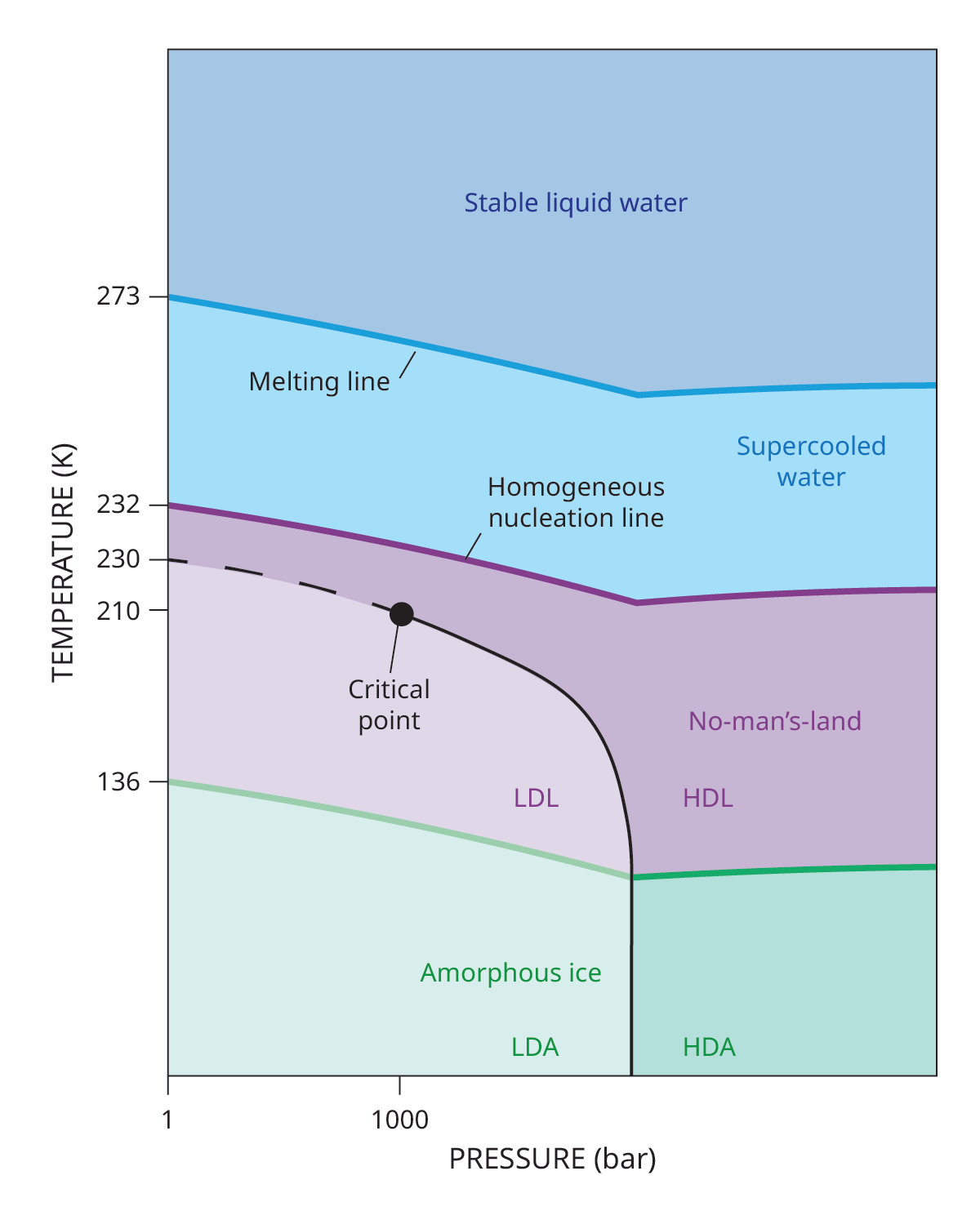
The liquid–liquid critical point is theorized to be found in a region of water’s phase diagram called no-man’s-land, which is difficult to access with standard experimental techniques. By melting samples of high-density and low-density amorphous ices (HDA and LDA, respectively), researchers found evidence that a critical point where high-density liquid (HDL) and low-density liquid (LDL) phases of water become indistinguishable lies at around 210 K and 1000 bar. (The figure is not to scale.)

Part of what makes LLCP research so difficult is that it requires keeping water liquid at low temperatures and high pressures. Water cooled beyond its freezing point can maintain its liquid state only if it is carefully prepared without imperfections, such as dust or gas bubbles, that can act as nucleation sites for crystallization. And in the region known as no-man’s-land (see the graph ), which at standard atmospheric pressure has a threshold temperature of 232 K, random molecular motion is enough to trigger rapid crystallization. It’s within that region that the LLCP is suspected to exist, but measuring the liquid state of the supercooled water before it crystallizes has been extremely challenging. Nilsson and colleagues have made many attempts, including in 2017 when they used x-ray scattering to measure the behavior of evaporatively cooled microdroplets (see the PT article “Supercooled water goes supercritical ”).
Rather than trying to glimpse the behavior of supercooled water as it’s cooled, Nilsson and colleagues entered no-man’s-land by melting an even colder form of water called amorphous ice. When water at standard atmospheric pressure is rapidly cooled to temperatures below 136 K, it freezes such that its molecules maintain their liquid configuration. When warmed into the supercooled regime, the water behaves like a liquid for up to microseconds before recrystallizing.
The researchers prepared samples of high- and low-density amorphous ices under pressure in a cryostat vacuum chamber and used pulses from a nanosecond IR laser to heat them and melt them into the two supercooled liquid phases. The team then used an x-ray free-electron laser to take measurements of the molecular and density states of the resultant transient liquids via small- and wide-angle scattering. By varying the energy per unit area of the laser, the team was able to systematically control the temperature of the liquids to search for spectral signatures of a liquid–liquid transition at conditions above and below recent estimated values of the LLCP.
As the researchers took measurements of the samples at different temperatures and pressures, they identified a region in no-man’s-land that exhibited characteristics consistent with proximity to an LLCP. They observed enhanced density fluctuations between the two liquid phases and a crossover from abrupt phase changes, consistent with a jump between discrete high- and low-density water phases, to the smooth changes predicted as the liquid phases become indistinguishable. They also observed a plateau in the liquids’ temperature increase despite more heat being added, suggesting a rise in heat capacity consistent with proximity to an LLCP. The team inferred the location of an LLCP at 210 K and 1000 bar, which is in alignment with other recent estimates, including simulation results from Paesani and colleagues.
Despite the progress toward nailing down the location of the LLCP, questions remain. For example, Nilsson and colleagues were unable to make an estimate of the samples’ correlation length, a measure of local molecular influence that grows alongside compressibility and heat capacity and that is predicted to diverge toward infinity at an LLCP. Small variations in the amorphous ice samples made it difficult to measure their internal structure using very small x-ray scattering angles. Increasing the homogeneity of the samples could be one way to solve the problem, Nilsson says.
“To me, this work does not close the subject on the LLCP,” says Paesani, “but it changes the subject from ‘Does this exist at all?’ to ‘How precisely can we now characterize it?’ ”
Editor’s note, 21 July 2026: The locations of the gas phase and of the boundary between the low- and high-density liquid and amorphous phases were incorrect in the original phase diagram. The figure has been updated.
Reference
1. S. You et al., “Experimental evidence of a liquid-liquid critical point in supercooled water ,” Science 391, 1387 (2026).