Energy scales of superconducting graphene come into focus

When sheets of graphene are stacked at just the right angle, their electrons form Cooper pairs at low temperatures, and the material becomes a superconductor.
(Illustration by Sampson Wilcox and Emily Theobald, RLE, MIT.)
It’s one of the most stubborn open questions of modern physics: What’s the mechanism of high-temperature superconductivity? All superconductors need some way of binding their electrons, which are fermions, into quasiparticles called Cooper pairs, which act as bosons. The low-temperature superconductivity in metals is well described by the Bardeen-Cooper-Schrieffer theory, which states that the pairs are held together by phonons. But in 1986, cuprate ceramics were discovered to superconduct at a much higher temperature via a different, unknown mechanism. Despite four decades of research and the discovery of many other unconventional superconducting materials, their mechanism remains a mystery.
So the condensed-matter physics community took note when, in 2018, superconductivity was found in magic-angle graphene: two or more layers of the atomically thin carbon material stacked with a relative twist of 1.1°. Its allure is in its tunability: With a single graphene device, researchers can explore regions of the superconducting phase diagram that otherwise would require the synthesis of several new materials. But despite that advantage, magic-angle graphene has until now resisted a basic measurement: the size of the hole in the density of states called the superconducting gap, a measure of how much energy is needed to break apart a Cooper pair.
It’s not that the density of states couldn’t be measured. That could be done using tunneling spectroscopy, a technique related to scanning tunneling microscopy. The trouble lay in confirming that the gap being measured was really a superconducting gap. Other phases of matter—for example, insulators—also have gaps in their densities of states, and magic-angle graphene hosts a rich array of phases that all lie close to one another in parameter space and thus could be easily confused. (For details, see the 2024 PT feature article “Twisted bilayer graphene’s gallery of phases ,” by B. Andrei Bernevig and Dmitri K. Efetov.)
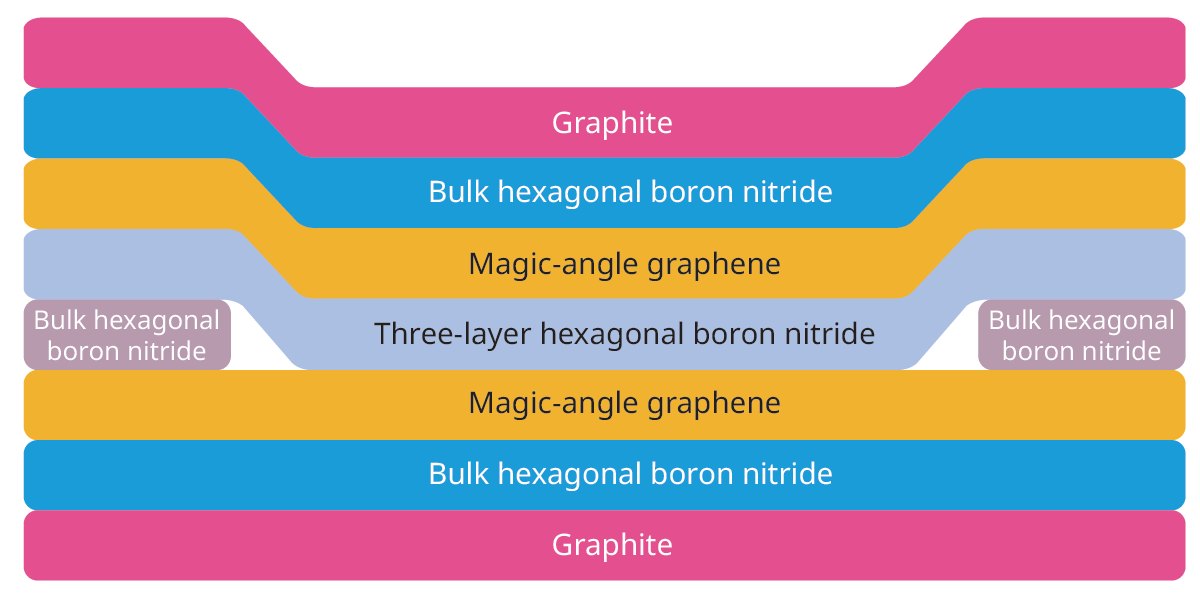
Now Princeton University’s Jeong Min Park, her former PhD adviser Pablo Jarillo-Herrero at MIT, and their colleagues have overcome that challenge. They’ve developed a way to simultaneously measure magic-angle graphene’s density of states and its charge-transport properties so that they know whether the phase that they’re probing is superconducting. 1 Their experimental device, sketched below, was intricate to construct. Several of the layers are atomically thin, the two graphene layers each have electrodes attached at several points, and the central layer of bulk hexagonal boron nitride has a precisely etched hole through which the adjoining layers must smoothly contact each other.

Magic-angle graphene superconducts at low temperatures, but probing the energetics of the superconducting state has been a challenge. With this multilayered device, researchers can simultaneously measure the charge transport and density of states of the elusive superconductor.
(Figure adapted from ref. 1 by Freddie Pagani.)

With their device, the researchers discovered that magic-angle graphene’s density of states features two distinct energy gaps: the superconducting gap, which disappears above the critical temperature, and another, higher-energy gap called a pseudogap, which persists at higher temperatures. That observation is not yet enough to clarify the Cooper-pairing mechanism of magic-angle graphene—or any other unconventional superconductor—but it does point to a possible similarity between them: Many other unconventional superconductors also feature pseudogaps that resemble the one seen in graphene. If magic-angle graphene’s pairing mechanism can be discovered, it could lead to the design of new superconductors—maybe even ones that superconduct at room temperature and pressure.
References
1. J. M. Park et al., “Experimental evidence for nodal superconducting gap in moiré graphene ,” Science (2025), doi:10.1126/science.adv8376.