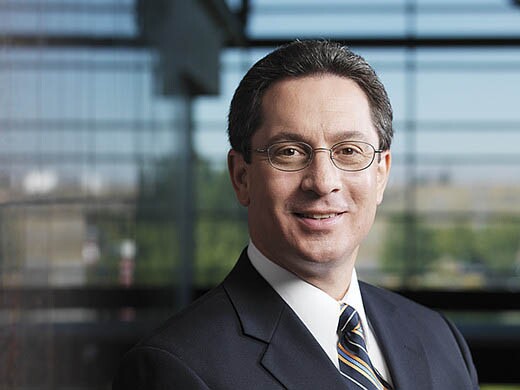
Steven Ashby was named director of Pacific Northwest National Laboratory in April 2015. He previously was the lab’s deputy director for science and technology. A computational scientist, Ashby came to PNNL in 2008, after having spent 21 years at Lawrence Livermore National Laboratory, where he became deputy principal associate director for science and technology. He spoke recently to Physics Today‘s David Kramer. The following is an edited transcript of the interview.
Steven Ashby. CREDIT: PNNL
PT: Back in the 1970s, PNNL was largely associated with the nuclear production complex at the Hanford Site in Washington State. Is that still the case?
ASHBY: At one point in time, most of the work done at the laboratory was in support of the Hanford and other priorities for DOE’s [Department of Energy’s] Office of Environmental Management. That was our genesis. We came out of the old Hanford Works. Today, PNNL is a DOE Office of Science–stewarded national laboratory that is fully independent from Hanford. We still support the Hanford cleanup by providing scientific and technical expertise for some of the more challenging problems they are facing. This work accounts for about 6% of our budget.
PT: What is the current mix of work at the lab?
ASHBY: We’re just under $1 billion in R&D expenditures, and the single largest sponsor in terms of dollars is the National Nuclear Security Administration [NNSA] for the nonproliferation mission, about 30%. The Office of Science is about 20%, yet it’s the largest single supporter of research staff at the lab, because much of our national security work involves globally deployed programs that require procurements, and subcontracts that we manage. Another 20% or so is from the applied energy programs, Energy Efficiency and Renewable Energy and Office of Energy in particular.
So 70% of the work is for DOE. The other 30% includes work we do for the Department of Defense and the intelligence community, for the Department of Homeland Security, for the Nuclear Regulatory Commission, for the National Institutes of Health, and for the private sector. If you combine the nonproliferation, the DOD, intelligence, and DHS work, about half the lab is in national and homeland security.
PT: What is your vision for the laboratory?
ASHBY: I’d like to see us become more widely recognized as a world-class scientific research institution. We enjoy that reputation in certain areas, but I’d like to see us more broadly recognized for our scientific leadership and innovative technical solutions. This is important to attract top talent and to increase understanding of the impact PNNL is delivering to the nation. Toward that end, we are pursuing our science vision of understanding, predicting, and controlling the behavior of complex adaptive systems. We look at three systems that are relevant to DOE: The Earth system, the energy system, and the security system.
Today we are widely recognized as DOE’s premier lab in chemistry, environmental science, and data analytics, and we’ve used those strengths to provide national leadership in four areas: climate science, the future power grid, nonproliferation, and environmental remediation. If you look at our publication record, listen to our sponsors, and see the impact we’re having, it would be hard to argue that we aren’t providing national leadership. Going forward, I’d like to see us strengthen the scientific foundations underpinning each of these areas.
For example, PNNL has world-class capabilities in catalysis and atmospheric chemistry. But if you ask the general public, or even people in the scientific community, which institutions are world-class, what you get are the usual suspects—Stanford, MIT, Berkeley, etc. They typically won’t mention a national laboratory. That’s an issue the secretary of energy is concerned about, raising the visibility of the system of labs and what we do for the country.
PNNL is the single largest recipient of NNSA competitively awarded nonproliferation funding. We understand plutonium quite well; that goes back to the Manhattan Project. We’re able to do exquisite levels of detection that can’t be done anywhere else. And we take that fundamental radiochemistry and physics capability and turn it into detection technology for treaty verification. Samples come in from around the world and we do some analysis and inform the government. When radionuclides came around the planet from the Fukushima disaster, PNNL was the first to detect them in the continental US. And we did the analysis to inform the Japanese and the US governments that indeed a partial meltdown was happening.
PT: What about grid modernization? Is it actually happening?
ASHBY: Yes. We are working to increase the grid’s reliability and resiliency, as well as allow for the incorporation of renewables, for which it wasn’t designed. We’re also worrying about cybersecurity because we are deploying sensors to gain a better understanding of the state of the grid. We want consumers to have control over when they use electricity and at what cost. This motivates our research in transactive controls and smart meters. PNNL is co-leading with the National Renewable Energy Laboratory the Grid Modernization Laboratory consortium, something the secretary has created.
To better understand the state of the grid, we’re looking at data from the phasor measurement units (PMUs) that are deployed around the grid. We’re going to exploit that data to improve operation of the grid. Before PMUs were deployed, we had [supervisory control and data acquisition] technology that collects data from the grid about once every four seconds. And they provided only one measurement. The analogy I use is that if I ask you about the weather and give you a thermometer, you could give me one reading. Now I give you a modern weather station, with a barometer, wind speed, direction, etc. You can give me not only a better picture of the weather at the moment, but a bit better idea of what it might be in a few hours.
What PMUs can do for us is get many more measurements 30 times a second, instead of every four seconds. The question is what do we do with all the data? We can analyze it and get a more accurate picture of what’s happening at a point in time, where you could see frequencies and oscillations that might go out of control and cause a blackout. Couple that with our visual analytics capability to display it in a way so a power engineer can see a problem developing in time to take action to avoid the problem from getting out of control. We’ve actually shown that if we’d had this data stream and these tools available during the 2003 blackout, operators could have taken action to avoid it.
We have an operations center where we get real data under nondisclosure agreements from utilities. We can bring power engineers in to see what tools they find useful, and then we license those tools to their vendors. We’ve shown utilities the potential to save tens of millions of dollars that they can pass right on to the ratepayer. Some utilities are adopting these tools already.
PT: What about your basic science program?
ASHBY: We have a very large climate science research program, and in particular we are known for the work we do in atmospheric chemistry, understanding aerosol–cloud interactions for example. We’ve done a lot of work in understanding the evolving regional impacts of climate. We have a leadership role in the Atmospheric Radiation Measurement program that the Office of Biological and Environmental Research at DOE runs. It’s a distributed climate science facility, and there are fixed mobile and aerial sites that collect invaluable data.
We have the Environmental Molecular Sciences Laboratory, another user facility that we manage that hosts 700–800 scientists a year who use its unique instruments in a variety of studies, often in collaboration with PNNL Earth scientists and biologists.
We have arguably one of the best catalysis research groups in the country. We’re looking at whether we can design catalysts that behave like inorganic enzymes and work at much lower temperatures, which would make them more cost-effective. That will require a catalyst that is 10 000, 100 000, or 1 million times more efficient in terms of the speed at which it can catalyze a chemical reaction. If we can do that, we perhaps can get catalysts that mimic nature.
We’ve been growing our high-energy and nuclear physics programs. We’re leading the US contribution to the Belle II detector at KEK in Japan. We’re also doing the management of all the data that is going to come off that experiment.
PT: How has your budget situation been?
ASHBY: Overall, we are in pretty good shape, but there is still a fair amount of uncertainty in the overall federal R&D budget. The variation in the potential budget numbers is a lot greater than it used to be. You might see a House appropriations bill in the past with one number and the Senate another, but the difference wasn’t all that great. So when they went to conference, they would split the difference. And you could plan program by program.
Recently, we’ve seen much bigger differences in the House and Senate numbers, including some cases where one side may want to zero out a program. Budgets are not being resolved before the beginning of the fiscal year. The continuing resolutions and threats of shutdowns really shake the confidence of staff. In fact, whenever I meet with our congressional delegation and they ask about my biggest concerns, I tell them what’s really important for a scientific enterprise is stability in R&D support. My biggest responsibility is to be able to attract and retain the best talent. They want to know they can build a career at the national labs.