DOE urged to proceed more deliberately with global plan to expand nuclear power
DOI: 10.1063/1.2963000
In March the UK became the 21st country to sign a nonbinding “statement of principles” that attempts to address the conflicting Global Nuclear Energy Partnership goals of spreading nuclear energy generation throughout the world while preventing the spread of technologies needed to manufacture and recycle nuclear fuel to nations that don’t already possess them. Signatories to the GNEP include the nuclear haves Russia, China, Japan, and France, have-nots like Senegal, Jordan, and Ghana, and nations that have relied on other countries for their nuclear fuel, including the former Soviet satellites Hungary, Bulgaria, and Lithuania.
Many experts believe that a vast expansion of nuclear power is the only plausible option for meeting the anticipated explosion in electricity demand from the developing world while mitigating global warming. According to one widely accepted computer model, the Mini Climate Change Assessment Model, stabilization of atmospheric carbon dioxide concentrations at 550 ppm—a level that many climate scientists fear is still too high—will require as many as 4000 new nuclear reactors, said Victor Reis, a senior adviser at DOE. “This is an area where the US can provide some serious leadership,” Reis recently told an audience at the American Association for the Advancement of Science.
But the GNEP’s opponents argue that the program’s adoption will increase the risk of proliferation of fissile materials that could be fashioned into a nuclear explosive. They charge that the program can’t be justified on economics and say it will add to the environmental problems resulting from the use of nuclear energy by creating new waste streams.
Reactors and nuclear fuel
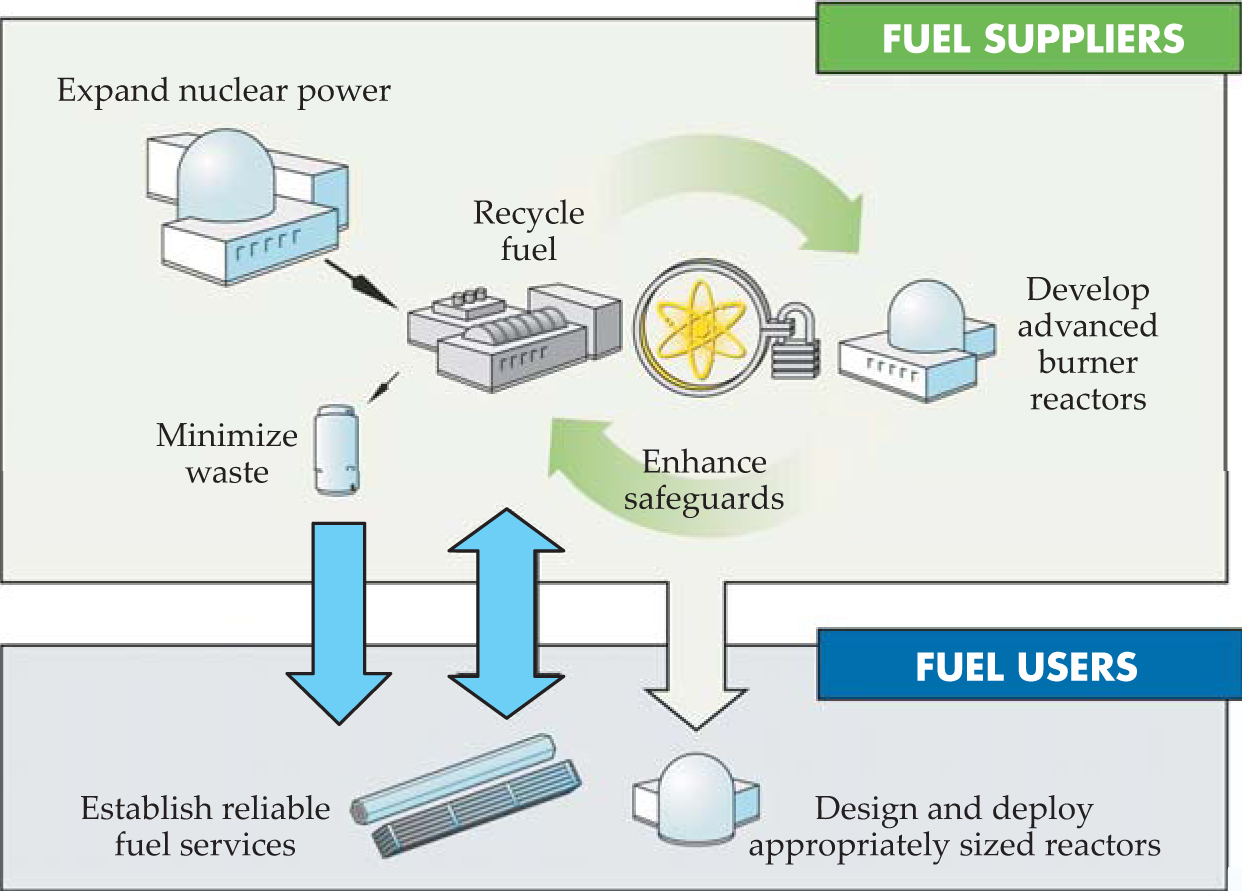
Unveiled in 2006 by President Bush, the GNEP envisions the US and other nuclear powers supplying aspiring nuclear nations with both advanced reactors and the nuclear fuel for them. For their part, recipient nations would agree to return their spent fuel to its nation of origin and pledge not to develop uranium-enrichment or spent-fuel reprocessing capabilities of their own. The US and other fuel-supplying nations would reprocess the spent fuel and recycle its plutonium into fresh fuel.
The GNEP blueprint includes R&D and construction of a reprocessing and fuel-fabrication facility and a fast neutron “burner” reactor that would transmute the long-lived actinides from spent fuel as it generates electricity. Together, the two technologies could so reduce the amount of waste needing storage that the Yucca Mountain dump in Nevada will suffice for the rest of the century. But achieving that goal would require deploying 40 to 75 advanced fast reactors.
DOE’s implementation strategy for the GNEP calls for the formation of a government—industry partnership by the end of this year to proceed with detailed design and planning to build the two technologies at a commercial scale. According to the plan, construction would proceed as soon as final designs can be validated. But it is unlikely that the agency’s schedule will be met; last year Congress slashed DOE’s $405 million GNEP request to $179 million and expressly prohibited construction, technology demonstration, or commercialization activities, saying the technologies were not ready for deployment. The agency has requested $301.5 million for the Advanced Fuel Cycle Initiative, the GNEP’s technology component, for fiscal year 2009, but lawmakers are widely expected to put off action on appropriations bills until after the November elections.
Immature technologies
Two groups of outside reviewers also have urged DOE to apply the brakes to the GNEP. The Government Accountability Office warned in a May report that moving to construction too rapidly will “likely require using unproven evolutions of existing technologies” and ultimately limit their usefulness for nuclear waste reduction and proliferation prevention. A National Research Council review completed late in 2007 reached the similar conclusion that the GNEP technologies are immature. The NRC committee recommended that DOE continue with R&D, but said the agency could do more to revitalize nuclear power in the near term by focusing on assisting domestic utilities with the licensing and construction of advanced light-water reactors. Thomas Cochran, senior scientist with the Natural Resources Defense Council and a GNEP opponent, advised the nuclear industry to place highest priority on enacting a cap on US carbon emissions. A charge of $40–$60 per metric ton of carbon dioxide emissions likely will be needed for nuclear energy to compete with fossil-fuel generation, he told the House Committee on Science and Technology in April. Cochran said the GNEP “would be a disaster for international security and a multinational economic boondoggle of staggering proportions.”
Robert Fri, chair of the NRC review panel, told a House hearing in April that the GNEP’s accelerated deployment strategy “will create significant technical and financial risks by prematurely narrowing technical options.” Although DOE argues that building the facilities sooner rather than later will save time and money, “just the opposite is likely to be true,” Fri warned.
Defending the GNEP, Idaho National Laboratory director John Grossen-bacher told the same hearing that “waiting until someone determines the economics are right to begin investing in alternate and advanced technologies tends to produce the kind of crises the world faces today, with oil prices well over $100 a barrel.”
Officials at DOE are continuing to assess the feasibility and projected costs of building the GNEP facilities. In March four industry consortia received follow-on awards from the department totaling $18.3 million to study the fuel-recycling and fabrication plant and the burner reactor. Preliminary designs and cost and schedule estimates that those consortia prepared under earlier contracts were released this spring. By one estimate, the cost of the fuel-recycling and fabrication facility alone would be $16.6 billion, and it could be operating as early as 2023. An initial burner reactor could be built by 2025, although one study suggests it’s likely to be mid-century before commercial versions are in operation.
Reprocessing revival?
No feature of the GNEP is more controversial than reprocessing, a technology that the US forswore for civilian use in the late 1970s out of concern that reprocessed plutonium could be stolen or diverted for weapons purposes. Princeton University professor Frank von Hippel, a longtime opponent of a closed nuclear fuel cycle, told a May roundtable discussion at the Carnegie Endowment for International Peace that nearly all nations that have acquired reprocessing capabilities—Pakistan, Brazil, and India among them—started nuclear weapons programs. South Korea, a GNEP member, recently declared its intention to develop a reprocessing capability. The GNEP does not require its members to renounce reprocessing, acknowledged Carter Savage, DOE associate deputy assistant secretary for nuclear energy. On the other hand, he added, GNEP members have no obligation to provide their reprocessing technology or know-how to the South Koreans.
Environmental and antinuclear activists are skeptical of public pledges by DOE to not deploy a reprocessing technology that yields weapons-usable plutonium, as does the plutonium—uranium extraction process that is used by France and the UK. But it isn’t clear what chemical separation process will be used, and the experts don’t agree on the extent to which various alternatives will serve as a barrier to proliferation.
Critics of the GNEP also argue that reprocessing can’t be justified economically. A dozen European nations have stopped buying reprocessing services from France, the UK, and Russia, von Hippel said, because they found that storing their spent fuel after a single pass through the reactors is less costly. But Alan Hanson, executive vice president of Areva, the French nuclear conglomerate that operates La Hague reprocessing complex, countered that the economics will vary with the price of uranium, which has fluctuated between $31 and $138 per pound in recent years. Reprocessing adds about 6% to electricity rates in France, which has the lowest rates in Europe, he said. “We know exactly what it costs to reprocess, but nobody has even the slightest idea what it will cost to store spent fuel,” Hanson told the May roundtable.
Indeed, storage costs can’t be estimated as long as the already decades-long delay with building the Yucca Mountain site drags on. But even if the repository is completed—not before 2020, according to DOE—it will have only enough room for spent fuel that is generated through the year 2010 (see Physics Today, June 2008, page 28 ). Without reprocessing, DOE warns, a second repository will need to be built to accommodate the growing quantities of spent fuel that will result from a revitalized US nuclear industry, let alone material that will be shipped back to the US under the GNEP.

The Global Nuclear Energy Partnership plan by the Bush administration would promote more widespread use of nuclear power abroad by having the world’s major nuclear powers supply reactors and fuel to developing nations. Those nations would return their spent fuel to the country of origin for recycling into new fuel.
DOE

More about the authors
David Kramer, dkramer@aip.org