DOE steps up US efforts on HEU-free medical isotopes
DOI: 10.1063/PT.3.1360
An agreement by the US Department of Energy’s National Nuclear Security Administration (NNSA) to fund $2.3 million in development work at NorthStar Medical Radioisotopes could lead to creation of a domestic supply for molybdenum-99, the most widely used medical radioisotope. The cost-shared cooperative agreement will help the Madison, Wisconsin, company with development of its accelerator-based process for manufacturing the isotope by bombarding targets of the naturally occurring isotope 100Mo with gamma rays.
During an April 2010 summit in Washington, DC, President Obama and 47 other heads of state pledged to secure all the world’s highly enriched uranium (HEU) by 2014 to eliminate the proliferation threat that the material poses (see PHYSICS TODAY,July 2010, page 24 ). But the US is without a domestic source of 99Mo, an isotope with a 66-hour half-life whose decay product, metastable technetium-99 (99mTc), is used in 8 out of 10 nuclear medicine procedures—about 16 million imaging procedures annually in the US. For decades, roughly half the world’s output of 99Mo has been provided, and most of the US demand has been met, by the Canadian company Nordion, which processes HEU targets irradiated at the aging National Research Universal (NRU) reactor in Chalk River, Ontario. The HEU for the NRU is supplied by the NNSA. (See PHYSICS TODAY,February 2011, page 17 .)
In recent years the NRU has been forced to shut down for extended periods, which produced severe shortages of 99Mo. In October NRU operator Atomic Energy of Canada reaffirmed previous commitments to halt medical isotope production in 2016.
In addition to its cooperative agreement with NorthStar, the NNSA is funding different novel approaches to 99Mo production at three other US companies: GE Hitachi Nuclear Energy has received $2.25 million to develop neutron capture technology; Babcock and Wilcox Technical Services Group has been provided $9.1 million to develop a low-enriched uranium (LEU) technology in which the fuel and target material are both dissolved in a solution that also provides the moderator; and the Morgridge Institute for Research has received $500 000 to develop accelerator technology to fission LEU. Each company is at least matching the government funding.
Separately, GE Hitachi and Exelon announced on 12 September a feasibility study of producing 99Mo at Exelon’s Clinton nuclear power station in Illinois. The two companies will develop a system to extract irradiated material from the reactor on a weekly basis. GE Hitachi also announced the signing of a memorandum of understanding with NorthStar and with NuView Life Sciences in Denton, Texas, for the two companies to process and purify 99Mo from the Exelon reactor targets.
Today, reactors in Belgium, the Netherlands, South Africa, and Australia also produce 99Mo. The Global Threat Reduction Initiative, part of the NNSA, has provided $25 million to help the South African Nuclear Energy Corp (Necsa) begin converting to all-LEU production, and an NNSA official said that the US remains willing to support the conversion efforts of Canadian and European suppliers.
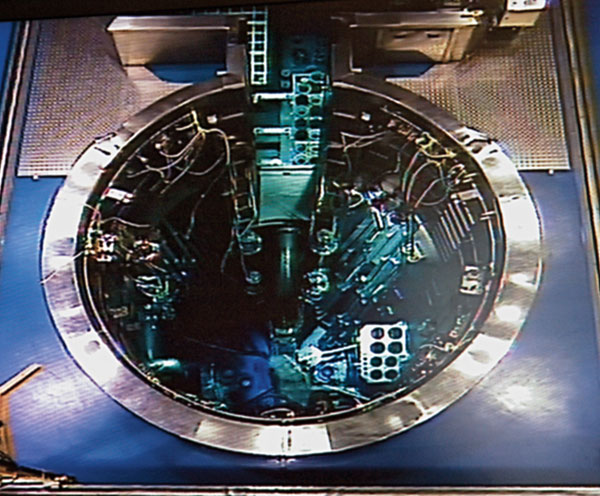
In June the NNSA reported that 99Mo produced exclusively with LEU fuel and targets was then supplying about one-third of the US demand for it. Necsa, the Australian Nuclear Science and Technology Organization, and Lantheus Medical Imaging, a US distributor of 99Mo, were delivering record amounts of the LEU-based isotope, the NNSA said. The Australian organization’s Opal reactor, which began operations in 2007, is the world’s only current 99Mo source that was designed for all-LEU operation.

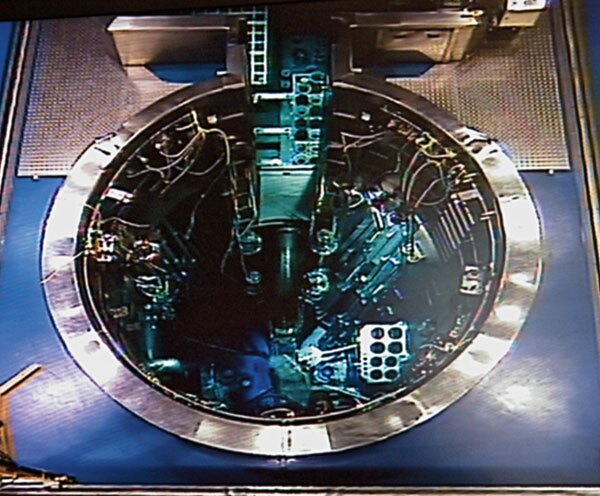
The core of the Opal research reactor is seen on a video display in this photo. Operated by the Australia Nuclear Science and Technology Organization, Opal is the world’s first molybdenum-99 production reactor built specifically to use only low-enriched uranium fuel and targets.
S. Benka, AIP
More about the authors
David Kramer, dkramer@aip.org