Discoverers of the Hubble expansion’s acceleration share Nobel physics prize
DOI: 10.1063/PT.3.1348
The Royal Swedish Academy of Sciences has awarded the 2011 Nobel Prize in Physics to Saul Perlmutter, Adam Riess, and Brian Schmidt “for the discovery of the accelerating expansion of the universe through observations of distant supernovae.” Half the prize goes to Perlmutter (University of California, Berkeley), who organized the pioneering Supernova Cosmology Project in 1988. The other half is shared by Schmidt (Australian National University), who led the High-Z Supernova Search Team organized in 1994, and Riess (Johns Hopkins University), lead author of the team’s discovery paper.
Early in 1998 both teams reported independently that their observations of the redshifts z and apparent brightnesses of distant type Ia supernovae led to the completely unanticipated conclusion that the Hubble expansion of the cosmos was speeding up (see PHYSICS TODAY, June 1998, page 17 ). Surely, one would have thought, gravity must be slowing the cosmic expansion down. Researchers are rightly cautious about making claims that are at once so surprising and so momentous—if true. But in this case, notes the Swedish academy, the two rival teams “found reassurance in the fact that both . . . had reached the same astonishing conclusion.”
It was known for several decades that spectroscopic type Ia supernovae are not only remarkably luminous but also remarkably uniform in their peak luminosities. That uniformity, attributed to the presumption that they all manifest the thermonuclear disintegration of white dwarf stars with masses close to 1.4 solar masses—the Chandrasekhar limit for white-dwarf stability—made them potentially useful standard candles for the study of the cosmic expansion and its presumed deceleration.
General relativity, as customarily applied to the Hubble expansion before the 1998 surprise, predicts that the expansion’s deceleration in the present epoch is simply proportional to ρM, the falling mean density of visible plus dark matter in the expanding cosmos. (Possible complications due to the “cosmological constant” Λ that Albert Einstein tentatively appended to the theory in 1917 to avoid the collapse of a steady-state cosmos had long since been dismissed.) And with the introduction and broad acceptance of inflationary Big Bang cosmology in the 1980s, it was thought that inflation’s exponential expansion before the cosmos was a picosecond old had stretched any large-scale cosmic curvature into Euclidian flatness.
Perlmutter and his Berkeley colleague Carl Pennypacker began the Supernova Cosmology Project (SCP) largely to resolve an apparent contradiction between those beliefs and what observers were finding. If the cosmic geometry is indeed flat and the slowing of its expansion is proportional to ρM, then ρM must have the precise time-dependent critical value ρc, whose present value is (1.0 ± 0.1) × 10–29 g/cm3. But surveys of galaxy clusters, including estimates of dark matter within them, were finding only about 20% of ρc. (In the absence of a cosmological constant, ρc marks the moving boundary between eternal expansion and ultimate collapse.)
So to test the inflation scenario, Perlmutter and company were hoping to determine ρM on a much larger scale than the galaxy surveys were covering, by measuring the deceleration of the Hubble expansion with high-z, type Ia supernovae. Perlmutter had finished his PhD at Berkeley in 1986 under Richard Muller, a jack-of-all-trades in the tradition of his own mentor, Luis Alvarez. Under the guidance of Muller and Alvarez, Perlmutter had developed robotic-telescope techniques for finding, among other things, low-z type Ia’s.
Tracing the cosmic expansion
One measures the present and past expansion rates of the cosmos by plotting the distances of cosmologically remote objects against their redshifts. To the extent that the objects are standard candles, apparent brightness measures distance. Up to z of about 0.1, however, such “Hubble plots” simply show that recessional velocity, given in the nonrelativistic limit by zc, is proportional to distance. They yield the present expansion rate, but not its time dependence over billions of years.
To measure the expected deceleration and thus determine ρM, the SCP team set out to harvest type Ia’s with z as high as 0.5 or even 1. The light from a z = 0.5 supernova would have left its source about 5 billion years ago, and its redshift would be a direct measure of the total stretching since then of the cosmos and of the wavelengths of light propagating through it. An observed z means that the linear scale of the cosmos has stretched by a factor 1 + z since the light was emitted. Measuring the distances of an adequate sample of type Ia’s out to z = 0.8 would yield a history of cosmic expansion halfway back to the Big Bang.
But type Ia supernovae are frustratingly rare and fleeting. A typical galaxy hosts just a few per millennium, and their vaunted brilliance fades after just a few weeks. So the SCP team put together a strategy for finding them promptly at high z with a 4-meter survey telescope at the Cerro Tololo Inter-American Observatory in Chile. The discovery rate had to be high enough to let the team prebook scarce follow-up time at bigger telescopes that could record peak brightness with enough precision to measure distance. (See the article by Perlmutter in PHYSICS TODAY, April 2003, page 53 .)
Using the survey telescope’s wide-field CCD camera, Perlmutter and company recorded many patches of dark Andean sky just after a new moon, and then again just before the next new moon. Digital subtraction of the previous images typically revealed a dozen fresh supernovae still waxing to peak brightness. These were then promptly followed up on bigger telescopes to spectroscopically verify type and determine z, and to record light curves—the waxing and waning of apparent brightness.
But if one wanted a useful cosmological measurement, finding the high-z type Ia’s and measuring them promptly was only the beginning. For one thing, type Ia’s are only approximate standard candles. The peak luminosities of outliers range over a factor of three. But Cerro Tololo’s Mark Phillips and coworkers, having studied a large number of low-z type Ia’s, showed in 1993 that each one could be calibrated from the time scale of its light curve; the longer-lasting ones are intrinsically brightest. The Ia’s were now “standardizeable candles.”
The rivals
In 1994 Schmidt was a postdoc at Harvard University, looking for a worthwhile project. The previous year, he had finished his PhD there under astronomer Robert Kirshner, using low-z type II supernovae to measure the current rate of cosmic expansion. Type IIs, manifesting the collapse of heavy stars over a great range of masses, are not even approximate standard candles. But one can estimate a type II’s luminosity by measuring the speed of its gaseous ejecta.
Having concluded, however, that type IIs are too difficult for doing high-z cosmology, Schmidt turned his attention to the Ia’s. He approached Cerro Tololo’s Nick Suntzeff. “You guys in Chile have figured out how to get reliable type Ia luminosities,” he recalls saying, “and Saul has figured out how to find them at high z. So why don’t we team up and take him on?” That was the start of the High-Z team. Riess, still a Kirshner graduate student working on a large sample of low-z Ia’s, became a founding member.
During its first year, the team was led jointly by Schmidt and Suntzeff. At the end of the year, Schmidt, a Montana native, emigrated to the homeland of his Australian wife. For the rest of the decade, he led the wordwide High-Z team from the Australian National University’s Mount Stromlo Observatory near Canberra.
Accelerating expansion
In the fall of 1997, Perlmutter and SCP member Gerson Goldhaber—a veteran Berkeley particle physicist who had caught the contagion of adult-onset cosmology—began reporting at small colloquia and workshops that their ongoing analysis of 42 high-z type Ia’s appeared to require a nonzero cosmological constant—if the geometry of the cosmos is flat.
The Λ term Einstein had introduced and then rejected when he learned of the Hubble expansion implies a time-independent vacuum energy density ρΛ with a repulsive negative pressure PΛ = –ρΛ that works against gravity on cosmological scales. If there is a nonzero ρΛ, the cosmic deceleration is proportional to
ρM + ρΛ + 3PΛ = ρM – 2ρΛ
instead of simply to ρM. So once the constant ρΛ exceeds one-half the falling ρM, the cosmos enters a state of perpetually accelerating expansion.
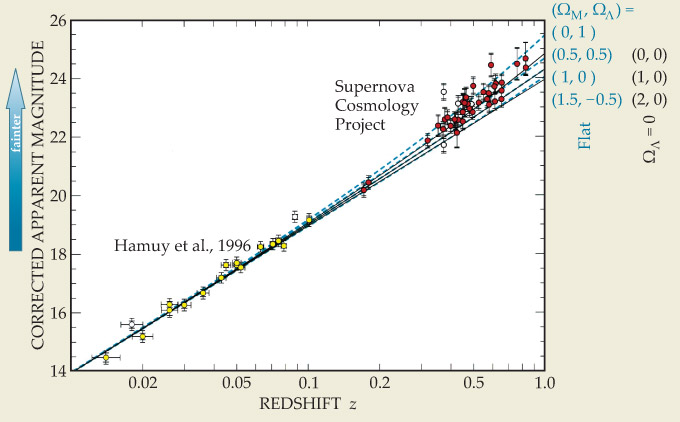
In January 1998 Perlmutter revealed to a broader audience the team’s conclusion that the cosmic expansion was indeed accelerating by showing figure 1 at the American Astronomical Society’s winter meeting in Washington, DC. “Our own data,” recalls Riess, “had been driving us to the same hard-to-believe conclusion.”

Figure 1. Hubble plot of distance against redshift z for 42 high-z type Ia supernovae (red) observed by the Supernova Cosmology Project and 18 low-z Ia’s (yellow) observed by Mario Hamuy and coworkers in Chile. Distance is measured by apparent magnitude—an inverse logarithmic measure of brightness—corrected for the fact that the supernovae are imperfect standard candles. Blue and black curves show expectations for various assumptions about the cosmic mean densities of matter and vacuum energy, labeled respectively by the normalized parameters ΩM and ΩΛ. Flat cosmic geometry requires that ΩM + ΩΛ = 1. (Adapted from ref.
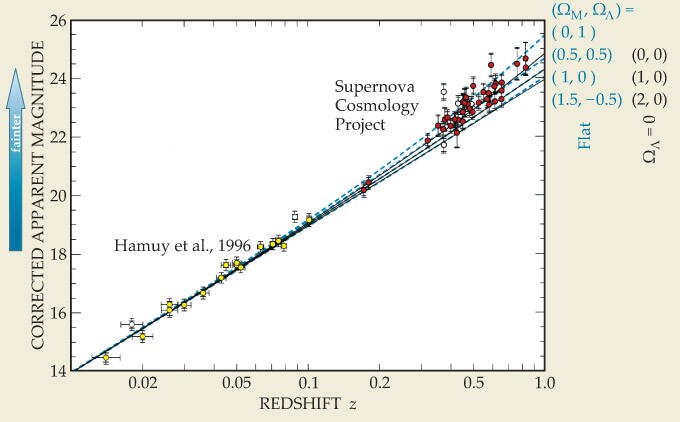
Perlmutter’s Hubble plot shows not only the SCP’s 42 high-z events but also 18 low-z type Ia’s from Mario Hamuy and coworkers at Cerro Tololo. The low-z events pin down the current expansion rate to provide a secure reference for what had been happening over the past 8 billion years.
The plot shows cosmological fits for various assumptions about the mean mass density and the putative vacuum energy, labeled respectively by the normalized parameters ΩM ≡ ρM/ρc and ΩΛ ≡ ρΛ/ρc. With a nonzero ΩΛ, the flat-geometry constraint becomes ΩM + ΩΛ = 1. In that case, an ΩM much less than 1 immediately implies a significant ΩΛ.
But even without that constraint, Perlmutter reported, the data disfavored a vanishing ΩΛ. He did, however, cautiously quote a conservative systematic uncertainty with regard to dimming by dust in the host galaxies. After all, the essential evidence for cosmic acceleration was the anomalous faintness of the high-z supernovae, which might be an artifact of intervening dust.
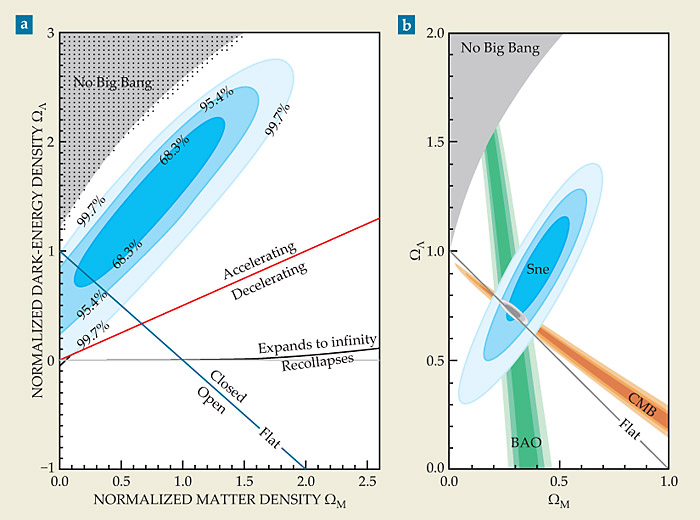
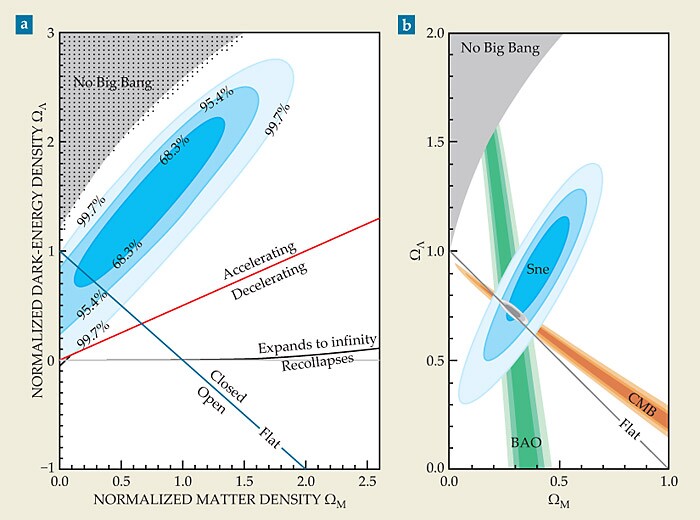
In the completed analysis of the 42 events, submitted for publication eight months later, the SCP team concluded that a zero or negative ΩΛ was indeed excluded “with a confidence of 99%.”1 The High-Z team had, however, made an even more confident claim earlier—just six weeks after the Washington meeting. With only 16 high-z events in hand, team member Alex Filippenko (Berkeley) reported at a dark-matter symposium in Los Angeles that those few high-z events, plus 34 events at low z, sufficed to require a positive ΩΛ with 99.7% confidence. Figure 2a shows the High-Z team’s confidence contours in the ΩMΩΛ plane, as submitted for publication a few weeks later. 2

Figure 2. Confidence contours in the ΩMΩΛ plane, then and now. (a) The High-Z Supernova Search Team’s plot of likelihood contours in its 1998 discovery paper2 excludes a zero or negative ΩΛ with 99.7% confidence, even without having to invoke the flat-geometry constraint. A positive ΩΛ means a vacuum energy whose pressure works against gravity on large scales. (b) The same plane with recent determinations of confidence contours from world results for three complementary observational regimes: high-z type Ia supernovae (Sne), the cosmic microwave background (CMB), and evidence of baryon acoustic oscillation (BAO) in the distribution of distant galaxies. The three nests of contours converge on a small region where vacuum energy dominates over matter and the cosmos is flat. (Adapted from K. Nakamura et al., Particle Data Group, J. Phys. G 37, 075021, 2010.)
In the end, both teams arrived at the same result. And, incidentally, both concluded that dimming by dust turned out to be negligible. The High-Z team attributed its greater early confidence with fewer high-z events largely to a scheme developed by Riess and the Chilean group for determining each event’s dust dimming from photometric measurements through several different color filters. Furthermore, the team had twice as many low-z events as the competition, and its 16 high-z events exhibited very little scatter on the team’s Hubble plot; four of them had been particularly well measured by Hubble Space Telescope follow-ups.
The dark-energy problem
Much has happened since 1998 to confirm and refine the new cosmic vista unveiled by the two teams. A recent plot of confidence contours in the ΩMΩΛ plane (figure 2b) shows how complementary data from the cosmic microwave background and galaxy surveys have converged with the shrinking supernova contours onto a small overlap region that does indeed seem to satisfy the inflationary requirement of a flat cosmos. (See the article by Daniel Eisenstein and Charles Bennett in PHYSICS TODAY, April 2008, page 44 .)
That convergence, near ΩΛ = 3/4, ΩM = 1/4, tells us that in the present epoch, Einstein’s constant vacuum energy density—or some subtly variable dark energy that mimics it—accounts for about three times as much of the cosmic mass–energy budget as does all the matter, visible and invisible.
The dark-energy problem has come front and center. Even if the dark energy is simply manifesting the cosmological constant, the small yet nonzero value of ρΛ is profoundly puzzling. Quantum-fluctuation arguments expect it to be a hundred orders of magnitude bigger—or precisely zero in obedience to some overarching principle that would dictate perfect cancellation of all the fluctuation contributions. And then there’s the uncomfortable coincidence that we just now happen to be in the epoch when ρΛ and ρM are comparable. Ten billion years ago, ρM was dominant in a much more crowded cosmos, and ten billion years from now it will have dwindled to insignificance.
”Still, if you shave with Occam’s razor,” says Riess, “you must, for the moment, stick with the cosmological constant.” Searches for departures from the general-relativistic equation of state, PΛ/ρΛ = −1, have found none, nor is there any evidence yet of a spatial or temporal variation of the repulsive pressure that might indicate some sort of dynamical dark energy (see PHYSICS TODAY, June 2004, page 19 ).
The continuing quest for the true character of the dark energy will require space-based detectors that not only can search for very distant supernovae but can also survey the distribution and dark-matter lensing of very distant galaxies. “There’s an overwhelming desire in the community to launch such a mission,” says Perlmutter. “Since 1998 we’ve learned a tremendous amount about how to make more detailed measurements.” In that spirit, the National Research Council’s 2010 Astronomy and Astrophysics Decadal Survey gave highest priority to WFIRST (Wide-Field Infrared Survey Telescope), a proposed multimode dark-energy satellite.
NASA had hoped to launch WFIRST in 2018, but cost overruns for the James Webb Space Telescope have pushed WFIRST back at least to 2022. In the meantime, the European Space Agency’s Euclid mission, with only limited supernova capabilities, is scheduled for launch in 2019.

Riess, Perlmutter, and Schmidt (l to r) in Hong Kong at the ceremony awarding them the 2006 Shaw Prize.
SHAW PRIZE FOUNDATION

References
1. S. Perlmutter et al., Astrophys. J. 517, 565 (1999). https://doi.org/10.1086/307221
2. A. Riess et al., Astronom. J. 116, 1009 (1998).https://doi.org/10.1086/300499