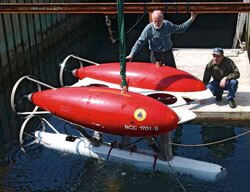
Physics Today: A pioneering deep-sea exploration robot—one of the first successful submersible vehicles that was both unmanned and untethered to surface ships— was lost at sea on a research expedition to explore the Chile Triple Junction—the only place on Earth where a mid-ocean ridge is being subducted (or pushed) beneath a continent (South America) in a deep ocean trench.
The 15-year-old Autonomous Benthic Explorer ( ABE), was launched late Thursday night by the Woods Hole Oceanographic Institution (WHOI) and had reached the seafloor to begin its 222nd research dive when, in the early hours of Friday morning, all contact with the surface vessel Melville abruptly ceased. All efforts to reestablish contact failed. “The loss had nothing to do with earthquake activity off Chile,” said the ABE team. ABE “revolutionized deep-sea exploration by expanding scientists’ abilities to reach into the deep,” said Chris German, chief scientist of WHOI’s National Deep-Submergence Facility. Although ABE had been recently replaced by Sentry, a more advanced robot, ABE was called out of retirement as Sentry had already been committed to another research expedition when the urgent call came through to investigate geological activity off the Chilean coast. Cracked glass
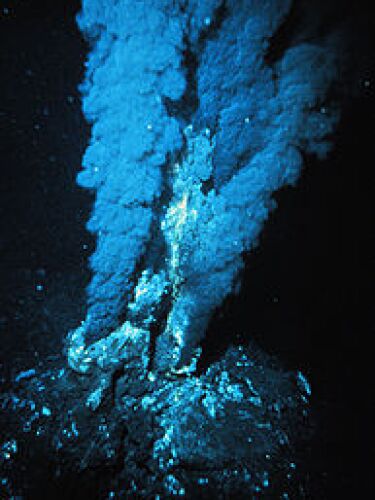
On ABE‘s first dive on the research cruise, it had detected evidence of hydrothermal vents. At the time of its loss, ABE had just begun a second dive to home into a vent site and photograph it.Researchers onboard Melville believe the craft may have suffered a catastrophic implosion of one of the glass spheres used to keep ABE buoyant. An implosion, under pressure equivalent to more than two tons per square inch at depths of 3 km, would have caused all of ABE‘s other spheres to implode, destroying onboard systems used to communicate with the surface ship and return ABE to the surface. A strong workhorseUnlike human-occupied submersibles or vehicles connected by cables to surface ships, ABE could survey wide swaths of undersea territory on dives lasting up to a day.Enhanced over the years with multibeam sonar, Doppler navigation, and an anchoring system, ABE was pre-programmed to maintain a designated course but had enough decision-making capacity to avoid collisions with seafloor terrain. ABE made detailed, high-resolution maps, “sniffed out” unusual chemicals emerging from the seafloor, and photographed biological communities and complex geological features. It often operated from ships in remote areas with no other systems available for rescue should it become trapped or disabled. While risky, this strategy paid off, enabling multidisciplinary research in previously unexplored regions, such as the South Atlantic and the Indian Ocean.Built as a prototype, ABE was the first autonomous robot to make detailed maps of mid-ocean ridges, the 64373-km undersea volcanic mountain chain at the boundaries of Earth’s tectonic plates where new sea-floor crust is created. It was also the first AUV—a new kind of deep-submergence vehicle—to locate hydrothermal vents. ABE explored seamounts, undersea volcanoes, and other areas with harsh, rugged terrain."In a way, it’s fitting that its demise comes on the job, and that it has gone to be recycled through the Chile subduction zone,” said German.Paul Guinnessy Related linkPost-Triple Junction Blues