Congressional fellows tackle a range of national issues
DOI: 10.1063/1.3273010
Sweeping US health-care and climate-change reforms, should they become law, will bear the fingerprints of physicists and engineers, thanks in part to an annual fellowship that places scientists in congressional offices or on committees. “If there’s ever been a year that you want to be a health-care staffer, it’s this one,” says biomedical engineer Robert Saunders, who was hired by Representative Rush Holt (D-NJ) in September. Saunders had spent a year on Holt’s staff as a congressional fellow sponsored by the Optical Society of America (OSA) and SPIE. Saunders, who helped develop amendments to the House’s health-care bill, says the fellowship “is one of the few ways that a bench scientist working in the lab can jump right in to working on the hill.”
Some 187 scientists—most of them PhDs—started their 12-month terms in Congress and the executive branch this summer as fellows of a program managed by the American Association for the Advancement of Science. More than 30 scientific organizations partner with AAAS to sponsor the fellows; the American Institute of Physics (AIP), which also sends a fellow to the State Department (see accompanying story), and some of its member societies are sponsoring seven congressional fellows this year, up two from 2008.
The public option
This year AIP and the Acoustical Society of America cosponsored PhD physicist Jeffrey Fox, who will focus on education policy in the office of Senator Jeff Bingaman (D-NM). Fox says he’s learned that in Congress, “it’s about knowing how to evaluate what the problem is and who to talk to.” Although fellows traditionally gravitate toward science policy, “the health-care debate dominates backroom office discussions” right now, says PhD astrophysicist Marcos Huerta, this year’s AIP/AVS congressional fellow, who is working on environmental issues for Rep. Raúl Grijalva (D-AZ). Huerta, who was a volunteer for Barack Obama’s presidential campaign, says he’d like to stay on the policy track and may eventually consider running for public office.
“The change in administration has made it an exciting time to be in Washington,” says this year’s OSA/SPIE fellow, Matthew McMahon, who is on leave from Second Sight Medical Products Inc, a California company that develops visual prostheses for the blind. A PhD experimental psychologist, McMahon is working on space and climate-change issues as a staff member for the Senate Committee on Commerce, Science, and Transportation. Also working on climate-change legislation is midcareer PhD industrial geologist Maeve Boland, a native of Ireland and this year’s American Geophysical Union (AGU) fellow. The Clean Energy Jobs and American Power Act, the flagship US climate-change bill, was introduced on her first day as a staff member for Sen. Byron Dorgan (D-ND), a member of the Senate Committee on Energy and Natural Resources. Boland says she intends to return to her research faculty position at the Colorado School of Mines, where she teaches a seminar on US public policy.
“Everyone’s preparing for the climate bill to take center stage,” says Virginia Corless, a PhD astrophysicist and one of this year’s American Physical Society congressional fellows. Corless, a staffer on the Senate’s energy committee, says she didn’t come to Congress just to work on energy; she cites education and international science policy among her other committee responsibilities. International policy fits squarely in the portfolio of the other APS fellow, PhD astrophysicist Arti Garg; she joined the staff of the House Foreign Affairs subcommittee on terrorism, nonproliferation, and trade. “I’m interested in all three words,” says Garg, who worked as a postdoc at Lawrence Livermore National Laboratory before the fellowship. Unlike academia, she says that Congress is often reactive, so “priorities can change quickly depending on current news.”
“How the sausage gets made”
Some new fellows don’t have to wait long to witness the excitement of seeing a bill on its way to becoming law. PhD physicist Gavi Begtrup, this year’s OSA/Materials Research Society (MRS) congressional fellow, joined the staff of Rep. Gabrielle Giffords (D-AZ) just in time to see the Solar Technology Roadmap Act, sponsored by his new boss, pass in the House. That legislation directs the Department of Energy to appoint a committee to create a 15-year solar technology roadmap and to provide $2.25 billion in solar energy R&D over five years to DOE-managed, industry-led consortia. Begtrup gives credit for the bill’s passing to professional staff members such as 2003 APS fellow Adam Rosenberg. Elaine Ulrich, last year’s APS fellow, also worked on the bill; she says the process of crafting it was just as satisfying as seeing it passed. “When you get involved and you have a stake in the bill, you’ll find yourself rooting for it when it comes up for a vote,” says Ulrich, who now works for New West Technologies LLC, where she does policy analysis on energy issues for DOE’s Office of Energy Efficiency and Renewable Energy.
Although most fellows leave in August, two of last year’s fellows stretched their stays on the hill through November: AGU fellow Maggie Walser continued her work on water and energy policy for the Senate’s energy committee, and OSA/MRS fellow Amit Mistry stayed on in the office of Rep. Edward Markey (D-MA), working on health and education policies. Outgoing AIP fellow Richard Thompson returned to the University of Arizona, where he lectures in the geosciences and teaches a course on public policy. During his fellowship, he helped write environmental legislation for Grijalva; he says it was a rewarding experience to participate in policymaking and “interesting to watch how the sausage gets made.” Thompson’s advice to the new fellows is, “Throw yourself into your work, but don’t forget you are living in the most exciting place in the world.”
Congressional fellowship applications are due in early 2010. For details on sponsorship through AIP or its member societies, visit http://aip.org/gov/fellowships.html .
Congressional fellowship applications are due in early 2010. For details on sponsorship through AIP or its member societies, visit http://aip.org/gov/fellowships.html .

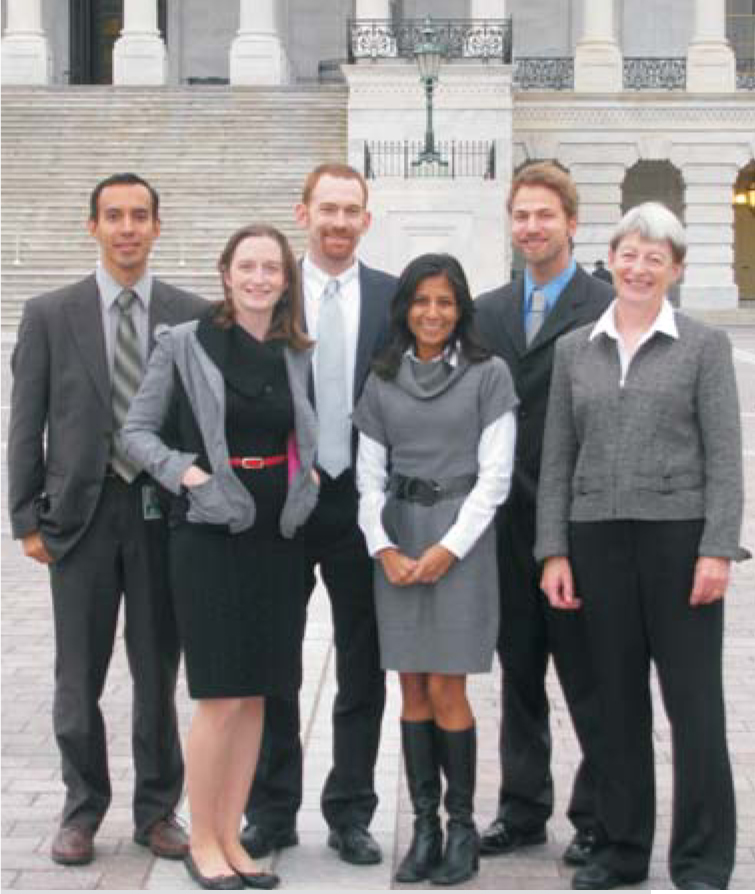
Congressional fellow sponsored by AIP-affiliated societies this year are, from left, Marcos Huerta, Virginia Corless, Jeffrey Fox, Arti Garg, Gavi Begtrup, and Maeve Boland. Not Pictured is Matthew McMahon.
JULIE DEMEESTER