Climate Talks Reach New Milestone
DOI: 10.1063/1.1457261

In early November, 170 countries finally achieved consensus on how to cut global carbon dioxide emissions produced by humankind to 5% below their 1990 levels. The plan is part of the ongoing negotiations for implementing the 1997 Kyoto Protocol to slow down global warming. Nearly 4500 delegates gathered in Marrakech, Morocco, for the seventh session of the Conference of the Parties to the UN Framework Convention on Climate Change (COP7). Negotiations on how to implement the cuts had, until this point, frequently collapsed (see Physics Today, November 2000, page 43 ). So far, only 44 countries have ratified the Kyoto Protocol. Romania is the only industrialized country to have done so.
COP7 covered the right to buy and sell carbon emissions between countries, methodologies for reporting and monitoring emissions, the transfer of energy technology, and mechanisms for enforcing compliance with targets set under the Kyoto Protocol. One stumbling block overcome at the meeting involved natural carbon sinks such as forests. After an 18-hour negotiating session, Russia demanded—and got—a doubling (to 33 million tons) of the amount of carbon it could claim for Russia’s forestry sinks. “All the decisions on sinks were, by necessity, a blend of science and politics,” says Elliot Diringer, director of international strategies at the Pew Center on Global Climate Change in Arlington, Virginia. “The science simply is not clear enough to provide the firm guidance policy-makers would like.”
For the Kyoto Protocol to become international law, countries representing 55% of global carbon dioxide emissions in 1990 must ratify the treaty. The US, the world’s largest emitter, currently refuses to do so. “The emissions targets are not scientifically based or environmentally effective. … The protocol is not sound policy,” Paula Dobriansky, under secretary for global affairs at the US State Department, told delegates in the closing session. But, even without the US, the treaty could still become law if the European Union, Russia, and Japan ratify it. These three hope to bring the protocol into force by September 2002, when the World Summit on Sustainable Development meets in Johannesburg, South Africa.

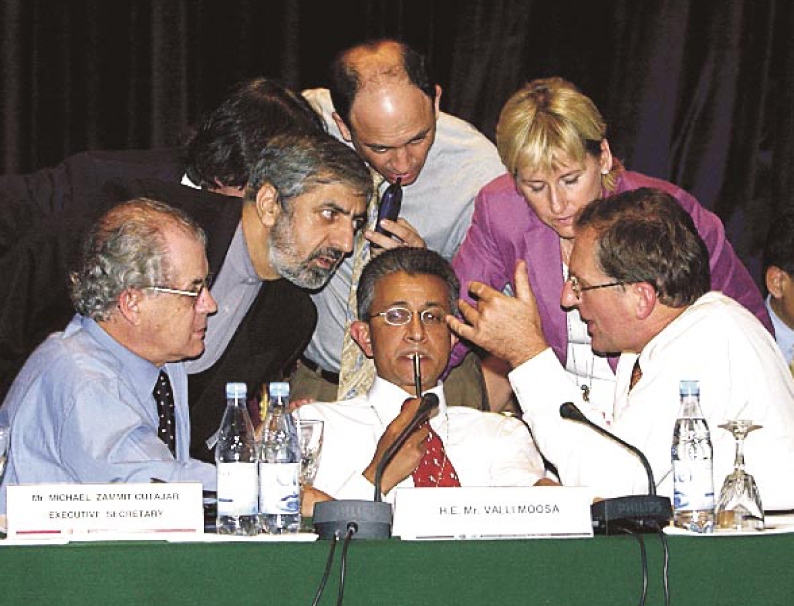
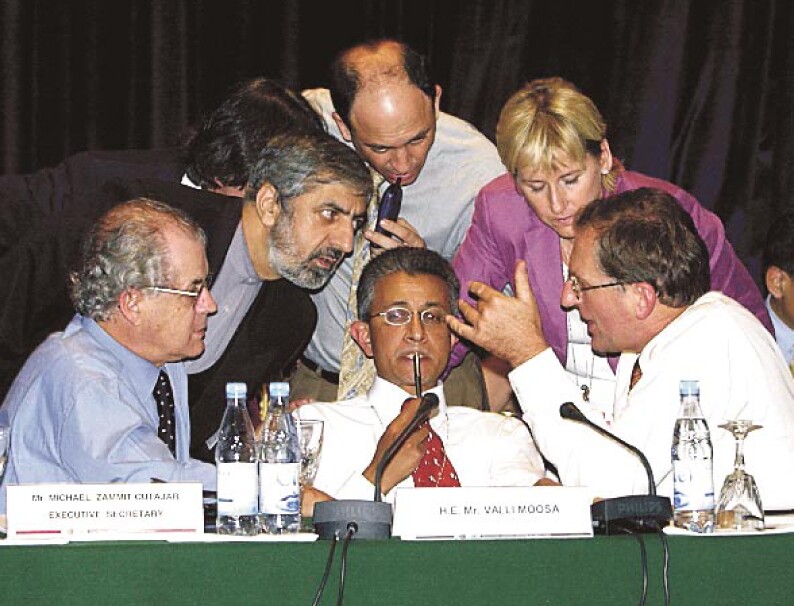
Intense negotiations at COP7: Michael Zammit Cutajar (left) saw success at his final meeting as executive secretary of the United Nations Framework Convention on Climate Change.
IISD/ENB–LEILA MEAD
More about the authors
Paul Guinnessy, American Center for Physics, One Physics Ellipse, College Park, Maryland 20740-3842, US . pguinnes@aip.org