Circularly polarized light from a gamma-ray burst
DOI: 10.1063/PT.3.2438
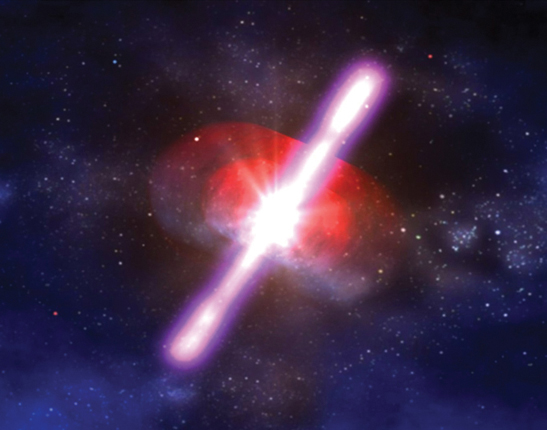
Gamma-ray bursts (GRBs) are the most violent explosions in the universe. Most of them are likely powered by jets of relativistic particles that are launched from dying stars as they collapse into a compact object such as a black hole. They are named for their initial blast of high-energy radiation, but GRBs can glow for days, emitting radiation across the electromagnetic spectrum. Studies of the linear polarization of GRB light provide information about the magnetic field in the jet and help clarify jet geometry. Now, a collaboration led by Klaas Wiersema of the University of Leicester in the UK reports having observed circularly polarized optical light in the radiation of a GRB detected on 24 October 2012. The strength of the signal, measured a few hours subsequent to the initial burst, in the afterglow phase, was orders of magnitude above what simple models predict. Scattering from dust can convert linearly polarized light into the circularly polarized variety, and the Wiersema team considered that possibility as a source for their signal. They concluded, however, that the scattering processes capable of generating the circularly polarized light they measured would also affect linearly polarized light in a manner inconsistent with their data. Models of GRBs generally assume that the electrons in the shocked ambient material responsible for the afterglow have velocities that are isotropic with respect to local magnetic field lines. Theorists recognize that one way to get circularly polarized light in a GRB is to relax that assumption. But they have yet to craft a convincing model that incorporates anisotropy. (K. Wiersema et al., Nature 509, 201, 2014, doi:10.1038/nature13237 .)

NASA