Bush Gives Bement NSF Nod
DOI: 10.1063/1.2408612
Arden Bement, a metallurgical engineer who has been doing double duty as head of NIST and acting director of NSF, has been nominated by President Bush to become NSF’s director. Bement, 72, is widely respected in Washington and is expected to easily win confirmation by the Senate early next year.
“The foundation has a rich history of strong and independent directors, and I look forward to continuing with that tradition,” Bement said in a memo to the NSF staff following his 15 September nomination. “Although NSF faces significant challenges in the near future due to federal budget issues, I am committed to the policies and operations that have stood the test of time and have helped make NSF an extraordinary agency.”
Bement stepped in as acting director after NSF director Rita Colwell left in February, several months before her term was to expire (see Physics Today, June 2004, page 28 ). The search for Colwell’s replacement was made unusually difficult because of the uncertainty caused by the presidential election. Just three days before the legal deadline for nominating a new director, the White House offered the permanent position to Bement. Once he is confirmed, a new director for NIST will have to be found.
Representative Vern Ehlers (R-MI), one of two physicists in Congress, said Bement was an “excellent choice” to head NSF, but added that his “departure from NIST is a great loss for the institute.” Before coming to NIST in 2001, Bement was the head of the school of nuclear engineering at Purdue University, and prior to that worked at TRW Inc, the Defense Advanced Research Projects Agency, Battelle Northwest Laboratories, and General Electric. He was also a professor of nuclear materials at MIT.

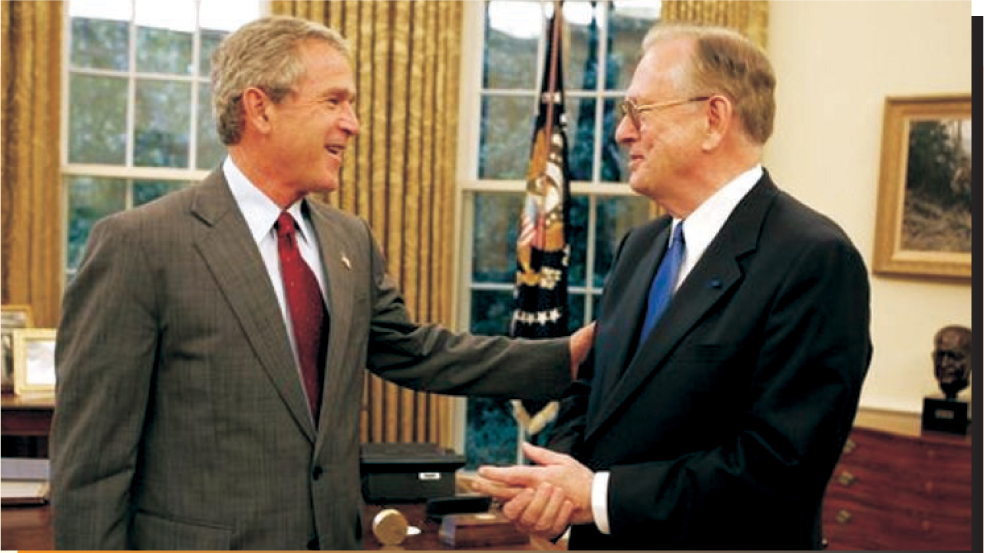
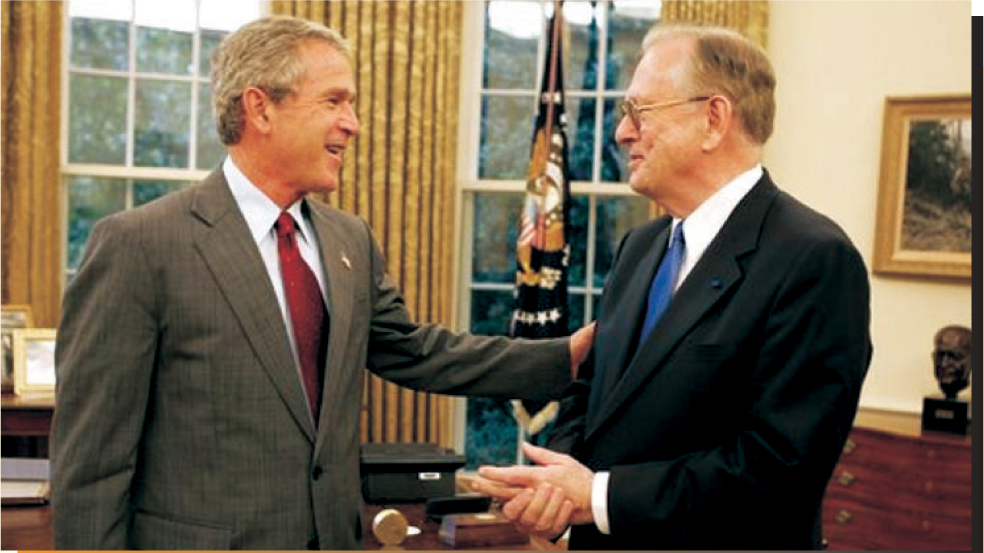
President Bush congratulates Arden Bement.
WHITE HOUSE PHOTO