Legend has it that J. C. Jacobsen, founder of Carlsberg Breweries and their innovation and research arm, the Carlsberg Laboratory, experimented with fermented yeast while visiting Germany and was eager to further explore its properties and potential at his brewery back in Copenhagen. But he needed a way to bring a yeast sample back with him. So he transported the yeast in his hat box, stopping whenever he could at wells to apply water in order to keep the yeast cool and thriving. An idea just off the top of his head, as you might say.
Although this legend is told (with a wink) at the brewery, there is nothing apocryphal about the influence that the Carlsberg Laboratory has had on science generally, and on fermentation and malting processes specifically. Its scientists have consistently contributed to multiple fields, including chemistry, biochemistry, physiology, genetics, plant sciences, and molecular biology, with research centering on barley, yeast, ingredients, and brewing technology. This broad and deep approach to research helps Carlsberg beer remain fresh, tasty, and safe to consume longer, and be delivered to its customers efficiently and sustainably. But in the course of endeavoring to make the beer with the distinctive green bottle more delicious, Carlsberg has also brought its research facilities into the realm of other world-class corporate labs.
This is innovation by design. “Jacobson specifically wanted a laboratory that expanded science for the benefit of society,” says Birger Lindberg Møller, current director of the Laboratory. Its charter declares that “the principal task of The Carlsberg Laboratory shall be to develop as complete a scientific basis as possible for malting, brewing and fermenting operations.” And on the wall of the building’s central grand staircase, the following mantra is inscribed in gold leaf: “No result of the Laboratory’s activities which is of theoretical or practical importance shall be kept secret.” Indeed, Carlsberg scientists are encouraged to publish, file patents, and seek collaborations with experts outside the company. Some of the researchers have joint appointments in academia—like Lindberg Møller, who is also a professor in the department of plant and environmental sciences at the University of Copenhagen.
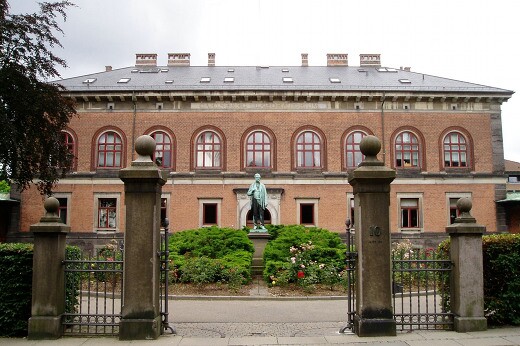
A statue of company founder J. C. Carlsberg stands outside the Carlsberg Laboratory in Valby, Copenhagen.
As with many large labs, Carlsberg recruits graduate students and postdocs from all over the globe to pursue their passions for science. “We need to be competitive, to be [able to] offer an exciting international and multidisciplinary research environment . . . to attract and recruit the right people,” says Lindberg Møller. “This is the basis for founding an active and dynamic research environment.” Teams are small, and “we will never put a person on a project that they don’t burn for,” he adds. Although admittedly there are numerous perks to working here, not the least of which is being surrounded by top talent, there are also the benefits of being able to taste the product—to ensure its excellence of course—and the knowledge that you are contributing to something extremely important: our comprehension of nature. Nature and beer.
Carlsberg Laboratory is housed in one building on a nondescript street behind the main brewery complex. It is connected to a museum that honors the history of the research enterprise which was first launched in 1875 and then a year later, became a part of the Carlsberg Foundation, consisting of a department of chemistry and a department of physiology. Among its notable contributions to science are the development of a method for pure culturing of yeast, free not only from bacteria, but also from wild yeast; the establishment of the concept of pH and its far-reaching fundamental and practical importance; and the pioneering of protein chemistry—in particular proteolytic enzymes and the dynamic nature of proteins.
The Laboratory juggles multiple projects at any given time. “Driven by a semper ardens (always burning) mentality, the Carlsberg Laboratory employees strive to carry out excellent science to position Carlsberg products as ‘The Thirst of the Future,’” says Lindberg Møller. A current research area focuses on processes that keep the beer stabilized. “We aim at developing barley cultivars that improve beer quality by eliminating enzymes like lipoxygenase which destabilize the beer,” he explains. “Breeding is also targeted towards preventing the formation of off-flavors. To reach these objectives we need to build on a deep basic understanding of the physiology of the barley grain and of its polymer constituents, especially the cell wall and starch biopolymers. Our yeast group recently succeeded in using next-generation sequencing to obtain a good draft genome of Saccharomyces carlsbergensis. Genomic insight into our yeast production strains provides the scientific basis for focused breeding of production yeasts with new improved traits such as increased formation of desired flavor and aroma compounds.”
“We are also trying to unravel the hidden treasures of another important raw material in beer production, namely hops,” he says. “Hops is a traditional medicinal plant and we want to augment the content of the constituents in hops that increase beer aroma and offer the desired bitterness. For thousands of years, botanicals in China, India, or Japan have been popular ingredients in, for example, teas, based on their considered contribution to health and wellness. Such botanicals may also be introduced as beneficial constituents in beer.”
Lindberg Møller encourages the lab’s scientists to engage other experts throughout the company and pursue interdisciplinary projects. Joint meetings between researchers, engineers, manufacturing experts, and even marketing professionals are commonplace. This is a crucial element of Carlsberg’s identity, as it enables the firm to be nimble as it approaches or anticipates complex problems impacting production. One fascinating example is adaptation to climate change. “Environmental conditions cause barley to develop different properties,” he says. “Using classical breeding, we strive to develop barley lines that meet future needs. Not only does the barley need to withstand the negative impact of climate change – i.e. to give a high yield in spite of extended periods of drought and warm temperatures – but it also needs to maintain an elite quality…So if we can make barley that is adapted to climate change, we can make better beer.”
A smaller carbon footprint
But the company is not simply interested in working around environmental impacts. Carlsberg is also dedicated to reducing its carbon footprint. Across the firm, engineers in multiple disciplines including packaging, manufacturing, environmental quality, and sustainability collaborate to reduce and reuse materials in novel ways. “We are looking to the future to see how we can create packaging that not only keeps our product safe and affordable but also contributes to sustainability,” describes Simon Hoffmeyer Boas, senior corporate social responsibility (CSR) manager at Carlsberg Group. Part of his work involves partnering with experts across the enterprise as well as their suppliers around the world. “Packaging accounts for approximately 45% of the Carlsberg Group’s total end-to-end CO2 emissions. However, this impact lies largely outside our direct sphere of influence,” says Boas. Thus, “we need to engage with suppliers and others to reduce this impact. From the distinctive green glass that is designed to keep your beer cool to the metal used in cans and kegs, engineers constantly endeavor to optimize the design of the containers, in order to use the least amount of materials while at the same time ensuring [that] the beer stays delicious,” he concluded.
To that end, Carlsberg instituted a life-cycle assessment tool that quantifies the environmental impact of all packaging types globally. “The tool draws on a huge database, including how much energy is used, how far product and raw materials travel, which fuel is used in which country, and other factors,” says Boas. This allows “us to develop packaging that is optimized from an environmental perspective.” The tool is powerful, in that it can be customized “to simulate the environmental impact in a specific country for a specific type of packaging,” he says, so the teams can make informed decisions in terms of what packaging to use and where to use it, based on its potential environmental impact.
Carlsberg also makes use of another important CSR tool: the Cradle to CradleTM design framework, a holistic methodology for quality assessment and innovation that was invented by William McDonough, an architect and designer, and Michael Braungart, a chemist. The two coined the term in their 2002 book, Cradle to Cradle: Remaking the Way We Make Things. “The framework first asks what is the given product’s function: food for natural systems or food for industry,” according to the Cradle to Cradle Products Innovations Institute, founded by McDonough and Braungart. “In our world, everything is conceived of, and designed to be, food. When everything—every material, manufacturing process and emission—is food for one system or the other, then humanity will be indeed benefitting the environment.”
Carlsberg weaves this idea into everything it does: “we want to create packaging that is not a cost [to] the environment, but [instead] can positively contribute to it,” says Boas. The team achieves this by examining ways in which packaging, raw materials, and anything else that is used to produce the beer can be, not just recycled, but upcycled again and again. The work is formalized through the Carlsberg Circular Community, which aims to develop the next generation of packaging products, optimized for recycling and reuse, while at the same time retaining or improving their quality and value. Scientists at the Laboratory, engineers within the larger company, and external partners all collaborate on this effort.
The company’s social responsibility leitmotif permeates into other divisions as well. For example, the Carlsberg Foundation donates more than $40 million each year to science, arts, and culture initiatives. But all of these ventures stem from Jacobson’s original intent to share his research with the world. In fact, at the edge of the brewery complex is a tower where for decades in the nineteenth and twentieth centuries, employees would leave spent yeast for the community to take for free to make bread—a “delicate bread with a beer flavor,” joked one Carlsberg chemist recently.
Alaina G. Levine is a science and engineering writer, career consultant, and professional speaker and comedian. Networking for Nerds, her new book on networking strategies for scientists and engineers, will be published by Wiley early next year. She can be reached through her website or on Twitter at @AlainaGLevine.