Baryon acoustic oscillation
DOI: 10.1063/PT.3.2298
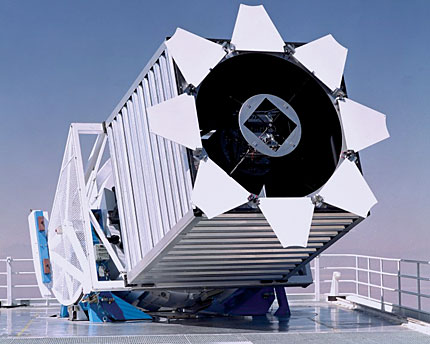
Investigating the nature of the “dark” vacuum energy (DE) that’s presumed to drive the present acceleration of the cosmic Hubble expansion requires tying the redshifts z of distant objects to independent measurements of their distances. One such method involves measuring both z and celestial position for large numbers of galaxies, in search of a spatial-correlation feature of known length at different values of z. That baryon-acoustic-oscillation (BAO) correlation length is attributed to sound-like waves in the early universe’s hot-plasma epoch. At the epoch’s abrupt end, the plasma waves became density fluctuations of ordinary “baryonic” matter that remain imprinted on the spatial distribution of galaxies (see Physics Today, April 2008, page 44 ). How the BAO correlation length at any particular z looks from here and now (z = 0) measures our distance from that z. The Baryon Oscillation Spectroscopic Survey (BOSS) collaboration has now reported its analysis of more than a million galaxies measured with the Sloan Foundation’s 2.5-meter-aperture survey telescope in New Mexico (shown in the photo). The BOSS sample covers almost a quarter of the sky to a depth of z = 0.7, which corresponds to a look-back time of 6 billion years. The analysis measures the effective distance to objects at z = 0.57 with a record precision of 1%, and it yields an improved measurement of the DE’s pressure-to-density ratio w. If the DE is simply Einstein’s cosmological constant, then w = −1. The BOSS analysis, incorporating complementary cosmological data, yields w = −1.03 ± 0.06. (L. Anderson et al., BOSS collaboration, http://arxiv.org/abs/1312.4877 .)

SLOAN FOUNDATION