Augustine panel urges more autonomy for NASA
DOI: 10.1063/1.3273007
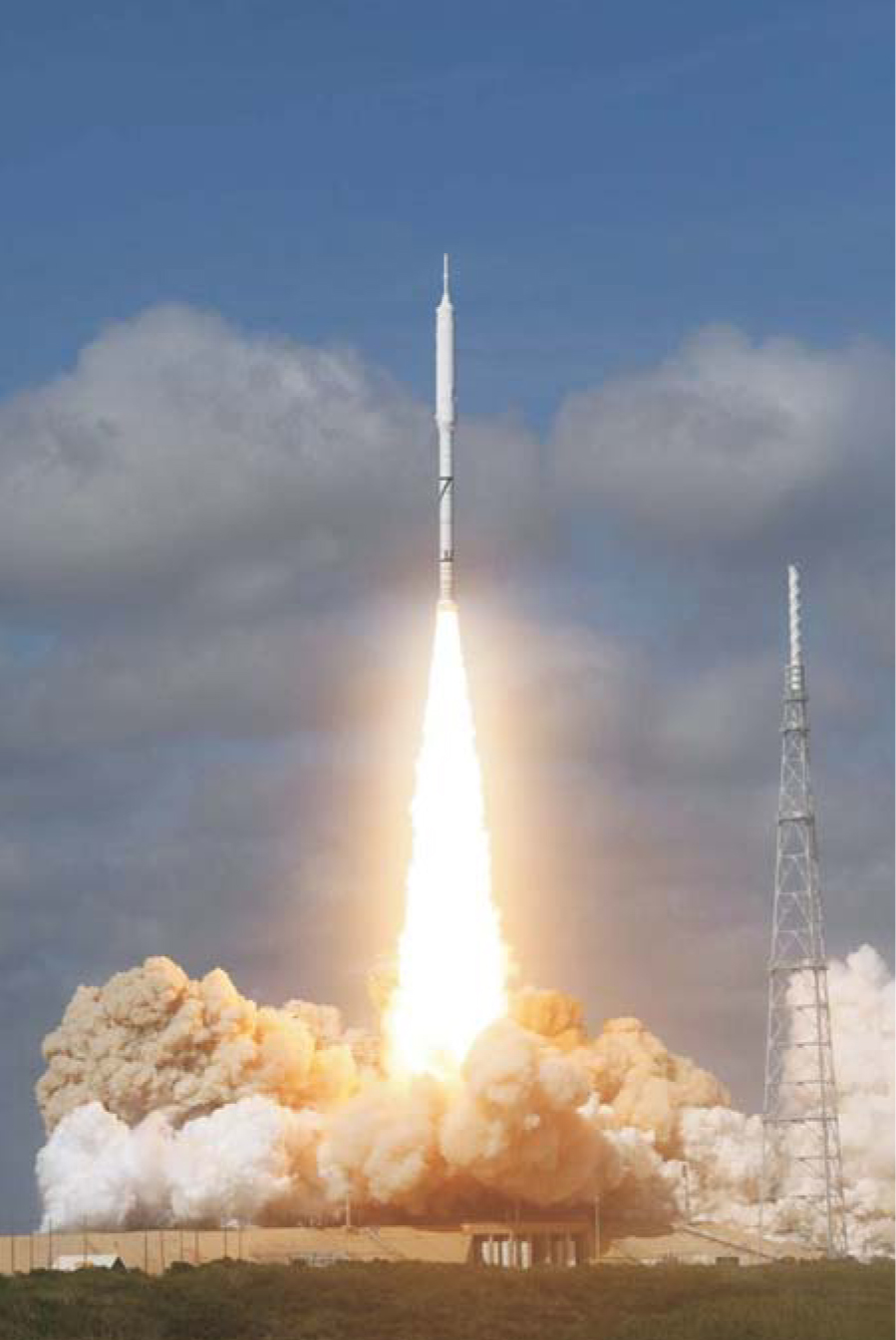
On 29 October, one week after a blue-ribbon advisory committee declared that NASA’s timetable for returning astronauts to the Moon is unrealistic, a prototype of the Ares-1 rocket that will lift humans into space launched successfully from Kennedy Space Center. Several options for a future US human space exploration were presented to President Obama by a committee led by retired Lockheed Martin chairman Norman Augustine. In the coming weeks, the president will choose from among those options.
In addition to its recommendation that NASA’s exploration budget be boosted by $3 billion, the panel’s report urges that NASA administrators be given greater latitude to manage the agency, realign its bloated 1960s-era infrastructure, and adjust the workforce.
“You [can] either spend your money on fixed costs and overhead, or you can spend it doing exciting exploration,” Augustine said at the press conference marking the release of the committee’s final report. “I think NASA is going to have to face that question, but if they are not given any latitude by the Congress, basically, or the White House—I should say both—they won’t be able to do that.”
Although the committee was asked only to chart a course for future manned space missions, the report argues that the agency’s severely constrained resources make it vital that the administrator be allowed to move resources around. “Good management is especially difficult when funds cannot be moved from one human spaceflight budget line to another, and where new funds can ordinarily be obtained only after a two-year budgetary delay (if at all),” the report says.
The comments are clearly meant for Congress, which has frequently meddled with NASA, mostly to protect the workforces at the agency’s 10 centers. NASA’s current authorizing legislation, enacted last year, prohibits the layoff of any of NASA’s 18 000 employees through the end of the 2010 calendar year. According to the report, though, only a small fraction of NASA workers can be considered to possess critical skills that the space program must retain. But since the agency must keep its existing workforce and facilities configuration, at least for now, it is forced to produce in-house items that could be purchased commercially for less.
In an interview with Physics Today, former NASA administrator Michael Griffin said he “couldn’t agree more” with the report’s admonitions about management, but he noted that a significant restructuring would require “finding a congressman to raise his hand and say it’s okay to close the center in his district.” Although “you could run NASA effectively with fewer centers,” Griffin said, he would leave the federal workforce untouched. The agency operates the same number of facilities today, he said, as it did in the peak years of the Apollo program in the 1960s, when it had twice the workforce it has now and, in inflation-adjusted terms, twice the budget.
Griffin suggested that any downsizing of NASA will require a process analogous to the Defense Base Closure and Realignment Commission (BRAC), which took decisions on post-cold war closings of military bases out of the hands of lawmakers. Other civilian research facilities, including the Department of Energy’s national laboratories, should be included in the exercise, he added.
John Logsdon, emeritus director of the Space Policy Institute at the George Washington University, agrees that congressional interference has been “a significant obstacle” to streamlining NASA. Some procedure outside the political arena will be needed to make the workforce and facilities adjustments, he says, but with only 10 NASA centers, a BRAC approach isn’t likely to work. Given that downsizing has been needed for decades, Logsdon says he’s not optimistic it will happen soon.
Other restrictions and practices impair NASA’s ability to make effective use of US industry, the report says. Examples include the inability to use loan guarantees and mechanisms that other agencies, such as the Department of Defense, have used to create a market and attract private investment from commercial suppliers. The committee also was critical of the “spiral development” model that NASA has used for the procurement of some items. The report notes that the model, in which the requirements for an engineering project aren’t known at the outset and are determined as the item is being built, “inevitably leads to a very expensive result.”

A prototype of the Ares-1 rocket, which will carry astronauts into space in the coming decade, blasts off from NASA’s Kennedy Space Center on 29 October. An advisory committee has recommended changes to NASA’s human space exploration program.
NASA

More about the authors
David Kramer, dkramer@aip.org