Atomic History as Art
DOI: 10.1063/1.1634527

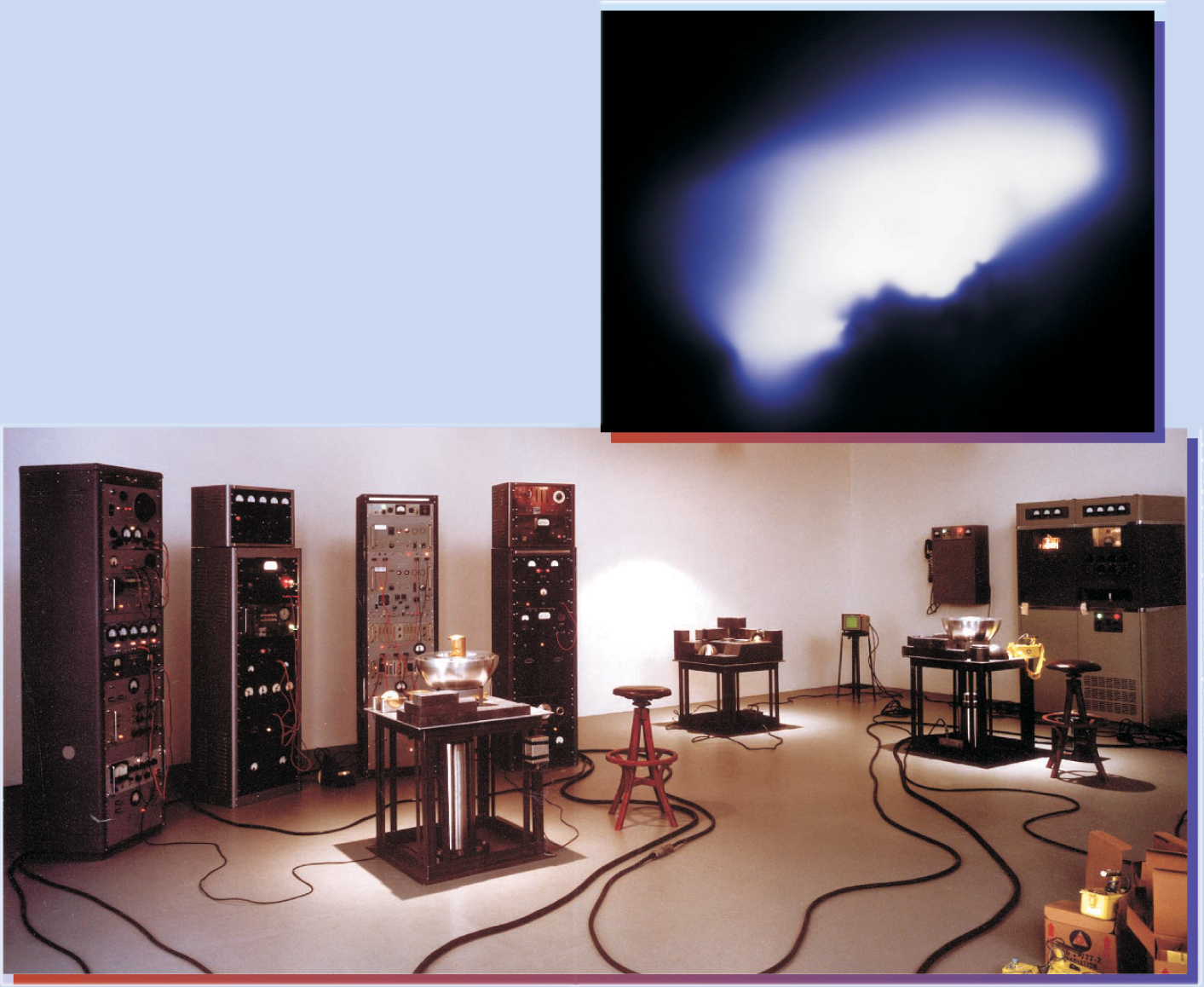
Art based on criticality experiments of the early 1940s at Los Alamos National Laboratory are on exhibit starting this month at the Corcoran Gallery of Art in Washington, DC. The installation, called Critical Assembly, emits sound and visual effects to mimic Geiger counters and contains some of the original laboratory furniture and equipment. The artifacts in Critical Assembly were purchased from scientists and machinists who worked on the Manhattan Project. Washington, DC, artist Jim Sanborn has spent the past five years constructing Critical Assembly, which is part of his larger art exhibit, Atomic Time: Pure Science and Seduction.
The rest of the exhibit includes a series of abstract autoradiographs that Sanborn created by exposing film to lumps of uranium, as well as images of radium-dial alarm clocks made between 1920 and 1950. The images appear cobalt blue, to symbolize Čerenkov radiation the soft blue glow that appears in cooling ponds around spent nuclear fuel rods as energetic particles travel faster than the speed of light in water.
“Critical Assembly is a very powerful and beautiful piece of art that is very seductive,” says gallery curator Jonathan Binstock, who organized the exhibit. “It does not take a position on political issues or nuclear weapons research. It is a dramatic, yet balanced, aesthetic expression derived from the artist’s fascination with the birthplace of the nuclear era.” Adds Sanborn, “I want it to stimulate a dialogue about the allure of pure science and the ethical dilemmas researchers have faced for decades.” The exhibit will remain on display at the Corcoran through 26 January 2004.

The Manhattan Project is re-created for visitors at the Corcoran Gallery of Art in Washington, DC. Autoradiographs (top) in the exhibit highlight the power of radioactivity.
CORCORAN GALLERY OF ART

More about the authors
Paul Guinnessy, pguinnes@aip.org