Halloween week in Indianapolis brought crisp fall weather, carved pumpkins, and the 168th meeting of the Acoustical Society of America. The acousticians joined in the Halloween spirit with a session on spooky sounds: “Acoustic Trick-or-Treat: Eerie Noises, Spooky Speech, and Creative Masking.”
In one of the talks, Miriam Kolar of Amherst College presented research on the uncanny acoustic characteristics of a 3000-year-old ceremonial center, known as Chavín de Huántar, in the Peruvian Andes. Like modern-day haunted houses, Chavín may have created spooky effects that led visitors to feel invisible presences and phantom forces.
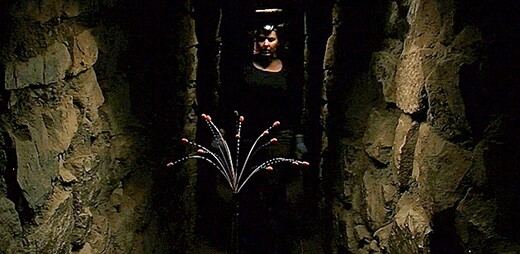
Miriam Kolar making acoustic measurements in the Lanzon gallery at Chavín. The photo was taken in 2011 when Kolar was a graduate student at Stanford University. CREDIT: Jose Luis Cruzado Coronel
Archaeologists believe the site, located approximately 250 kilometers north of the Peruvian capital of Lima, served as a religious gathering place where musicians from a pre-Inca culture likely played giant conch shell horns called pututus. Twenty intact pututus have been excavated from the mountainous grounds of Chavín, and large stone blocks display ancient carvings of figures holding the shells.
Present-day pututu musicians playing in the narrow, stone-lined corridors, alcoves, and rooms of Chavín have reported sensing their instruments “pulled into tune,” almost as if an unseen presence were guiding their playing. If two musicians blow on their shell horns close together, they may sense their instruments coming into sync with each other. What could account for that seeming phantom force?
While playing a shell horn, a musician’s lips vibrate in sync with the oscillations of the air in the shell’s spiraled interior. A player can modify the instrument’s tone by increasing the frequency of his or her lip vibrations, changing the shape of the air column inside the instrument by inserting a hand in the shell’s opening, or changing the shape of the vocal tracts. Those actions are all intuitive performance techniques.
Kolar explained that the small, enclosed spaces inside Chavín’s massive stone buildings have strong naturally occurring resonance frequencies, which can couple with the resonance of the pututu and the musician’s own lips and vocal tract. The acoustic coupling guides the musician and the instrument into a matching sound with the room. Both musician and listeners sense the eerie effect.
Archaeologists believe Chavín had ceremonial significance and perhaps spiritual importance to the people who built it, but how ancient people may have interpreted the uncanny acoustic phenomena observed at the site remains a mystery. The coupled resonances might have been interpreted as an embodiment of the instruments or an intervention by a higher power. When multiple musicians played together, the effect might be credited to the powerful skills of a lead player.
Despite the knowledge gaps, Kolar noted that reconstructing ancient soundscapes and musical practices could help connect our own sensory experiences to those of humans in the past. More information can be found at the website of the Chavín de Huántar Archaeological Acoustics Project.
Catherine Meyers is a writer in the Media Services division of the American Institute of Physics.