Underlying nearly all of particle physics is the presumption of CPT symmetry—that a system will look the same if, simultaneously, every particle is replaced by its antiparticle, space undergoes mirror reflection, and time runs backward. An immediate corollary is that a particle and its antiparticle will have the same mass. So far, no violations of the corollary have been found at accelerators or in the laboratory, but the hunt continues. (See the article by Maxim Pospelov and Michael Romalis, Physics Today, July 2004, page 40.) To obtain the requisite precision, it helps to have samples that are sufficiently cold and sufficiently long-lived. Masaki Hori of the Max Planck Institute for Quantum Optics and colleagues now report that buffer-gas cooling can chill antiprotonic helium to 1.5–1.7 K and that laser spectroscopy on the cooled atoms can offer more-precise measurements of the antiproton-to-electron mass ratio.
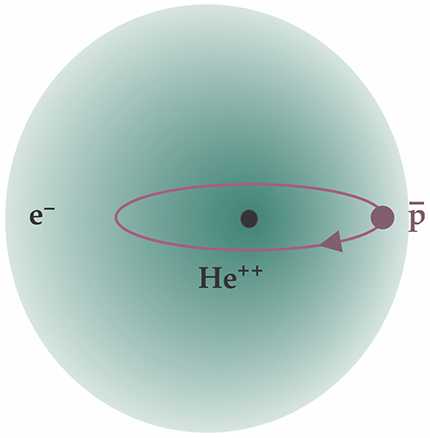
In antiprotonic helium (p‾He), one of the atom’s two electrons has been knocked out and replaced by an antiproton. The antiproton is in an excited, so-called Rydberg state that keeps the antiparticle safely away from protons in the helium nucleus. Meanwhile, the lone electron, whose wavefunction extends well past that of the antiproton, partially shields the antiproton during collisions with other atoms. Nestled in that protective environment, the antiproton survives for microseconds. That margin gave the researchers sufficient time to cool p‾He atoms via collisions with cold He gas and then measure the cooled atoms’ sharpened spectral lines. The results, collected from two billion p‾He atoms over a three-year period, had parts-per-billion precision and achieved comparable agreement with theoretical quantum electrodynamics calculations. Reassuringly, the team found agreement between the proton and antiproton masses to better than 0.5 ppb. (M. Hori et al., Science354, 610, 2016, doi:10.1126/science.aaf6702.)
An ultracold atomic gas can sync into a single quantum state. Researchers uncovered a speed limit for the process that has implications for quantum computing and the evolution of the early universe.
January 09, 2026 02:51 PM
This Content Appeared In
Volume 70, Number 1
Get PT in your inbox
PT The Week in Physics
A collection of PT's content from the previous week delivered every Monday.
One email per week
PT New Issue Alert
Be notified about the new issue with links to highlights and the full TOC.
One email per month
PT Webinars & White Papers
The latest webinars, white papers and other informational resources.