New Scientist: The Gravity Recovery And Climate Experiment (GRACE) is a pair of satellites traveling above Earth in the same orbit but 220 km apart. By accurately measuring changes in the satellites’ separation, GRACE can determine tiny variations in Earth’s gravity.
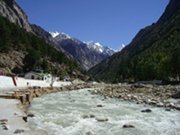
Walter Immerzeel of Utrecht University in the Netherlands and his collaborators have used GRACE data to monitor the changing thickness of Himalayan glaciers that feed five long and powerful rivers of South and Southeast Asia: the Indus, Brahmaputra, Ganges, Yangtze, and Yellow rivers. In the seven years covered by the study (2001–7), only the glaciers that feed the Ganges thinned appreciably. On the other hand, if Earth continues to warm, Immerzeel predicts that all five rivers will carry significantly less water downstream in the coming decades.