An odd fluid shows its inner workings
DOI: 10.1063/PT.3.4336
In a conventional fluid such as water, molecules tumble in random directions. Researchers in the fields of active matter, fluid dynamics, materials science, and condensed matter have long contemplated what would happen if the molecules’ rotations were instead coordinated, creating a so-called chiral fluid.
Parity, or mirror, symmetry restricts the ways in which conventional fluids can respond to applied forces. A flow caused by an external force in a conventional fluid can break mirror symmetry and lead to phenomena such as instabilities and vortices. In nature, most fluids exist in a perturbed, symmetry-broken state. In contrast, a chiral fluid built of spinning particles breaks mirror symmetry without the need for an externally forced flow. Theorists posit that a chiral fluid could intrinsically possess new properties not found in conventional fluids.
Materials such as two-dimensional electron gases and liquid crystals break mirror symmetry. And collections of spinning magnets and rotating bacteria are examples of systems that exhibit some of the large-scale patterns, such as unidirectional edge currents, predicted for a chiral fluid.
Creating a liquid that behaves in similar ways has remained an elusive goal until now. Researchers in William Irvine’s lab at the University of Chicago have for the first time developed a chiral fluid in the lab and identified the mechanisms that give rise to its unusual surface flows. 1
One-way waves
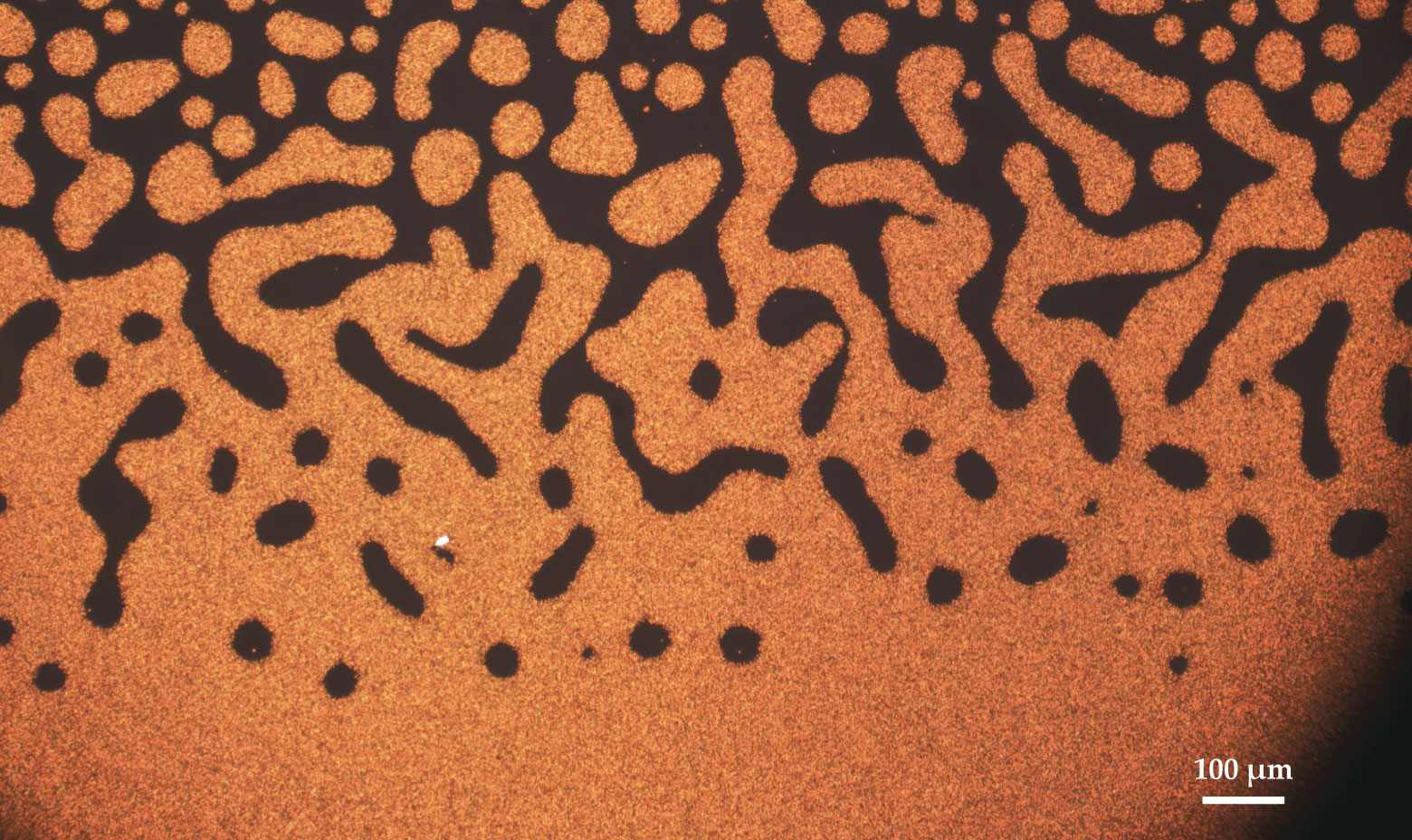
The Irvine group’s chiral fluid is a 2D colloidal suspension. To create the chiral fluid, graduate students Vishal Soni and Ephraim Bililign and postdoc Sofia Magkiriadou, all at the University of Chicago, suspended billions of 1.6 μm hematite cubes, made by Soni and collaborator Stefano Sacanna (New York University), in a thin layer of water atop a glass slide. A rotating magnetic field caused the cubes to spin simultaneously in the same direction. After a few minutes of spinning, the colloidal magnets, shown in figure
Figure 1.

An optical micrograph shows a bulk fluid of colloidal magnets (orange). After a few minutes of spinning, the particles attracted each other and formed a cohesive material. (Adapted from ref.

The material displayed several types of macroscale behavior reminiscent of a conventional fluid with positive surface tension. Nearby clusters of spinning particles merged into larger droplets. When the glass slide was tilted, the droplets bumped up against a hard edge and spread out, like raindrops on a windshield joining and then flattening when they hit the frame. When an obstacle was removed from the bulk, the voids quickly filled, like bubbles collapsing.
The material also displayed patterns not typical of a conventional fluid but expected for a chiral fluid. With no external stimulation beyond the rotating field, clockwise currents formed at the interface between the clockwise-spinning colloids and the suspending liquid. Such edge currents follow from the symmetry breaking caused by particles’ active rotation in the chiral fluid.
2
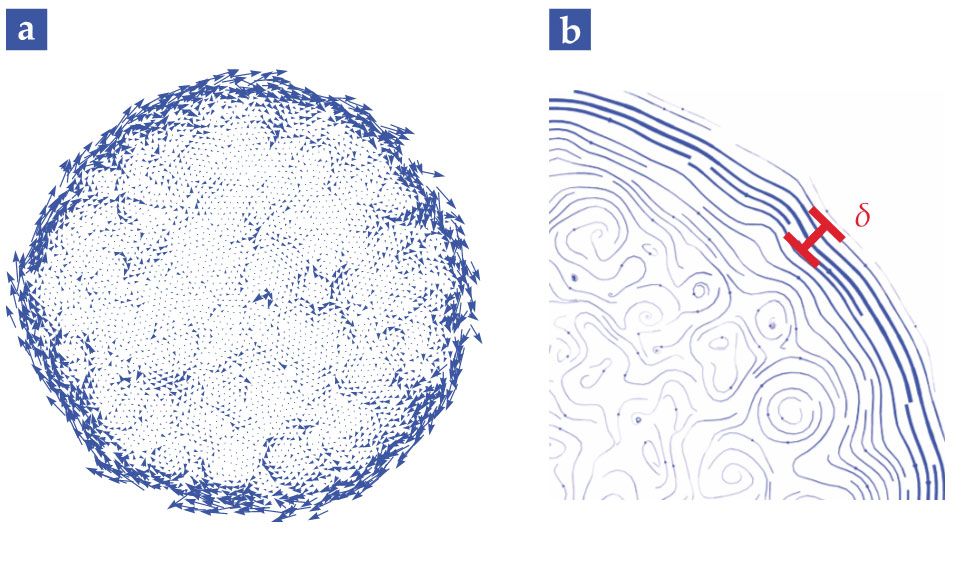
Instantaneous velocity profiles of a chiral fluid droplet showed that the edge current extended to a finite depth δ into the bulk. For the 100-μm-diameter droplet shown in figure
Figure 2.

Measuring the velocity of each particle provides a flow profile (a) of a droplet of diameter 100 μm. (b) The flow is concentrated at the edge of the droplet in a layer of depth δ (4.5 μm). (Adapted from ref.

High-resolution videos of the 2D fluid’s surface revealed a surprise: Unidirectional waves propagated along the fluid’s free surface in the direction of the particle rotation. An overdamped system—such as a viscous fluid or a fluid inhibited by substrate friction—should not be able to sustain surface waves.
Pumping hematite
How does one account for the unusual phenomena? Navier–Stokes and other hydrodynamic equations provide a general description of a moving fluid based on conservation of mass, momentum, and energy. Transport coefficients known to be zero in a conventional fluid could, in theory, have a nonzero value in a chiral fluid. For example, nonzero rotational viscosity determines the rate at which local angular momentum differences equilibrate, and it should force a chiral fluid to rotate with the same angular velocity as the fluid’s constituent particles. At the same time, friction between the fluid and the substrate should suppress the bulk fluid motion, and it affects the interior more than the edge. Higher friction results in a narrower edge current (smaller δ).
Irvine’s group and his collaborators Michael Shelley (New York University) and Denis Bartolo (École Normale Supérieure de Lyon) sought to understand the experiments by using the most general model for chiral fluids and informing it with estimates of transport coefficients based on the individual particles’ spinning rates on the glass substrate. When the researchers solved the hydrodynamic equations to determine the forces responsible for the observed surface wave patterns, they found a surprise. In a conventional fluid, viscosity acts as a damping force. But in the chiral fluid, viscosity and surface friction turned out to be what drove the propagation of surface waves.
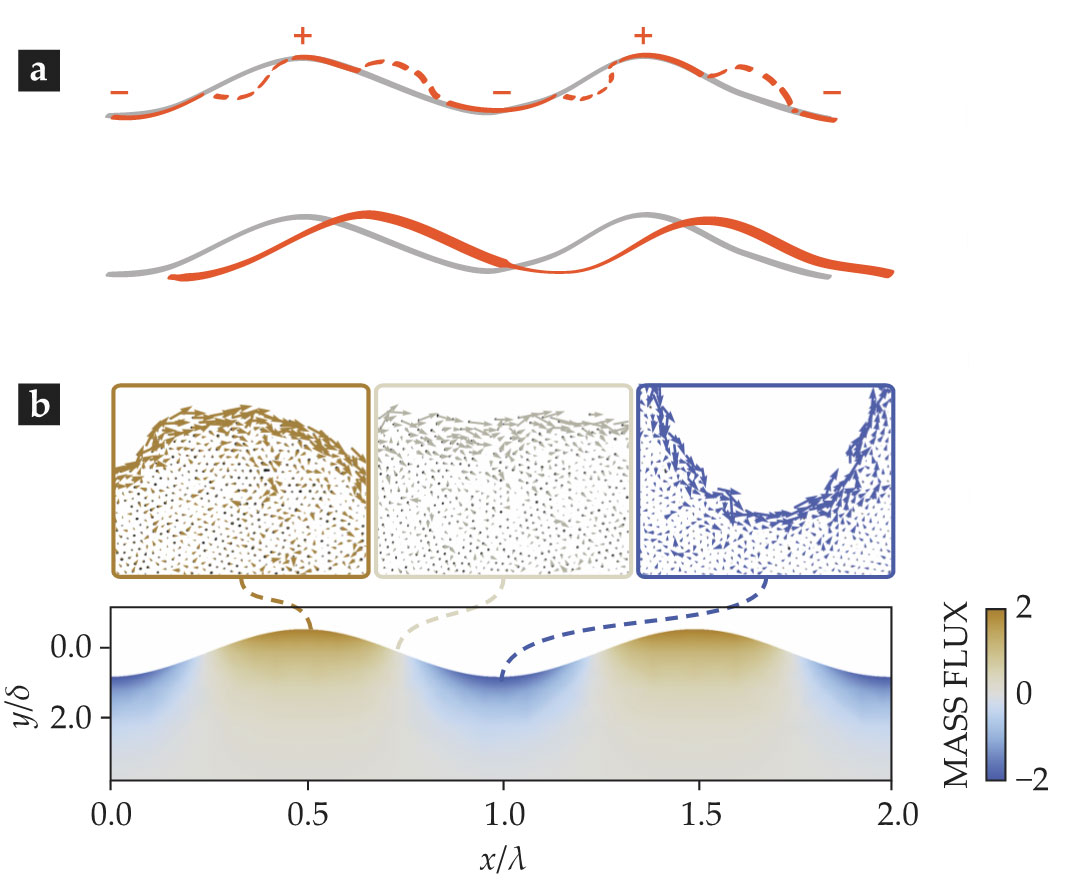
“The best way to think of the wave propagation mechanism is to think of the wave in terms of mass flux,” says Irvine. A chiral fluid always has an edge current, and a 2D droplet or a perturbed flat interface always has some nonzero curvature. The value of vorticity, the local spinning motion, is increased at regions of positive curvature (wave crests) and gives rise to enhanced mass flux relative to the average mass flux. Similarly, vorticity is decreased at regions of negative curvature (wave troughs) and gives rise to reduced mass flux. As shown in the sketch in figure
Figure 3.

Surface waves propagate on a chiral fluid’s free surface. (a) In the presence of viscosity, fluid from regions with higher-than-average mass flux (+) gets pumped into regions with lower-than-average mass flux (–). The process propagates waves in the direction of particle rotation. (b) A sinusoidal perturbation (wavelength λ) generates a net mass flux along the fluid’s free surface (height y, in an edge current of average depth δ). Color intensity indicates the relative strength of the flow. The inset velocity profiles show the microscopic origin of the mass flux variation. (Adapted from ref.

The transport resembles a shifting sand dune in which surface wind pushes material away from curved regions toward the flat wavefront; that motion leads to unidirectional wave motion. However, unlike the sand dune analogy, the surface motion is not an external force but a property intrinsic to the chiral fluid. The researchers dubbed the mechanism “edge-pumping.”
That’s odd
Surface waves in most fluids lose energy to their surroundings through viscous damping, which diminishes the waves’ motion and flattens the fluid’s surface. For the colloidal chiral fluid on the glass substrate, however, the observed damping rate resulted from the competition between surface tension and substrate friction. Surface tension flattens any curves, and substrate friction restricts any movement of the material.
To find out how damping arises when substrate friction is reduced, Soni, Bililign, and Magkiriadou placed droplets of the colloid suspension on an air–water interface. The lower-friction situations also sustained surface waves. However, those waves did not flatten according to the equations that described their glass-substrate counterparts—the measured damping rates could no longer be explained by surface tension alone.
The researchers found their answer in a phenomenon called odd or Hall viscosity, a term coined in 1998 by Joseph Avron. 3 Odd viscosity can be understood by decomposing the edge-current velocity into its tangential and perpendicular components. 4 Whereas shear viscosity is a stress that acts on a fluid in the same direction as the flow, odd viscosity is a stress that acts on a fluid orthogonally to the direction of the flow. In the case of a chiral fluid, the odd viscosity gives rise to a flow perpendicular to an applied pressure and thus, perhaps counterintuitively, does not dissipate energy.
In Irvine’s lab, the odd viscosity flattened the chiral fluid’s surface waves in a manner similar to surface tension. For the glass substrate, damping could be fully accounted for with a zero value of odd viscosity. For the air–water interface, the magnitude of the odd viscosity was of the same order as the shear viscosity. Although researchers at Leiden University had demonstrated in 1966 that odd viscosity could exist in a magnetized gas 5 and researchers at the University of Manchester recently reported odd viscosity in a 2D electron gas, 6 Irvine and colleagues have now provided the first measurement of it in a chiral fluid.
Thomas Powers, a physicist at Brown University, says, “The field of active matter is still a little theory and computation heavy, and there aren’t that many clean experimental systems. This is a nice one with relatively new features.” The chiral fluid provides the first platform for probing and designing materials with properties that arise from uniformly spinning particles. The model system could also help predict behaviors that may emerge in some plasmas or in charge carriers in 2D electronic materials.
References
1. V. Soni et al., Nat. Phys. (2019), doi:https://doi.org/10.1038/s41567-019-0603-8 .
2. J.-C. Bacri, A. O. Cebers, R. Perzynski, Phys. Rev. Lett. 72, 2705 (1994). https://doi.org/10.1103/PhysRevLett.72.2705
3. J. E. Avron, J. Stat. Phys. 92, 543 (1998). https://doi.org/10.1023/A:1023084404080
4. P. Wiegmann, A. G. Abanov, Phys. Rev. Lett. 113, 034501 (2014). https://doi.org/10.1103/PhysRevLett.113.034501
5. J. Korving et al., Phys. Lett. 21, 5 (1966). https://doi.org/10.1016/0031-9163(66)91315-1
6. A. I. Berdyugin et al., Science 364, 162 (2019). https://doi.org/10.1126/science.aau0685