Aligning scattered light for pain-free diagnostics
DOI: 10.1063/PT.3.1353
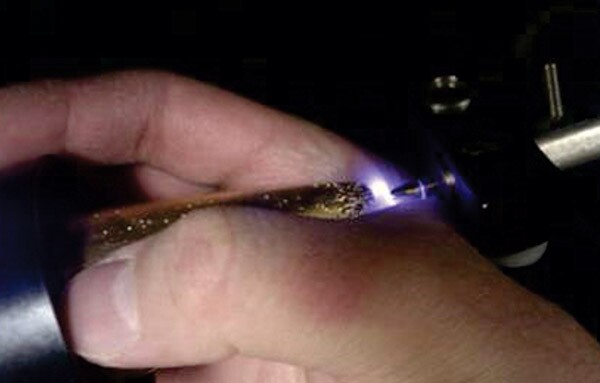
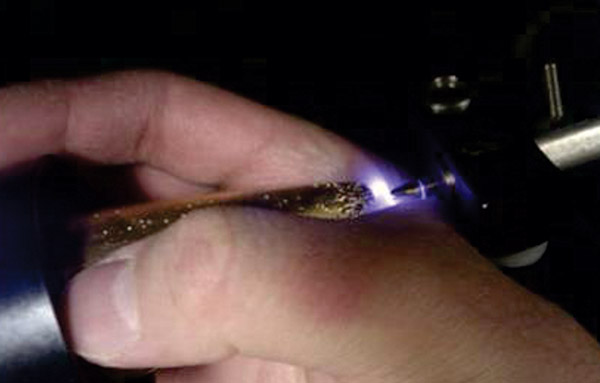
Aligning scattered light for pain-free diagnostics. Though tried and proven, conventional portable diagnostic equipment, such as the glucose monitors used by diabetes patients, require frequent and mildly painful extraction of blood samples. One promising noninvasive technique is based on irradiating the glucose-rich subdermal tissue with near-IR light and analyzing the spectra of the inelastically scattered photons, which correspond to an impinged molecule’s unique vibrational modes. Light scattered from the target tissue is aligned by a hollow reflecting parabolic optical element before it reaches a filter that separates inelastic photons from elastically scattered ones. However, the high degree of alignment required for efficient filtering leads to optical elements too large for practical use. Now a team of researchers at MIT has developed a hyperbolic element—the gold-colored conical component shown in the picture—that when coupled to a focusing lens at its output, provides the same filtering efficiency as a parabolic element five times its length. In effect, light that is reflected in the hyperbolic chamber can be virtually traced back to a distant point-source whose rays are less scattered when they exit through the focusing lens. Results from the device’s measurements of glucose in human skin folds correlated with those from a finger-prick monitor. The researchers say their instrument can be made even smaller by further optimization of the optics and electronics and can be used to detect other biomolecules or to monitor industrial chemical processes. (C.-R. Kong et al., AIP Advances 1, 32175, 2011 doi:10.1063/1.3646524 .) —JNAM