Academies Seek to Promote Scientific Excellence in Developing Countries
DOI: 10.1063/1.1628995

Scientists from around the world are working to establish national science academies in developing countries. They hope to advance scientific excellence, stop talent from leaving their home countries, and help solve global and regional crises. “Science academies can provide leadership in the development and application of science and technology, both within individual countries and internationally,” says Michael Clegg, foreign secretary at the National Academy of Sciences (NAS) in Washington, DC. But, he adds, major challenges lie ahead, such as maximizing science academies’ effectiveness. Some scientists argue that science academies can only be effective if they are independent from government control, whereas others claim the opposite.
No one, however, disputes that scientists should have a voice in influencing government policy. Says Alexander Animalu, past president of the Nigerian Academy of Science and chairman of the Institute for Basic Research in Abuja, Nigeria, “Given Nigeria’s bloated foreign debt, high rate of inflation, mass unemployment, fuel crisis, collapse of the health and educational sectors, deterioration of the infrastructure of roads, epileptic electric power supply, religious riots, ethnic militia, and insecurity of life and property, the only hope of tackling this myriad of problems is by focusing on science- and technology-driven socioeconomic initiatives.”
Leading the new academy-building movement are the InterAcademy Panel on international issues—a global network of 90 science academies—and the Third World Academy of Sciences, an international science academy representing more than 600 scientists, largely from the developing world. In the past two years, IAP and TWAS have held major workshops on dealing with Africa, on Latin America and the Caribbean, and on predominantly Muslim countries to promote the development and expansion of science academies. Individual academies also host similarly themed workshops. For example, the NAS recently held a workshop for African science academies on the role of science in policymaking.
Motivating scientists
The goal of the academy-building movement is to improve the science base through motivation, says TWAS Executive Director Mohamed Hassan. “We felt that the young scientists in developing countries are not getting enough recognition…. If you have a very strong national academy of science, young scientists would want to join it. This would help promote scientific excellence in their country.” Academies are ideal for promoting international links through exchange programs, says Lee Yee-Cheong, vice president of the Academy of Sciences Malaysia (ASM). In turn, he adds, these links increase the visibility and profile of researchers from developing countries and reduce their professional isolation and the likelihood that those researchers will choose to work abroad permanently.
The first results of the workshops can already be seen. African science academies have made progress in using merit-based approaches to elect academy members, and some academies have made a particular effort to engage women and interdisciplinary scientists. A March workshop in Trieste, Italy, on academy-building in Muslim countries has led to feasibility studies for new science academies in Saudi Arabia, Tunisia, and Sudan.
Few developing countries, especially in the Middle East, have effective national science academies, says Karim Ahmed, director of the international program of the National Council for Science and the Environment in Washington, DC. He points out four reasons why: Political and business leaders do not understand the benefits, the knowledge of how to run such an institution is not available locally, resources are scarce, and apathy tends to be high among the region’s scientists and engineers. An additional problem is that many scientists leave to work abroad, says Ahmed. “You must have a minimum core of 20 to 30 internationally recognized scientists to set up a national academy,” adds Hassan. “Otherwise it doesn’t work.”
A good role model?
Once set up, how influential are the new academies? “I am not convinced that academies ipso facto do help improve the science base,” says Yee-Cheong of the ASM. A successful academy, he adds, must have a mandate, money, manpower, the active participation of its members, and sound advice for the government. Academies in developing countries usually rely on government funding because few grant-giving foundations exist and dues from members are small. Yee-Cheong suggests that academies lacking direct government involvement are not good role models for developing countries because they typically attempt to influence policymakers through the media, a less effective approach than through direct connections with government officials. “There is little point in [an academy] offering any advice if you know in advance that the advice will not be considered,” says Yee-Cheong. “Establishing constructive relationships with government and funding are key challenges,” agrees Clara Cohen, NAS program officer for international affairs. Yee-Cheong says academies should adapt to the local social, political, and cultural ethos and, above all, serve national development needs. New academies that emulate Western values of independence and transparency “are languishing,” he adds.
Academies in India and China “are doing a terrific job” in specific areas such as information technology and climate change research, and Brazil and Chile are well-regarded models for the rest of Latin America, says Hassan. Their success is due to promoting the best research scientists to high-ranking positions within the science academies, creating scientific reports that influence government policy, and focusing on specific research areas. Among predominantly Muslim countries, Hassan adds, Malaysia’s academy, which is only seven years old, is highly respected. It is successful and influential in part because the country’s chief science adviser is also the academy president. Similar academy-government links may be helpful to new academies because, as Yee-Cheong points out, “governments in developing countries are generally very sensitive about being advised.”
How influential are academies at translating research into public policy analysis? When African delegates attended a recent workshop, “in many cases it was the first time the science minister and the president [of their country’s science academy] had met,” says Hassan. In the US, the NAS is very effective, but in Africa, he adds, “many academies we already have are not fully engaged in [public policy] issues.” Hassan cites the AIDS epidemic as an example: Few governments have asked or received information about AIDS from local scientists or academies, he says. “For this reason, part of our program has been to assist in developing their [public policy] capabilities.”
“There are notable exceptions, such as Ghana, where scientists have long had a role in government,” says Irving Lerch, director of international affairs at the American Physical Society But, he adds, most countries have focused on obtaining advice or resources from specialized United Nations agencies instead of developing local institutions to provide local solutions. To help develop long-term sustainable support, the NAS has started a 10-year program to conduct joint policy advisory studies with African academies of science. Each study will focus on a critical issue facing the nation involved. “There are many good African scientists out there who are strongly committed to the improvement of their own societies,” says NAS’s Clegg. With support, he adds, they can have a major impact.
New academies might be valuable to more than just developing countries. For the US to “have a population that is so ignorant of how most of the world lives is a threat—both to the US and to the rest of the world,” says NAS President Bruce Alberts. “As a start, it is critical that we find a way for a large proportion of our nation’s young scientists to engage with their colleagues in developing nations.”

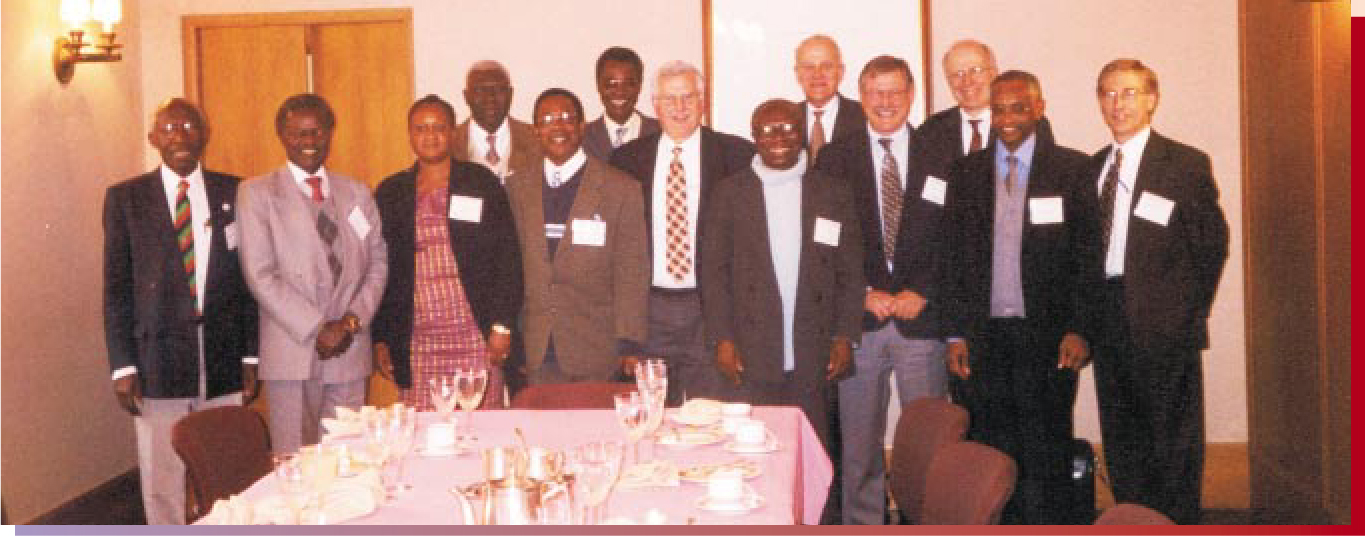
Representatives of seven African science academies attended a National Academy of Sciences workshop on science in policymaking in April. The representatives are pictured with NAS President Bruce Alberts (center) and other NAS officials.
NATIONAL ACADEMY OF SCIENCES

More about the authors
Paul Guinnessy, pguinnes@aip.org