A newly found pair of stars appears destined to merge and explode
DOI: 10.1063/PT.3.2739
As its nuclear fuel runs out, a Sun-like star balloons into a red giant whose outer layers are blown farther outward by the stellar wind. The naked carbon–oxygen core left behind contracts under gravity into a white dwarf, its surface becoming hot enough in the process to ionize its surrounding envelope of dust and gas. The glowing shells, known somewhat confusingly as planetary nebulae, are among the most beautiful sights in the night sky.
The vast majority of the thousands of such nebulae cataloged by astronomers have shapes that seem inconsistent with the stellar wind’s spherical symmetry. For the past two decades, theorists have been trying to figure out why. Although the issue remains unsettled, most believe that the presence of a pair of orbiting stars is the most efficient way to generate sufficient angular momentum to break the symmetry and shape the wind into an outflowing equatorial ring, sometimes with bipolar lobes. 1 Orbital drag causes the stars—a soon-to-be white dwarf interacting with either another nearby dwarf or something else, such as a main-sequence star or red giant—to spiral inward toward each other as nebular jets are thrown outward. The sightings and analyses of some 50 close binary stars found in sky surveys of planetary nebulae have largely borne out that hypothesis.
As part of one recent sky survey, Miguel Santander-García of Spain’s National Astronomical Observatory, Romano Corradi of the Institute of Astrophysics of the Canary Islands, and their collaborators have discovered an especially intriguing binary: 2 two pre-white-dwarf stars of virtually identical mass and size orbiting each other with a period of just four hours inside the planetary nebula Henize 2-428. What’s more, the mass of each star is about 0.9 solar masses (M⊙). When the two finally merge in 700 million years, their combined mass will exceed the Chandrasekhar limit of 1.4 M⊙, above which electron degeneracy pressure cannot support a white dwarf against its own weight. According to theory, that “super-Chandrasekhar” merger will ignite a spectacular nuclear explosion—the runaway thermonuclear fusion of some 1030 kg of carbon into nickel—provided the merger sufficiently pressurizes the core of one of the stars.
Because the newly observed binary has the essential ingredients required for so ferocious an explosion, known as a type Ia supernova, it qualifies as a credible progenitor—the first ever observed. “Of the few dozen white-dwarf binaries found so far, all have been either too widely spread to merge within the age of the universe or their combined mass has been below the Chandrasekhar limit,” says Corradi. Louisiana State University’s Bradley Schaefer puts the claim in a broader perspective: “It’s been a hard, 40-year-long slog searching for a type Ia progenitor.” Those supernovae are responsible for much of the universe’s iron and other trace elements and have long been standard candles for gauging cosmological distances (see the Physics Today articles by Saul Perlmutter, April 2003, page 53 , and by Mario Livio and Adam Riess, October 2013, page 41 ).
A weird system
Although finding a progenitor is reassuring, it is not unexpected. About 10% of all white dwarfs are born as close binary pairs, and 100 million such binaries are thought to populate our galaxy at the moment (see the article by Gijs Nelemans, Physics Today, July 2006, page 26 ). Planetary nebulae have long been considered good hunting grounds. Indeed, the fraction of type Ia supernovae exploding inside planetary nebulae may be as high as 20%. 3
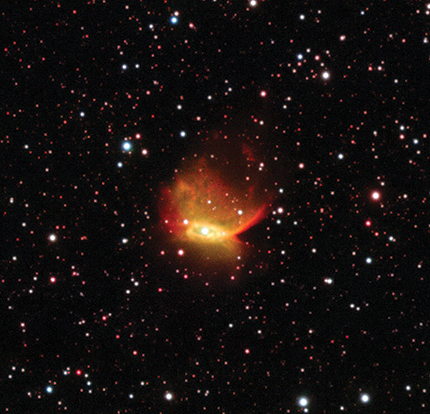
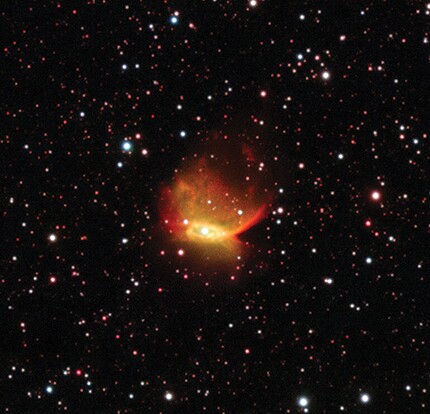
Santander-García and company were not looking for supernova progenitors. Their challenge, finding new binaries, is its own difficult task. White dwarfs dim quickly and, while very young, much of their light may be obscured by the nebular gas and dust. The researchers pored over catalogs, looking for nebulae whose elongated, bipolar shapes seemed to best suggest the interaction of companion stars. The pair of extended lobes and ring-shaped waist of Henize 2-428, shown above, drew their attention. The nebula itself is a light-year across, but the stars at its center orbit within two solar radii from each other.

This snapshot of planetary nebula Henize 2-428, about a light-year across and 4200 light-years away, was taken using the European Southern Observatory’s Very Large Telescope in Chile. At its center, the hourglass-shaped nebula hosts two stars, each with a mass slightly less than the Sun and close enough to merge and explode—possibly as a type Ia supernova—in 700 million years. (Image courtesy of ESO.)
From our distant perspective 4200 light-years away, no telescope can spatially resolve so compact a binary. The usual tack, which the researchers followed, is to monitor the modulations in visible-light emission as the stars repeatedly cross in front of each other. Quasi-sinusoidal variations due to the stars’ tidal distortions of each other confirmed the presence of the binary and provided a handle on its orbital dynamics. To measure the stars’ radial velocities and extract the stars’ masses, the researchers used the Gran Telescopio Canarias, whose 10-m mirror captured the Doppler shifts in the absorption-band frequency of helium as the stars orbited each other.
Aspects of the system are still mysterious. “Frankly, the identical masses, radii, luminosity [and thus temperature] of the stars is just weird,” says Gijs Nelemans of Radboud University Nijmegen in the Netherlands. “Maybe one star has been transferring mass to the other.” Or the stars may have started life in nearly the same state at the same time, a rare situation. 4 At about 0.7 solar radii, both are still large and hot.
Nelemans also questions the relevance of the Chandrasekhar limit as a forecasting tool for merging white dwarfs. The violent merging process is distinctly different from the situation in which one of the stars slowly accretes by siphoning off matter from a normal hydrogen-burning star until its mass exceeds the limit (see Physics Today, May 2010, page 11 ). Three-dimensional hydrodynamic models have found complex structures that may explode in a way that resembles a type Ia supernova even when the total mass of the merger is below the Chandrasekhar limit. 5
Two years ago Rüdiger Pakmor and colleagues from the Max Planck Institute for Astrophysics in Garching, Germany, showed that the thin shell of helium surrounding a white dwarf can become entrained onto its companion so rapidly during a merger’s onset that the helium detonates and sends into the star’s core a shock wave that ignites its store of carbon. 6 Yet other simulations suggest that a white dwarf rotating fast enough can also stabilize itself against carbon ignition. In short, modeling mergers is complicated, and theorists are not sure what initial conditions and evolutionary paths take a white dwarf from stable equilibrium to a supernova explosion.
Nonetheless, says Nelemans, “the companion stars in Henize 2-428 are so massive that something explosive is bound to happen. Their discovery is an important case to guide theory.” The context of the discovery is likely to intrigue astronomers as well. As Noam Soker at the Technion–Israel Institute of Technology puts it, “Planetary nebulae are much more than just beautiful. They are the crossroads of many other astrophysical objects.”
References
1. For a review, see O. De Marco, Publ. Astron. Soc. Pac. 121, 316 (2009). https://doi.org/10.1086/597765
2. M. Santander-García et al., Nature 519, 63 (2015). https://doi.org/10.1038/nature14124
3. D. Tsebrenko, N. Soker, Mon. Not. R. Astron. Soc. 447, 2568 (2015). https://doi.org/10.1093/mnras/stu2567
4. For an alternative interpretation of the binary system, see E. García-Berro, N. Soker, L. G. Althaus, arXiv:1503.01739 .
5. D. Maoz, F. Mannucci, G. Nelemans, Annu. Rev. Astron. Astrophys. 52, 107 (2014). https://doi.org/10.1146/annurev-astro-082812-141031
6. R. Pakmor et al., Astrophys. J. Lett. 770, L8 (2013). https://doi.org/10.1088/2041-8205/770/1/L8