A galaxy with surprisingly little dark matter
DOI: 10.1063/PT.3.3916
Stars in the Milky Way account for only a few percent of our galaxy’s mass. According to the consensus picture of galaxy formation, most of the mass in the Milky Way—and every other galaxy—is housed in a sphere of dark matter, the nonluminous, feebly interacting substance whose identity is still a mystery. Now Pieter van Dokkum of Yale University and his international team have identified a galaxy, NGC 1052-DF2, that challenges the standard formation picture: Its mass in dark matter is at most about the same as its mass in stars, and possibly it is much less.

NASA, ESA, AND PIETER VAN DOKKUM
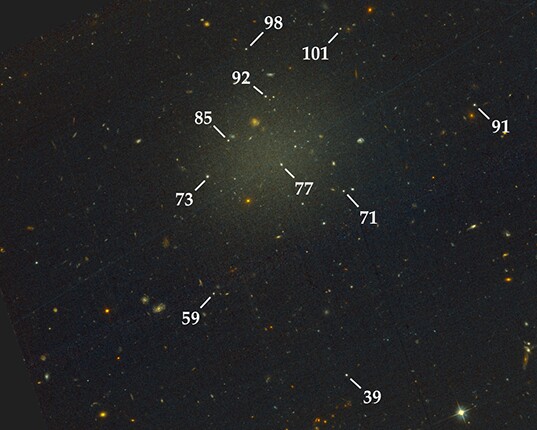
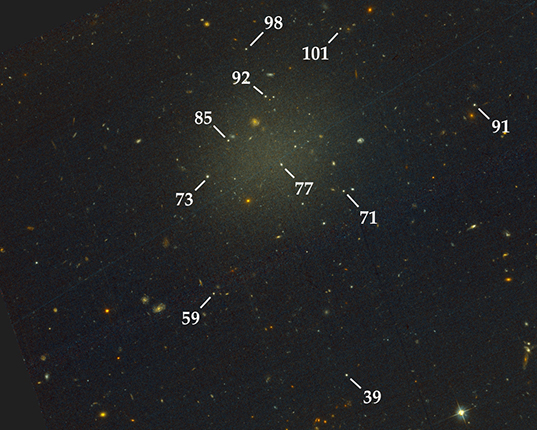
The figure shows a Hubble Space Telescope image of the faint galaxy; the 10 labels indicate star clusters on the outskirts. From Doppler-shift measurements of each cluster’s absorption spectrum, the researchers could obtain the speed at which the cluster orbits the galaxy.
Just as, in our solar system, the mass of the Sun can be deduced via Kepler’s third law from the speed and radius of a planet, so the mass of NGC 1052-DF2 can be estimated from the speeds and locations of the star clusters. NGC 1052-DF2 can’t be approximated as a point, but even in the more complicated galactic system, smaller orbital velocity means smaller mass. And the cluster velocities were so small that NGC 1052-DF2’s stars might account for all of the galaxy’s mass, though a more sober conclusion is that, at the 95% confidence level, the dark-matter mass is at most approximately equal to the mass in stars. That’s still more than two orders of magnitude less dark matter than expected.
Astrophysicists do not know for sure how NGC 1052-DF2 formed. One possibility is that it was created during galaxy merger, a process that can fling out gas without ejecting dark matter.
Ironically, the existence of a galaxy with little or no dark matter would falsify some alternatives to dark matter. Modifications to Newtonian dynamics and other fixes have been invoked to explain the dynamics observed in other galaxies. Those approaches, however, necessarily mimic the effects of a dominant dark-matter component and thus are not compatible with the relatively lethargic movement of NGC 1052-DF2’s satellite clusters. (P. van Dokkum et al., Nature 555, 629, 2018, doi:10.1038/nature25767 .)