A double take on the double arc
DOI: 10.1063/PT.3.1354
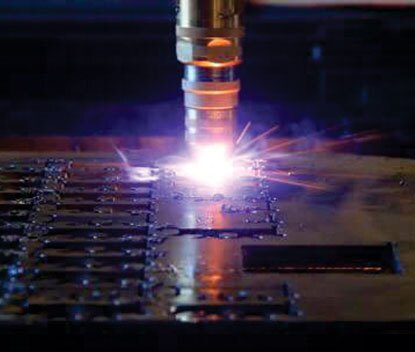
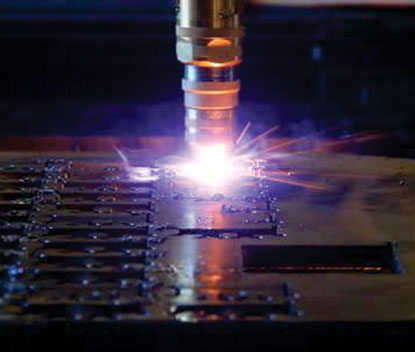
A double take on the double arc. More than just a tool for movie stars to break into a vault, the plasma cutting torch has many industrial uses, as depicted here. In plasma cutting, an electric arc is established between a cathode on the torch and the metal workpiece, which acts as the anode. A collimated gas stream blows at high speed through a conducting nozzle in the torch and, in the presence of the arc, becomes the high-temperature plasma that melts through the metal. The nozzle can be damaged if the arc, instead of passing through the orifice, contacts the wall and then jumps onto the workpiece. That so-called double arc has also been seen in a transient, nondestructive form that spikes in milliseconds; neither form is well understood. A trio of researchers in Argentina has now studied the nondestructive double arc experimentally, using the nozzle as a probe of the plasma properties. A surprising finding is that, contrary to long-held assumptions, the nonequilibrium plasma within the nozzle is not in a steady state when close to double arcing. Instead, it is highly sensitive to electric fluctuations arising in the power source. Their results could also overturn the hypothesis that because an insulating film forms on the nozzle’s interior, the transient spikes are nondestructive. The transient discharges instead seem to occur within the space-charge layer between the plasma and the nozzle wall—no film needed. (L. Prevosto, H. Kelly, B. Mancinelli, J. Appl. Phys. 110, 083302, 2011 doi:10.1063/1.3651398 .) —SGB