A deep earthquake goes supershear
DOI: 10.1063/PT.3.2501
On 24 May 2013, the tectonic plate that subducts under Russia and Eurasia ruptured 607 km beneath the Sea of Okhotsk, west of the Kamchatka Peninsula, and produced the strongest deep earthquake ever recorded, with a moment magnitude of 8.3. Nine hours later a magnitude 6.7 aftershock struck even deeper, at 642 km. A new seismic analysis by Zhongwen Zhan at the Scripps Institution of Oceanography and his colleagues there and at Caltech reveals a surprise: The aftershock’s fault ruptured at an astonishing 8 km/s, nearly 50% faster than the shear-wave velocity at that depth. 1 The analysis puts the aftershock in rare company as one of only seven so-called supershear earthquakes ever identified, and the only deep one.
That cracks can propagate so quickly in a part of the mantle thought to plastically deform rather than fracture only adds to most geophysicists’ perception that deep earthquakes are strange. According to traditional ideas about rock friction, a fault shouldn’t slip at all under the huge load of so much overlying rock; the stronger the squeeze, the less likely the slip.
Yet so-called deep-focus earthquakes, whose faults lie between 400 km and 700 km below the surface, are not uncommon, and they exhibit a diversity of behavior even greater than shallow ones. The main, magnitude 8.3 Sea of Okhotsk earthquake, just 300 km northeast of its aftershock, clocked in at a moderate subshear pace close to 4.5 km/s. And the second strongest deep earthquake on record, which occurred in Bolivia in 1994 at about the same depth, ruptured at only a third of that speed, about 1.5 km/s. Says Thorne Lay of the University of California, Santa Cruz, “The latest observation that deep earthquakes can possibly go supershear reinforces how undistinctive [or variable] deep earthquakes are in almost anything we measure about them. But that’s revealing: Whatever mechanism might be at play must accommodate that diversity.”
Doppler shifts
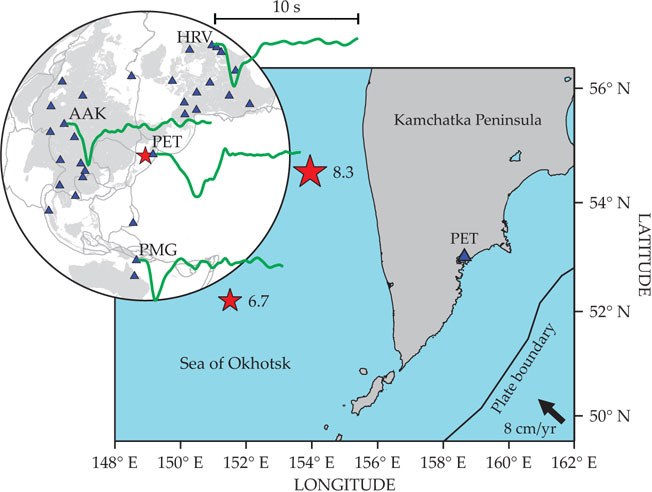
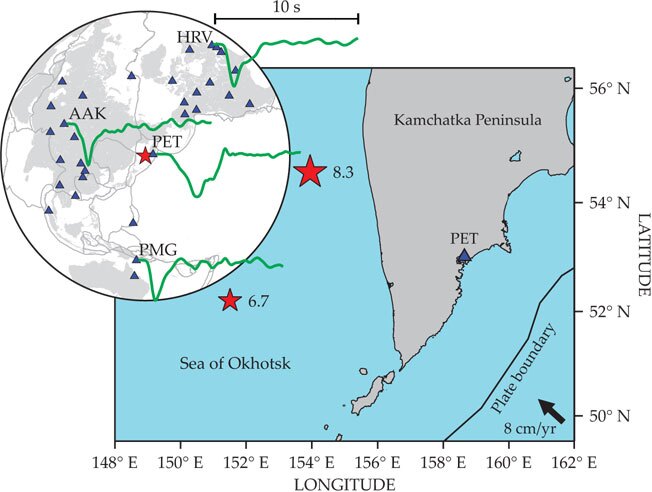
Resolving rupture velocity is straightforward, at least conceptually, because the transverse shear waves and longitudinal compressional waves radiated during an earthquake contain information about when and where the fault is slipping. The procedure is akin to measuring the Doppler-shift change in the period of sound waves reaching different locations from a moving source. Zhan and colleagues had access to the global network of broadband seismometers deployed by the Incorporated Research Institutions for Seismology (IRIS) consortium. But the pulse widths of the compressional waves radiated from the source and recorded by the numerous distant and widely distributed stations in the network (for example, AAK, PMG, and HRV in the figure on page 14) all appeared much shorter in time than that recorded at a nearby station (PET).

Last year’s earthquake beneath the Sea of Okhotsk occurred deep on the Pacific plate that slides under Russia at about 8 cm/yr. Of magnitude 8.3, it mainly affected eastern Russia and the Kamchatka Peninsula, though the shaking forced even some Moscow residents, 7400 km away, to flee their homes. Later, a magnitude 6.7 aftershock occurred 300 km southwest. The inset shows the distribution of IRIS, a global network of seismology stations (triangles) used to analyze the two earthquakes (red stars). Representative pulses of the aftershock’s compressional waves recorded at distant stations (HRV, AAK, and PMG) and one nearby station (PET) are shown in green. (Image adapted from ref.
The reason, the group later realized, was that the aftershock rupture proceeded steeply downward from its initiation point. Because of the way seismic waves refract through Earth’s mantle and curve toward the surface, each distant station saw downward-going waves racing toward it. And just as it’s hard to tell how fast an approaching train is moving if you only listen from straight ahead of it, the distant seismometers together couldn’t unambiguously resolve the start, stop, and thus speed of the rupture.
Fortunately, the one nearby seismic station (PET) in the network offered a key difference in perspective. Located almost directly above the earthquake, the station detected compressional waves whose pulse widths were broadened because the rupture sped away from it. The researchers still had to correct for the path-obscuring effects of diffraction as the waves passed upward through hundreds of kilometers of cold plate near hot mantle. But the asymmetry in Doppler shifts between the distant and nearby seismometers was sufficient to constrain the rupture’s extent and speed. During its 1.5-second lifetime, the aftershock tore a crack about 12 km long.
A need for speed
Of the two elastic waves that propagate in rock, compressional waves are almost twice as fast as shear waves. But they are only one-fifth as strong as shear waves, whose shaking usually drives the propagation of a crack tip. So for an earthquake to go supershear and be driven by compression rather than shear, the fault must already be so stressed that it’s close to failure.
As the compressional wave runs ahead of the shear wave, the small addition of stress it concentrates ahead of the crack tip is enough to trigger a new rupture front that expands farther downstream of the first. The two fronts then coalesce, provided they’re on the same fault line. (Elastic waves are known to trigger earthquakes on other fault lines as well, which sometimes makes the proper interpretation of their signals tricky.)
Although the measurements of compressional-wave intensities that push a fault over the edge have no direct bearing on the absolute stresses, they can offer researchers a handle on the incremental stresses that produce earthquakes. That’s one reason that shallow supershear earthquakes have attracted attention. Another is that as shear waves are spawned at the moving crack tip, they pile up, coalesce into a Mach cone, and produce the earthquake equivalent of a sonic boom. The phenomenon may amplify the shaking from an otherwise less hazardous event.
The difference in rupture speeds of the Sea of Okhotsk earthquake and aftershock indicates that substantial spatial heterogeneity—in both the stress required to nucleate a rupture and the energy consumed to sustain it—can exist even in the same plate. That’s a new level of complexity that needs to be addressed, says Zhan.
In search of mechanism
A particularly puzzling feature of deep earthquakes is that although they occur at depths where mantle pressures and temperatures are very different from those where shallow earthquakes occur, their seismic signals have always been indistinguishable. A clue to why comes from geographical context. Deep earthquakes initiate only in subduction zones, where the downwelling of cold and water-saturated crust is thought to help buoy the load and allow brittle faulting, at least down to depths of 300 km. Ordinarily bound up as ionic impurities in minerals, the water can be released during dehydration reactions and is known to lubricate the slab, alter viscosities, and weaken certain rocks (see the article by Marc Hirschmann and David Kohlstedt, Physics Today, March 2012, page 40 ).
Earthquake occurrences drop exponentially with depth down to 300 km, only to pick up again in the deep-focus regime. At around 400 km, olivine, the most predominant mineral in Earth’s upper mantle, changes phase to the 8% more compact spinel. In the late 1980s, Harry Green of the University of California, Riverside, and Pamela Burnley, now at the University of Nevada, Las Vegas, argued that the cool temperatures of a subducting plate could kinetically hinder the phase transition enough for olivine to remain metastable at pressures hundreds of kilometers deeper. When it finally transforms, the crystal structure implodes, an event that produces an earthquake-nucleating shearing instability. 2 (See Physics Today, October 1994, page 17 .) In lab experiments on the phase transitions in ice, germanates, and silicates like olivine, the radiated elastic waves are audible as loud acoustic emissions.
In his 1 May 2014 talk at the Seismological Society of America Annual Meeting in Anchorage, Alaska, Northwestern University’s Emile Okal announced having seen the first seismic signature of such an implosive volume contraction. The contraction showed up as a small isotropic component of the seismic moment tensor—a general system of forces used to represent earthquake sources—and was found by analyzing the global breathing-mode oscillations excited by the main Sea of Okhotsk earthquake. The oscillations, involving Earth’s radial expansion and contraction, remained observable for weeks on the IRIS network. According to Okal, the isotropic component amounted to just 2% of the total seismic moment but 9% of the part of the moment that went toward exciting radial modes.
Intriguingly, Okal and others, independently, had attempted to isolate the same breathing-mode component shortly after the 1994 magnitude 8.2 Bolivian tremblor, but found none. 3 And any volume change for the supershear rupture would be too small to detect. But it’s possible that all deep earthquakes may nucleate from similar phase-transformation triggers. 4 No doubt Okal’s announcement in May will send seismologists back to the archived data from dozens of late, great, deep earthquakes.
References
1. Z. Zhan et al., Science 345, 204 (2014). https://doi.org/10.1126/science.1252717
2. H. W. Green II, P. C. Burnley, Nature 341, 733 (1989); https://doi.org/10.1038/341733a0
see also S. H. Kirby et al., Rev. Geophys. 34, 261 (1996). https://doi.org/10.1029/96RG010503. E. A. Okal, Geophys. Res. Lett. 23, 431 (1996). https://doi.org/10.1029/96GL00375
4. Z. Zhan et al., Earth Planet. Sci. Lett. 385, 89 (2014). https://doi.org/10.1016/j.epsl.2013.10.028