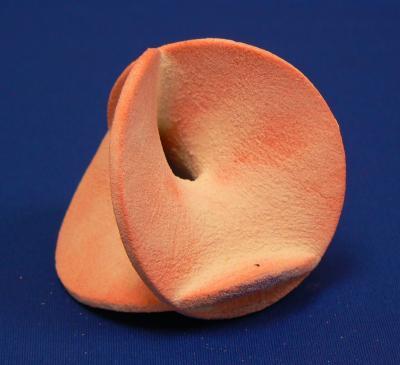
Physics Today: A team of engineers and artists working at the University of Washington’s Solheim Rapid Manufacturing Laboratory has developed a way to create glass objects using a conventional three-dimensional printer and “open-sourced” the technique so anyone can use it.
The team’s method, which it named the Vitraglyphic process, is a follow-up to the Solheim Lab’s success last spring printing with ceramics. (See an example image on the right. Photo credit: University of Washington)"It became clear that if we could get a material into powder form at about 20 microns we could print just about anything,” said UW professor Mark Ganter.Three-dimensional printers are used as a cheap, fast way to build prototype parts. In a typical powder-based 3D printing system, a thin layer of powder is spread over a platform and software directs an inkjet printer to deposit droplets of binder solution only where needed. The binder reacts with the powder to bind the particles together and create a 3D object.Glass powder doesn’t readily absorb liquid, however, so the approach developed for ceramic printing had to be radically altered.By adjusting the ratio of powder to liquid the team found a way to build solid parts out of powdered glass that fused when heated to the right temperature. Glass is a material that can be transparent or opaque, but is distinguished as an inorganic material (one which contains no carbon) that solidifies from a molten state without the molecules forming an ordered crystalline structure. As the glass molecules remain in a disordered state, the resulting object is technically a super-cooled liquid rather than a true solid."By publishing these recipes without proprietary claims, we hope to encourage further experimentation and innovation within artistic and design communities,” said UW associate professor Duane Storti. Ronald Rael, an assistant professor of architecture at the University of California, Berkeley, has been working with the Solheim Lab to set up his own 3D printer. Rael is working on new kinds of ceramic bricks that can be used for evaporative cooling systems."3D printing in glass has huge potential for changing the thinking about applications of glass in architecture,” Rael said. “Before now, there was no good method of rapid prototyping in glass, so testing designs is an expensive, time-consuming process.” Rael adds that 3D printing allows one to insert different forms of glass to change the performance of the material at specific positions as required by the design.