The origin of the elements
DOI: 10.1063/PT.3.4134


What is the world made of? Ancient philosophers postulated four or five elements. Much later, Dmitri Mendeleev and Lothar Meyer extended the quest to a rapidly expanding table of chemical elements. Using spectral analysis techniques that they had pioneered, Robert Bunsen and Gustav Kirchhoff discovered Fraunhofer lines in the solar spectrum, which showed that the elements found on Earth also existed in stars, though in different proportions. The abundance tabulations of Victor Goldschmidt and later Hans Suess and Harold Urey showed a standard pattern for the solar system, which astronomers today extend for objects throughout the cosmos. 1 How could all those observations be explained?

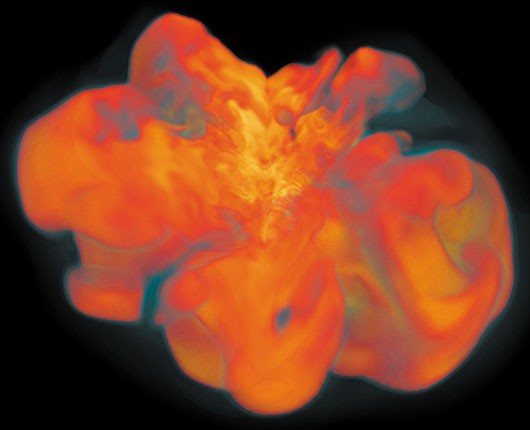
Three-dimensional visualization of the supernova explosion of a 15 solar-mass star after the first second. The expanding plumes of neutrino-heated matter around the neutron star (invisible at the center) contain iron-group and light trans-iron elements. (Courtesy of Leonhard Scheck, H.-Thomas Janka, Ewald Müller, Max Planck Institute for Astrophysics, Garching, Germany.)

Fred Hoyle promoted an idea in the context of the steady-state cosmological model that he favored: Whereas hydrogen was created continuously throughout the universe, other elements must be made in stars, with their explosive deaths as supernovae playing a dominant role. 2 Adherents of the Big Bang model, on the other hand, thought that perhaps all the heavy elements might be primordial. 3 That hypothesis faltered due to physicists’ inability to bridge, at low density, unstable mass gaps for mass numbers 5 and 8.
Bringing together diverse theoretical arguments and observations, Margaret Burbidge, Geoffrey Burbidge, William Fowler, and Hoyle (B2FH for short) made the compelling case for stellar nucleosynthesis. 4 Similar work was carried out by Alastair Cameron. 5 Stars had to gain their energy from making heavier elements out of lighter ones. Winds and stellar explosions offered a means of returning those newly synthesized elements to the interstellar medium, from which they found their way into later generations of stars. The notion of recycling was consistent with the fact that older stars contain less heavy elements. Some stars showed evidence of nuclear transmutation going on within them, while even exhibiting short-lived radioactivities at their surfaces. 6
The four scientists of B2FH tapped into a wealth of new laboratory data, especially nuclear reaction rates; many were measured at the Kellogg Laboratory by Fowler and colleagues. Their study brought systematic order to explaining element abundances and delineated all of creation—except for hydrogen—into eight processes. For the first time, every stable isotope was ascribed to a proposed synthesis process and a corresponding astrophysical setting. In addition to the already well-known hydrogen- and helium-burning reactions responsible for making helium and some isotopes of carbon, nitrogen, and oxygen, they included the alpha-, or capture-, process responsible for making intermediate mass elements from magnesium to calcium; the e-process responsible for the iron group abundances (in chemical equilibrium of nuclear reactions); the r-, s-, and p-processes of heavy-element production (the last responsible for proton-rich isotopes); and the x-process responsible for light species like deuterium, lithium, beryllium, and boron, now attributed to the Big Bang, cosmic-ray spallation, and neutrino interactions.
The B2FH study summarized evidence for the operation of two distinct neutron-capture processes, r (rapid) and s (slow). The s-process was attributed to side reactions during helium burning that release neutrons, and the abundances reflected nuclear properties (the neutron-capture cross section). The r-process was attributed to unspecified explosive events. The requisite time scales were too short and the neutron density too high to occur in stable stars. Type I supernova light curves were attributed—correctly—to energy deposited by radioactive decay, 7 but the responsible isotope was misidentified as r-process californium-254 rather than e-process nickel-56. Despite uncertainty in the explosion mechanism, the rate of supernovae could account for the entire heavy-element inventory in the galaxy.
Much progress has been made over the years. The origin of the heavy s-process elements is now identified with winds blowing from the surfaces of low- and intermediate-mass stars, though the lighter s-process elements up to zirconium come from massive stars. 8 Computer simulations routinely replicate the evolution of stars and their elemental abundances. 9 Many adjustments to the original eight processes have occurred. The alpha process has been supplanted by the burning of carbon, neon, oxygen, and silicon, with heavy-ion fusion reactions (12C + 12C, 16O + 16O) playing a greater role than previously realized. 10 Supernovae are modeled in three dimensions including hydrodynamic instabilities required for the explosion mechanism. 11–13 Nucleosynthesis during explosions produces many species via radioactive progenitors rather than directly. A notable example is 56Fe, the mainstay of the e-process, which is actually made as radioactive 56Ni, predominantly produced in type Ia supernovae. 4 , 12 Deuterium and most of helium are ascribed to the Big Bang. 14 The site of the r-process remained a mystery for 60 years with clear evidence only recently uncovered for a key role played by merging neutron stars. 15
The combined nucleosynthesis of all participating sources in the evolution of galaxies has been examined repeatedly. 12 , 16 Questions remain about the role of the first stars, the exact ejecta compositions, and the use of related explosions for cosmology. 13 , 15 B2FH and Cameron laid the foundations. Nuclear astrophysics became a quantitative science, one to which observers, stellar and galaxy modelers, and nuclear experimenters and theorists could all contribute.
The online version of this article includes a figure that shows how the assignment of elements to processes has changed since the publication of B2FH in 1957.
References
1. V. M. Goldschmidt, Geochemische Verteilungsgesetze der Elemente ix: Die Mengenverhältnisse der Elemente und der Atomarten, J. Dybwad (1938), p. 1–148;
H. E. Seuss, H. C. Urey, Rev. Mod. Phys. 28, 53 (1956). https://doi.org/10.1103/RevModPhys.28.532. F. Hoyle, Mon. Not. R. Astron. Soc. 106, 343 (1946); https://doi.org/10.1093/mnras/106.5.343
F. Hoyle, Astrophys. J. Suppl. 1, 121 (1954). https://doi.org/10.1086/1900053. R. A. Alpher, R. C. Herman, Rev. Mod. Phys. 22, 153 (1950). https://doi.org/10.1103/RevModPhys.22.153
4. E. M. Burbidge et al., Rev. Mod. Phys. 29, 547 (1957). https://doi.org/10.1103/RevModPhys.29.547
5. A. G. W. Cameron, Stellar Evolution, Nuclear Astrophysics, and Nucleogenesis, Atomic Energy of Canada Ltd (1957);
rev. ed., Dover (2013).6. P. W. Merrill, Science 115, 484 (1952). https://doi.org/10.1126/science.115.2992.479
7. J. W. Truran, W. D. Arnett, A. G. W. Cameron, Can. J. Phys. 45, 2315 (1967). https://doi.org/10.1139/p67-184
8. F. Käppeler et al., Rev. Mod. Phys. 83, 157 (2011). https://doi.org/10.1103/RevModPhys.83.157
9. A. Maeder, G. Meynet, Rev. Mod. Phys. 84, 25 (2012). https://doi.org/10.1103/RevModPhys.84.25
10. S. E. Woosley, A. Heger, T. A. Weaver, Rev. Mod. Phys. 74, 1015 (2002). https://doi.org/10.1103/RevModPhys.74.1015
11. A. Burrows, Rev. Mod. Phys. 85, 245 (2013). https://doi.org/10.1103/RevModPhys.85.245
12. K. Nomoto, C. Kobayashi, N. Tominaga, Annu. Rev. Astron. Astrophys. 51, 457 (2013). https://doi.org/10.1146/annurev-astro-082812-140956
13. D. Branch, J. C. Wheeler, Supernova Explosions, Springer (2017).
14. R. V. Wagoner, W. A. Fowler, F. Hoyle, Astrophys. J. 148, 3 (1967); https://doi.org/10.1086/149126
R. H. Cyburt et al., Rev. Mod. Phys. 88, 015004 (2016). https://doi.org/10.1103/RevModPhys.88.01500415. F.-K. Thielemann et al., Annu. Rev. Nucl. Part. Sci. 67, 253 (2017); https://doi.org/10.1146/annurev-nucl-101916-123246
B. P. Abbott et al., Astrophys. J. Lett. 848, L12 (2017). https://doi.org/10.3847/2041-8213/aa91c916. V. Trimble, Rev. Mod. Phys. 47, 877 (1975); https://doi.org/10.1103/RevModPhys.47.877
G. Wallerstein et al., Rev. Mod. Phys. 69, 995 (1997). https://doi.org/10.1103/RevModPhys.69.995
More about the authors
Stan Woosley is a professor of astronomy and astrophysics at the University of California, Santa Cruz. Virginia Trimble is a professor of physics and astronomy at the University of California, Irvine. Friedel Thielemann is a professor emeritus of theoretical physics at the University of Basel in Switzerland.