The decline in physics bachelor’s degrees: Contributors and consequences

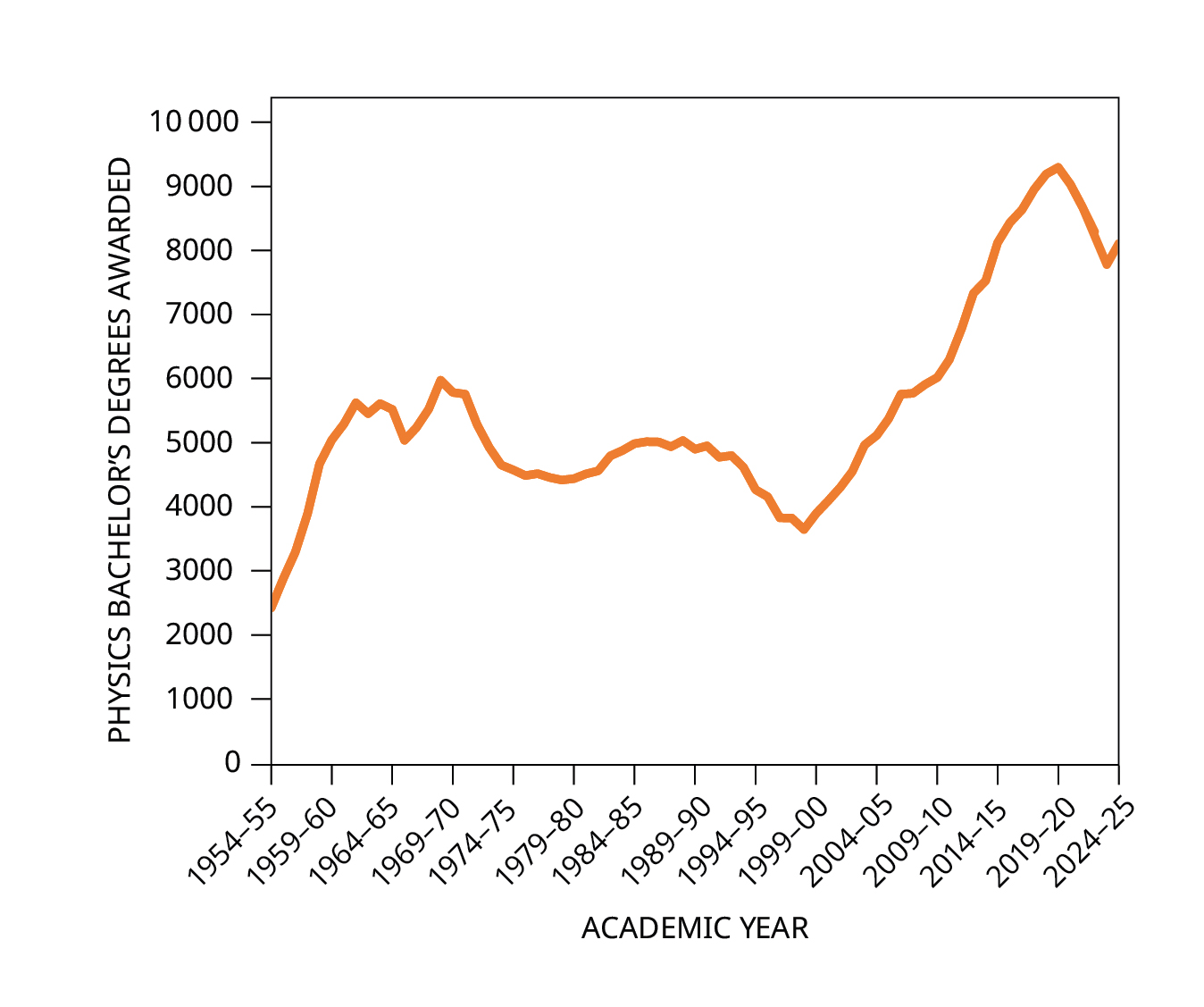
The numbers are unnerving. After two decades of sustained growth, the number of physics bachelor’s degrees awarded in the US declined from the years 2020 to 2024, according to a recent trend analysis from the research team at the American Institute of Physics (AIP, publisher of Physics Today). 1 Figure 1 shows the drop, which, the latest AIP data show, was followed by a slight increase in the 2024–25 academic year. 2 US physics departments awarded 8108 bachelor’s degrees in the 2024–25 academic year—that’s down 13% from the peak of 9296 degrees awarded in 2019–20.
Figure 1.

After peaking in 2019–20, the number of physics bachelor’s recipients decreased for four consecutive years before rebounding slightly in 2024–25. Although the decrease is partly influenced by broad trends in higher education, departments can take actions to attract and retain students.
(Data courtesy of the American Institute of Physics.)

As AIP’s chief research officer, I have been asked by many people in the physics community to explain the multiyear decline. Is the decline a result of department closures? Is it unique to physics? Does the signal indicate a coming physics, or physics educator, workforce shortage? And what, if anything, should physics departments and the broader community do in response?
The goal of this article is to clarify what the enrollment and degree trends do—and do not—tell us about the current state and future of undergraduate physics education. Amid broad structural trends in higher education, physics departments will increasingly need to adapt and make institutional choices that remain firmly in their control.
Are department closures to blame?
The shuttering of physics departments in recent years has received considerable attention. 3 That makes sense: An institution of higher education ending its physics bachelor’s degree program is disruptive and upsetting for faculty and students. (You can expect to read more on the situation in an upcoming issue of PT.) The visibility of the closures has led to the question of whether the recent decline in physics bachelor’s degrees is primarily because of departments disappearing.
Indeed, the number of institutions awarding physics bachelor’s degrees has declined. In the 2023–24 academic year, 723 US institutions offered physics bachelor’s degrees—that’s a net decline of 34 departments (4.5%) from five years earlier. 1
It is tempting to try to connect those closures to the broad decline in degree production. But the institutions that stopped awarding physics bachelor’s degrees from 2019 to 2024 averaged 2.5 graduates per year. As a result, department closures account for no more than 10% of the overall decline since the 2019–20 peak.
Although the closure of any physics program has substantial consequences for students, faculty, and communities, the trend of fewer bachelor’s recipients appears to be driven by an overall decline in degree production at institutions across the physical sciences.
Is physics alone?
Interpreting the recent decline in the number of physics bachelor’s degrees requires situating physics within the broader trends occurring in the sciences and higher education. The data show that the decline is not unique to physics.
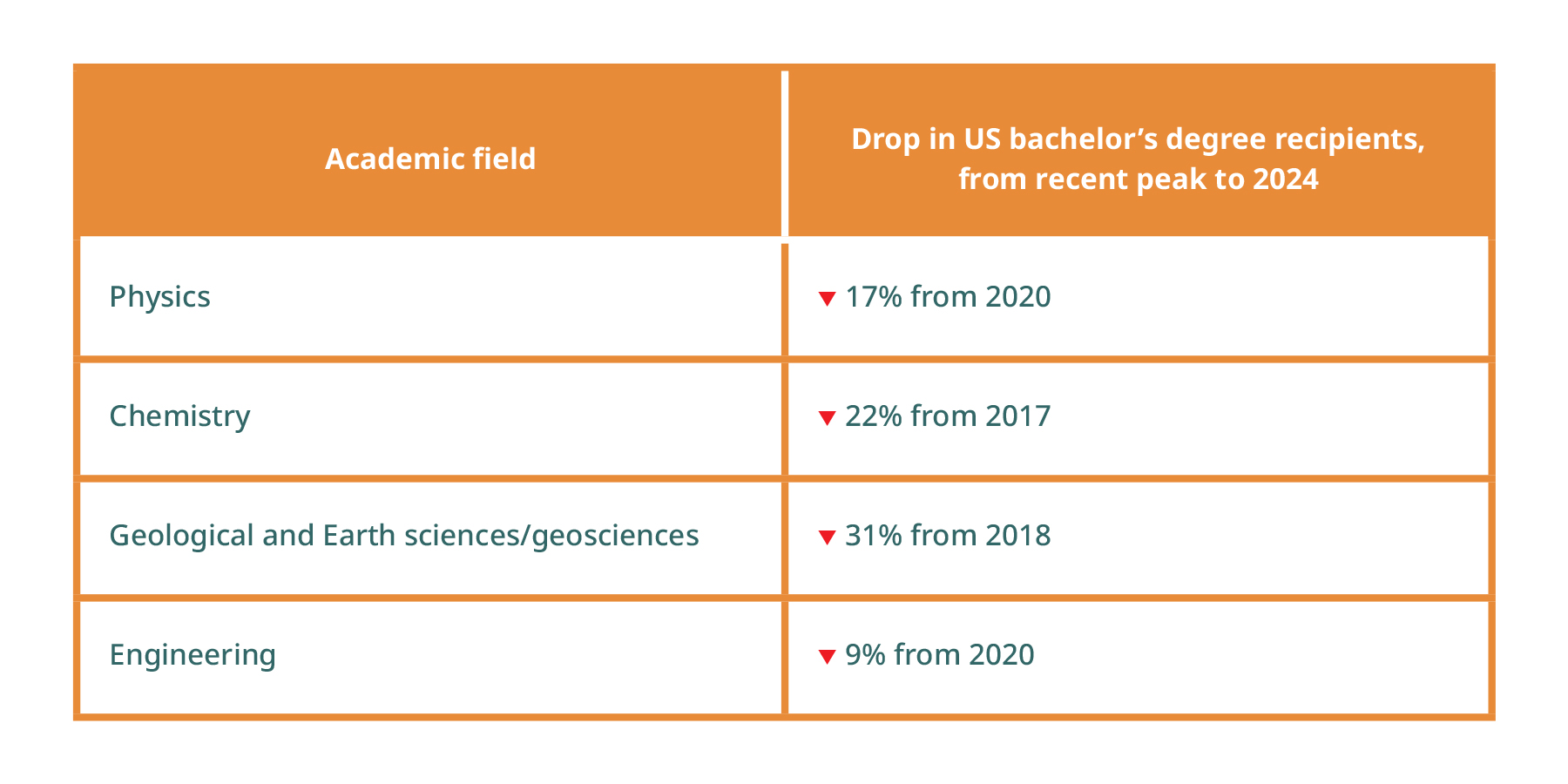
Data from the Department of Education show similar or steeper declines across several physical science disciplines. In 2024, there were 12 590 people who received bachelor’s degrees in chemistry, a 22% drop from the all-time peak in 2017. There were 4802 geoscience and Earth science degrees awarded in 2024, a 31% decline from the all-time high in 2018. Taking all the physical science fields in the data, the number of awarded bachelor’s degrees dropped from 33 150 in 2018 to 27 177 in 2024, a decline of about 18%. 4 Figure 2 tabulates some of the drops in degree production.
Figure 2.

The numbers of students in the US who have been awarded a bachelor’s degree in certain physical science fields and in engineering have dropped from their peaks of 6–9 years ago, according to the US Department of Education. The percentage decrease for physics differs slightly from that in figure 1 because of methodology differences.
(Data courtesy of US Department of Education, National Center for Education Statistics, Integrated Postsecondary Education Data System.)

Despite the trend in the physical sciences, overall STEM degree production has continued to increase. Much of that growth, however, has been driven by the dramatic expansion of computer science and information science bachelor’s degrees, which more than doubled from 2014 to 2024. Outside of computing-related fields, many STEM disciplines have stagnated or declined. The biological and biomedical sciences have seen slight declines in 2023–24 compared with 2022–23, and the number of awarded engineering bachelor’s degrees has dropped about 9% from an all-time peak of more than 130 000 in 2020. The broad shifts likely reflect a combination of demographic pressures, changing student perceptions of career pathways, and evolving patterns in undergraduate enrollment behavior.
The rise and fall of degree numbers in different STEM fields helps explain an apparent contradiction in recent reports on STEM education. NSF’s The State of U.S. Science and Engineering 2026 report noted a 17% increase in science and engineering bachelor’s degrees from 2014 to 2024. 5 That statement is accurate. The choice of a 10-year window, however, obscures important changes in the latter half of the period. Many disciplines, including several physical science fields, experienced degree growth during the first half of that period before enduring declines more recently. Much of the increase during the decade-long period reflects the extraordinary growth of computing-related disciplines and, to a lesser extent, of other fields, such as psychology.
Will the situation improve?
One way to get an early indication of future degree production is to analyze the enrollment patterns of current students. Unlike the Department of Education and NSF data, which describe only degrees that have already been awarded, AIP’s annual Survey of Enrollments and Degrees also tracks the number of juniors and seniors in undergraduate physics programs. In those data, upper-level undergraduate enrollments appear to have bottomed out around the year 2022 and have since begun to rebound modestly. (Indeed, a recent report from AIP’s research team describes that modest rebound. 2 ) The increase in physics bachelor’s degree production in 2024–25 could be a sign of stabilization, and the trend may continue over the next several years.
But short-term stabilization is different from long-term structural recovery. The number of US high school graduates has begun a decline after peaking in 2025. The US birth rate has not bounced back from declines that began at the start of the Great Recession in late 2007, and the number of graduates is projected to decline steadily through at least 2041. In higher education, the trend is widely referred to as the “demographic cliff.”
Additionally, undergraduate enrollment nationally has been mostly declining since 2011 as a smaller share of potential students has pursued four-year degrees. 6 The trend is expected to intensify competition among colleges and universities for a shrinking pool of undergraduate students.
The demographic and enrollment pressures suggest that even if physics degree production rebounds modestly in the near term, departments will increasingly need to adapt: Compared with previous years, the higher-education environment today is more competitive and demographically constrained.
Will there be a shortage of physicists?
Scientific society leaders and physics department chairs frequently ask me whether the recent decline in physics bachelor’s degree production is likely to lead to a shortage of physicists in the US. That question is more complex than it initially appears because physics graduates pursue a broad breadth of educational and career pathways.
AIP’s studies of degree outcomes for physics students can help provide an answer. Conducted by the research team since the 1960s, those studies provide important context for understanding how physics graduates move through higher education and the workforce.
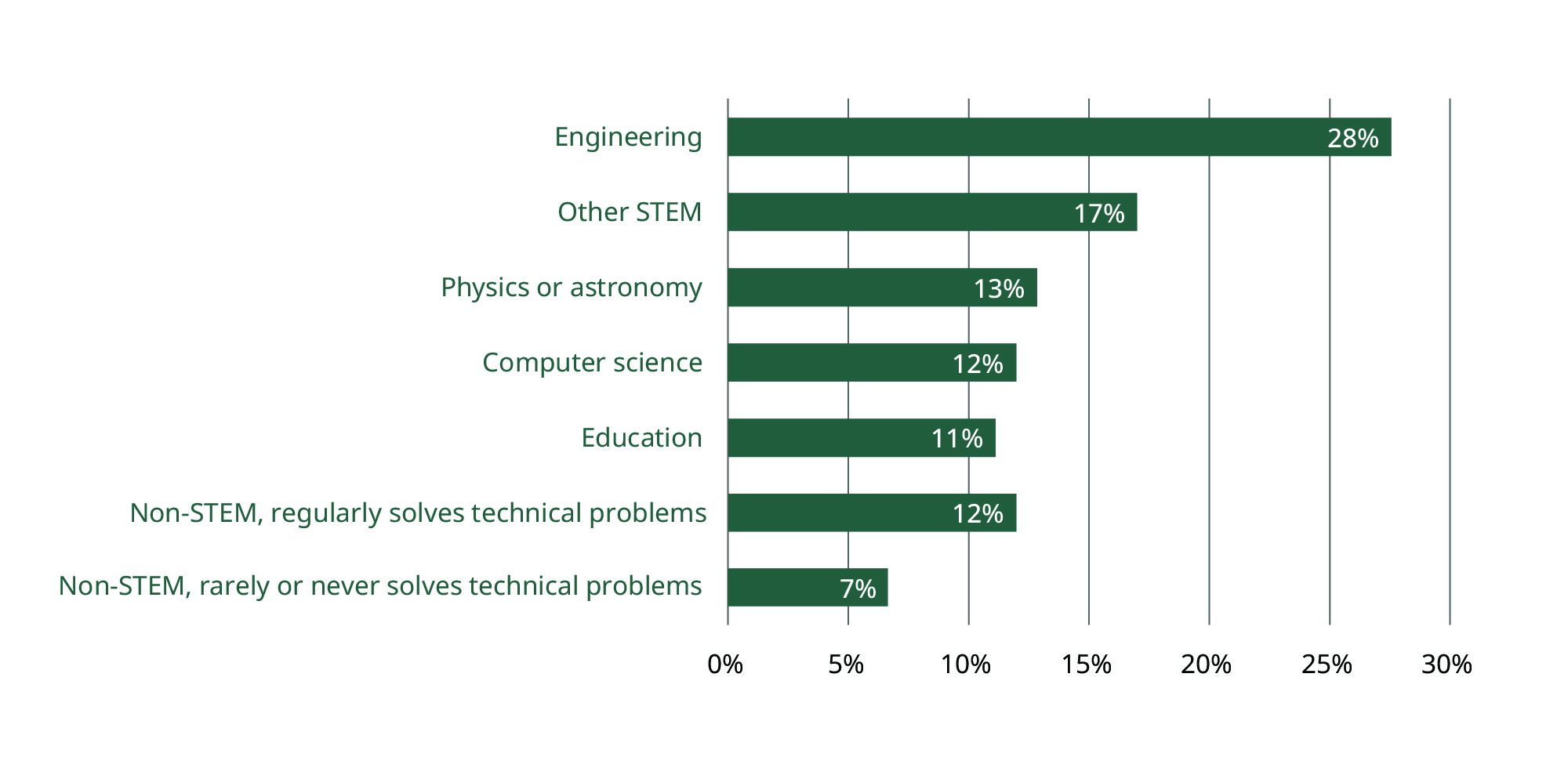
Among recent physics bachelor’s degree recipients, roughly half enter graduate school, while the other half move directly to the workforce. 7 Figure 3 shows that, of those entering the workforce in 2020–24, only 13% report working in positions they describe as physics or astronomy related. The predominant fields of employment are engineering (28%) and other STEM fields (17%), which include data science jobs and other technical occupations. Some 19% work in a non-STEM field. The data suggest that physics bachelor’s degrees function less as narrow vocational credentials and more as broadly applicable preparation for analytical and technical work across many sectors of the economy.
Figure 3.

Those who enter the workforce with a physics bachelor’s rather than pursuing graduate study are employed in many different job fields, according to survey data from 2020 to 2024. The breadth of jobs that they take weakens the argument that the recent decline in the number of physics degrees will result in shortages of workers for positions in physics and astronomy.
(Data courtesy of the American Institute of Physics.)

At the doctoral level, about half of newly awarded physics PhDs initially take postdoctoral positions, most of which are in physics research environments. But for those who move directly to potentially permanent positions, most report employment outside core physics roles and pathways. 8 Among those who take potentially permanent positions, 20% report working in data science, 17% in engineering, and 11% in computer software. 9 Those moving directly into the private-sector workforce report substantially higher incomes than those doing postdocs. 8
Taken together, the employment outcomes complicate any single narrative about potential workforce shortages. Declining physics degree production does not necessarily translate directly into shortages of workers for narrowly defined physics jobs, particularly given the broad occupational distribution of physics graduates.
The employment findings also complicate simplistic pipeline models of physics education. The data make clear that physics education is not merely, or even primarily, about moving students from bachelor’s degrees to graduate school, into postdoctoral training, and into academic research careers resembling those of their faculty mentors. Physics graduates already move into an exceptionally diverse number of scientific, technical, financial, and analytical professions. One of the central challenges facing the field is figuring out how to better communicate the value of those diverse career pathways and to prepare students for them more intentionally.
Acting where departments have agency
The forces shaping undergraduate enrollment are outside the control of individual departments. Physics faculty cannot reverse national demographic shifts or broad declines in undergraduate enrollment. Departments do, however, have substantial agency in shaping whether students who arrive interested in physics ultimately persist in the major.
A five-year longitudinal study published in 2024 by AIP examined persistence and attrition among undergraduate students who took an introductory physics course at four large universities. 10 The researchers found that physics departments were losing many students who initially were interested in majoring in physics. Among the 277 students who initially expressed interest in physics and were tracked from introductory coursework through degree completion, only about 38% ultimately graduated with a physics degree. Many of those students cited discouraging early classroom experiences, rigid and long course sequencing, or departmental cultures that made persistence difficult. They also reported finding other majors more attractive, perhaps because of discouraging experiences in physics.
The timing of attrition is also significant. Some 43% of the students in the study who ultimately left the major made that decision during or immediately after their introductory physics course, and another 30% left during their second year. Although the data are not necessarily representative of all undergraduates who begin their studies with an interest in physics, they still suggest that the first two years are critical.
The longitudinal study illustrates that now, in an era of demographic contraction and increasing competition for students, departments are in critical need of retaining students who are already interested in physics. Fortunately, a substantial number of programs that have been developed by the American Physical Society (APS), the American Association of Physics Teachers (AAPT), and other organizations can help departments address that challenge. Resources such as the APS and AAPT Effective Practices for Physics Programs (EP3) guide, AAPT’s ComPADRE collections, APS departmental resources, and programs supported by the Society of Physics Students provide concrete, research-informed approaches for improving pedagogy, advising, culture, and student support.
To thrive in the coming decades, physics departments will likely need to rethink introductory coursework. Rather than using introductory sequences as sorting mechanisms, departments should use them as invitations into the discipline. That effort would include prioritizing curricular innovations that support timely degree completion for undergraduates with various backgrounds, including those who arrive without preparation in calculus or advanced physics coursework. Physics education researchers have demonstrated that those kinds of changes in course sequencing and program design can be implemented and maintain rigorous standards for student learning. (For more on calculus-based physics and student readiness, see the October 2025 PT article by Suzanne White Brahmia and Geraldine L. Cochran.)
In the current higher-education environment, investments in evidence-based pedagogy, inclusive departmental cultures, flexible curricular pathways, and student support systems are not simply matters of educational philosophy or equity, although they are important in those areas. Those investments are increasingly central to the long-term viability of undergraduate physics programs themselves.
Departments entering a period of demographic contraction cannot afford to continue unnecessarily losing interested and capable students through discouraging introductory experiences, inflexible curricular structures, or unwelcoming departmental climates. The substantial body of work developed through physics education research and related professional initiatives increasingly offers practical institutional knowledge about how physics departments can adapt, remain sustainable, and ultimately thrive in a far more competitive higher-education environment.
References
1. P. Mulvey, S. Nicholson, Trends in Physics Bachelor’s Degrees: Decline and Signs of Stabilization , American Institute of Physics (2026).
2. P. Mulvey, S. Nicholson, J. Pold, Physics Bachelor’s Degree Recipients: Recent Trends, Educational Characteristics, and Influences , American Institute of Physics (2026).
3. L. Boatman, “Despite strong interest in physics, some universities are shuttering departments ,” APS News, 14 August 2024.
4. J. Tyler, Degrees Earned in the Physical Sciences and Engineering Fields , American Institute of Physics (2026).
5. National Science Board, Committee on National Science and Engineering Policy, NSF, Science and Engineering Indicators 2026: The State of U.S. Science and Engineering , NSB-SEP-2026-1 (May 2026).
6. J. Selingo, “The looming college-enrollment death spiral ,” The Atlantic, 12 April 2026.
7. P. Mulvey, J. Pold, Physics Bachelors Initial Employment Booklet—Academic Years 2020–21 and 2021–22 , American Institute of Physics (2025).
8. P. Mulvey, J. Pold, Physics PhDs Initial Employment Booklet—Academic Years 2020–21 and 2021–22 , American Institute of Physics (2024).
9. P. Mulvey, J. Pold, J. Tyler, Who’s Hiring Physics PhDs , American Institute of Physics (2025).
10. A. M. Porter, R. Y. Chu, R. Ivie, Attrition and Persistence in Undergraduate Physics Programs: A Five-Year Longitudinal Study (2018–2023) , American Institute of Physics (2024).