Celebrating science: How to launch a university science festival

For most people, cutting-edge science is invisible. There are no behind-the-scenes passes or highlight reels for what goes on in university labs. That’s why the Texas A&M University Physics and Engineering Festival has been my passion for the past 20 years.
Science festivals break down the walls between scientists and the public, creating opportunities for everyone to share in the excitement, creativity, and wonder of discovery. From small, locally organized events to larger citywide or statewide initiatives, science festivals give nonspecialists a chance to touch, test, and explore science firsthand.
If you’re looking to bring science to your own community through a festival, here are some practical tips and lessons I’ve learned from two decades of coordinating one at the university level.
Our festival
Organized by the department of physics and astronomy, Texas A&M’s festival is predominantly focused on physics, although we collaborate with other departments and a local museum. It is a one-day celebration of physics, science, and engineering that is attended by more than 7000 people each year. It features more than 200 interactive demonstrations presented by faculty, staff, and students. The program also includes talks by renowned physicists and astronauts, along with events such as the Science Circus —which illustrates physics concepts through circus arts—and a soap-bubble show by professional artists. The entire festival is free to the public and culminates in a signature explosive finale.

(Design by Masie Chong with artwork adapted from iStock.com artist Giorgi Gogitidze.)
It’s remarkable to see the entire department—faculty, students, and staff—come together to share their passion for physics with the public. The festival is the culmination of dozens of year-round outreach events, including the Physics Show, a set of physics demonstrations aimed at K–12 students; Just Add Science, an initiative that brings science to other public events; Game Day Physics, in which the department presents physics demonstrations before Texas A&M football games; and the Mitchell Institute Physics Enhancement Program, which supports teacher training. Our outreach is further amplified by our millions-strong social media presence. Collectively, those efforts have contributed to a significant increase in physics majors.
Our festival was founded in 2003 by then–department head Ed Fry, who challenged faculty to re-create hands-on demonstrations that had inspired them as students. He had invited Stephen Hawking to give lectures at the university and wanted to do something to engage the public. The event was a huge success and set a high standard from the beginning. His vision established a lasting departmental tradition of commitment to public outreach. As a result, one hallmark of the festival is the extraordinary amount of participation from faculty at all levels.
Starting a festival
If you’re considering starting a physics festival, here’s the first thing to remember: A sustainable and successful outreach program requires both a dedicated champion and strong administrative support. When I began organizing Texas A&M’s festival in 2006, Fry assured me that he had my back. Early-career faculty or graduate students can help spark interest and motivate colleagues, but the traditions and recognition that contribute to a lasting program do not develop overnight or even within the span of a graduate career. Without support from leadership, it’s difficult to build a departmental culture in which physics outreach is truly valued.
The most important lesson I’ve learned is this: What we often call public outreach not only benefits the public but provides an important educational opportunity for both undergraduate and graduate students. When we involve students in outreach, we deepen their learning and help prepare them for their future careers. When I began planning the science festival, my motivation was simple: I wanted to make physics accessible and enjoyable for a broad audience. That goal remains central to all our outreach efforts. But over time, I noticed that the festival was also helping to shape our students. As I watched them explain ideas, engage with diverse audiences, and take ownership of their work, I realized how much the experience enriches their education.

Texas A&M University undergraduates Josefina Medina-Perez, Victor Catalan-Avila, and Andrew Barclay (from left) help attendees insert straws into potatoes as part of a demonstration showing how trapping air in the straws makes them sturdier.
(Photo by Mathew Baughman.)

The dynamic and often less structured environment of the festival—as well as of other outreach programs—fosters in our students genuine enthusiasm to serve as ambassadors of science. Explaining the physics behind hands-on demonstrations sharpens their ability to clearly communicate complex ideas. At the same time, they develop teamwork and design skills, build connections with people in the department, and gain recognition from peers, faculty, and the broader public.
Those observations are not merely anecdotal. My collaborators and I have collected data showing that such outreach programs in which students explain physics to the public help them build disciplinary identity, develop a sense of belonging in the physics community, and acquire transferable skills such as communication, design, and teamwork, which are essential for 21st-century careers. Those findings are based on dozens of interviews and hundreds of surveys from students at Texas A&M and across the country.
I will conclude this section with a quote, which I find particularly powerful, from a Texas A&M freshman who participated in the festival: “I wasn’t sure if [physics] was a good fit for me, but I’ve definitely been really reaffirmed that it’s something that I want to do and something that I can do, something kind of I’m actually able to do.” 1 So if you decide to propose a festival to university administration, do not undersell it as simply a service activity. Emphasize to them that by organizing a festival, you are elevating the educational experience of your students.
Planning the festival
So you’ve decided to plan a festival. But where do you begin? My advice is to go with the hands-on format. Not all of us are natural science communicators, but it becomes much easier to connect with the public when you have a favorite physics toy or an engaging demonstration to share. And when the audience can participate—by touching, trying, and exploring—they are far more likely to listen, ask questions, and appreciate the science behind it. Physics offers a wealth of demonstrations that captivate students in our classrooms, so there’s no need to reinvent the wheel. Identify what your department already has and reimagine those familiar demonstrations as interactive experiences for the public. Even a modest collection of hands-on activities can create moments that draw people in and leave them with a lasting appreciation for physics.
People show up by the thousands to music festivals, even though most attendees aren’t professional musicians. Why can’t we celebrate science, physics, and engineering at a science festival? Invite everyone, whether they are interested in science or not. It’s wrong to think of a festival solely as an occasion where scientists educate the public because that emphasizes a divide: We, the scientists, are teaching you, the nonscientists. The goal is not to convert all audience members into scientists but for them to celebrate and learn science without even realizing they are learning. So ask yourself: What is your celebratory element? What will draw people to your festival?

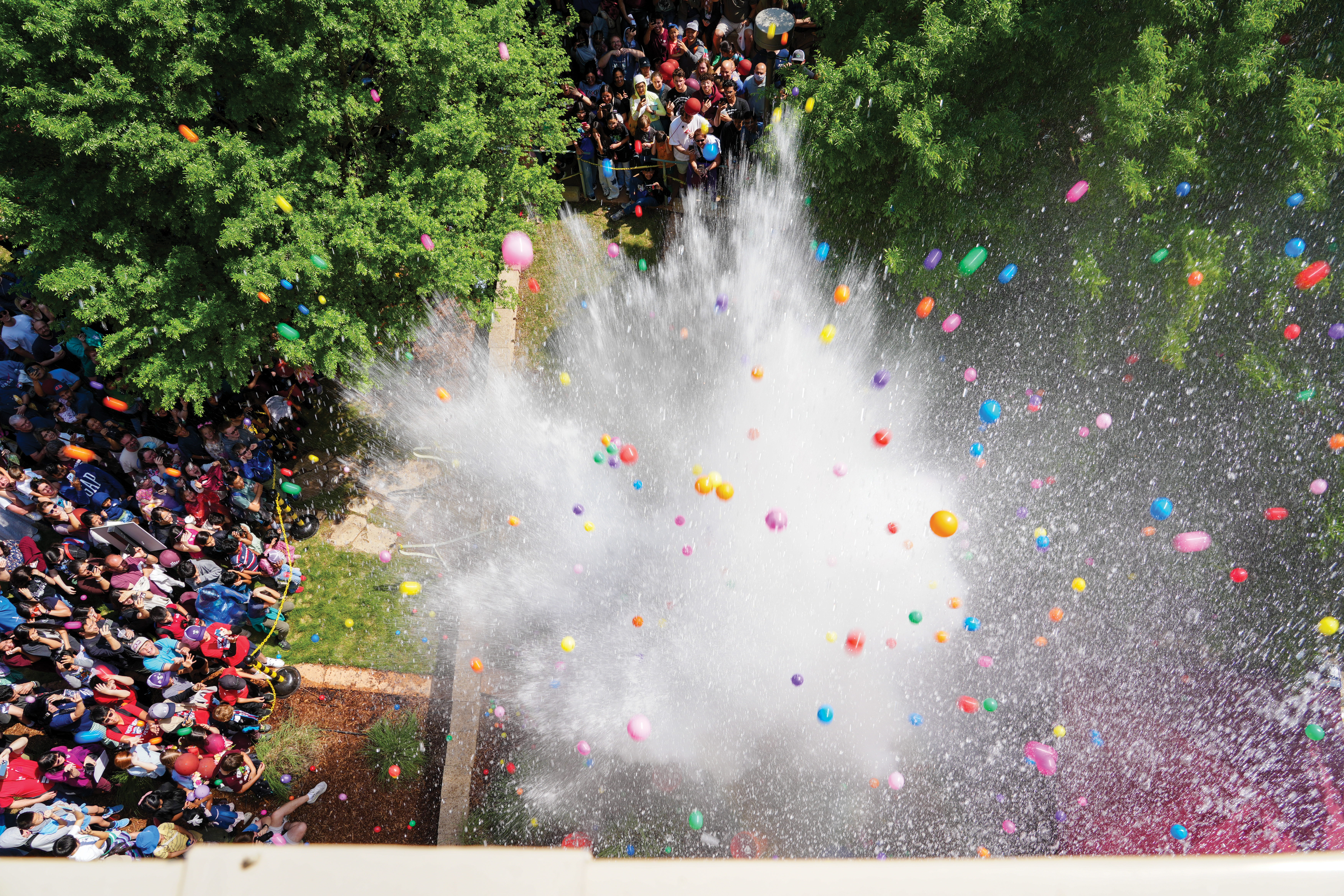
The grand finale of the Texas A&M University Physics and Engineering Festival: A Texas-sized liquid-nitrogen depth charge that explodes and sends about a thousand plastic balls into the air.
(Photo by Ryan Carmichael.)

The draw could be a public talk (I avoid calling it a lecture) by a prominent scientist or astronaut. In our festival’s first year, the main attraction was Hawking’s talk. Use the expertise of your own faculty. Our festival strongly benefits from a faculty-led virtual tour of the Large Hadron Collider at CERN and a low-temperature physics extravaganza showcasing our department’s expertise.
One of our festival’s main attractions is the grand finale: We seal a small amount of liquid nitrogen in soda bottles and anchor them in five water-filled barrels that are filled with about a thousand colorful plastic balls. As the nitrogen turns to gas, it bursts the soda bottles and sends up a Texas-sized explosive fountain of water that causes thousands to cheer for physics. To avoid cleanup, we label each ball with a Texas A&M logo and the year, which turns them into collectibles that children eagerly gather.
Building local connections
Engaging with the community and building partnerships is essential for your festival’s success. You can achieve that connection in various ways. Utah State University’s Physics Day at Lagoon draws thousands of middle and high school students to a popular amusement park. One of the most memorable events at our festival was a lecture on the physics of cooking by Harvard professor David Weitz. He teamed up with local chefs who cooked dishes as he explained the physics behind their creations.
Don’t put on the festival by yourself. Build partnerships with other departments and local museums. A strong support team is essential. Younger people are often enthusiastic about outreach, so tap into your student organizations. Family Physics Night at Texas Lutheran University in Seguin, for example, is led by its chapter of the Society of Physics Students (SPS). Our own festival would be impossible without the consistent and outstanding support of our graduate students and undergraduate SPS chapter members, who play a crucial role in its success. Whether your school is large or small, there will surely be students eager to share their passion with the public.
Safety for both the public and presenters needs to be a top priority. Few scientists are trained in crowd control, so it’s easy to overlook. If you expect large crowds, secure support from campus and local police and emergency medical services. Work with your institution’s environment, health, and safety team and learn its rules from the start. Simple steps matter, such as lost-child stickers with a parent’s contact information.

After dipping his hand into a soapy solution containing methane-filled bubbles, Texas A&M University graduate student Alexander Thornton ignites the bubbles on his hand and creates a flame plume.
(Photo by Igor Kraguljac.)

Have presenters test the activities in smaller settings because presenting to an undergraduate class is very different from working with large groups of excited, and sometimes unruly, children around you. The goal is not just protecting equipment but keeping everyone safe. Are your hands-on exhibits safe for both visitors and presenters? Are demonstrators properly trained? A useful guideline is to ask, How are risks to spectators, presenters, and the environment being mitigated?
To attract people to your festival, remember that word of mouth remains one of the most powerful tools. Promote your event through schools, social media, and local TV and radio stations, which are often willing to provide coverage at no cost. Advertising on social media may require a small budget but can extend your reach significantly. If resources allow, consider producing T-shirts or other merchandise that people can wear and share, which will further amplify visibility and highlight your sponsors.
Even a modest departmental budget can support a special event featuring small, hands-on demonstrations that you already use in your physics courses. To grow, reach out to donors in industry and the private sector. Support from sponsors can transform and even endow a festival. When seeking funding, present it as a dual benefit: Beyond public outreach, science festivals enhance students’ educational experience. It is equally important to plan how you will evaluate success. The approach will depend on your budget, but photos, videos, and testimonials from both visitors and students are powerful tools for reporting impact and sustaining donor and institutional support.
Universities are home to thousands of individuals passionate about science. Making science festivals a sustained priority at institutions of all sizes would help extend that passion into the broader community, enrich the educational experience of our students, and contribute to a better-informed society.
Reference
1. C. Rethman et al., “Impact of informal physics programs on university student development: Creating a physicist ,” Phys. Rev. Phys. Educ. Res. 17, 020110 (2021), p. 13.
More about the authors
Tatiana Erukhimova holds the Marsha L. ’69 and Ralph F. Schilling ’68 Chair for Physics Outreach in the department of physics and astronomy at Texas A&M University in College Station. She is the 2023 recipient of the Dwight Nicholson Medal for Outreach from the American Physical Society.