TikTok your science: How to cultivate a digital audience

When I started posting videos about my physics homework out of boredom during COVID-19 lockdowns, I was incredibly surprised to find that there was an audience of thousands for a brief description of the Casimir effect. Having no ring light or dedicated camera, I made the video with just my phone and a fun idea.
In the years following, I posted more than 100 videos about physics concepts to TikTok and YouTube under the handle @physicsdude and amassed millions of views. While I have stepped away from posting videos to focus on materials science doctoral research at Brown University, the endeavor was a meaningful part of my life for years. Beyond the soaring view counts, I received comments and messages from students, many of whom told me my content inspired them to major in physics in college. Even one message like that makes all my video-making efforts worthwhile.
Science as an institution requires a continuous influx of bright, passionate students, but scientists cannot sit idly by and wait for them. When engaging in outreach, scientists need to meet young people where they are, which is, realistically, on their phones.
For researchers who want to do outreach through short-form video creation, here is some background and practical advice for making engaging, effective content.
Get to know your chosen platform
Historically, most video entertainment platforms had a huge gulf between creators and consumers. A big studio would make movies or shows, and people would watch them. The internet enabled YouTube and similar platforms to democratize creation by allowing anybody to post content. But creators still needed to put in a lot of work and time to grow their audiences and make high-quality content that got noticed.

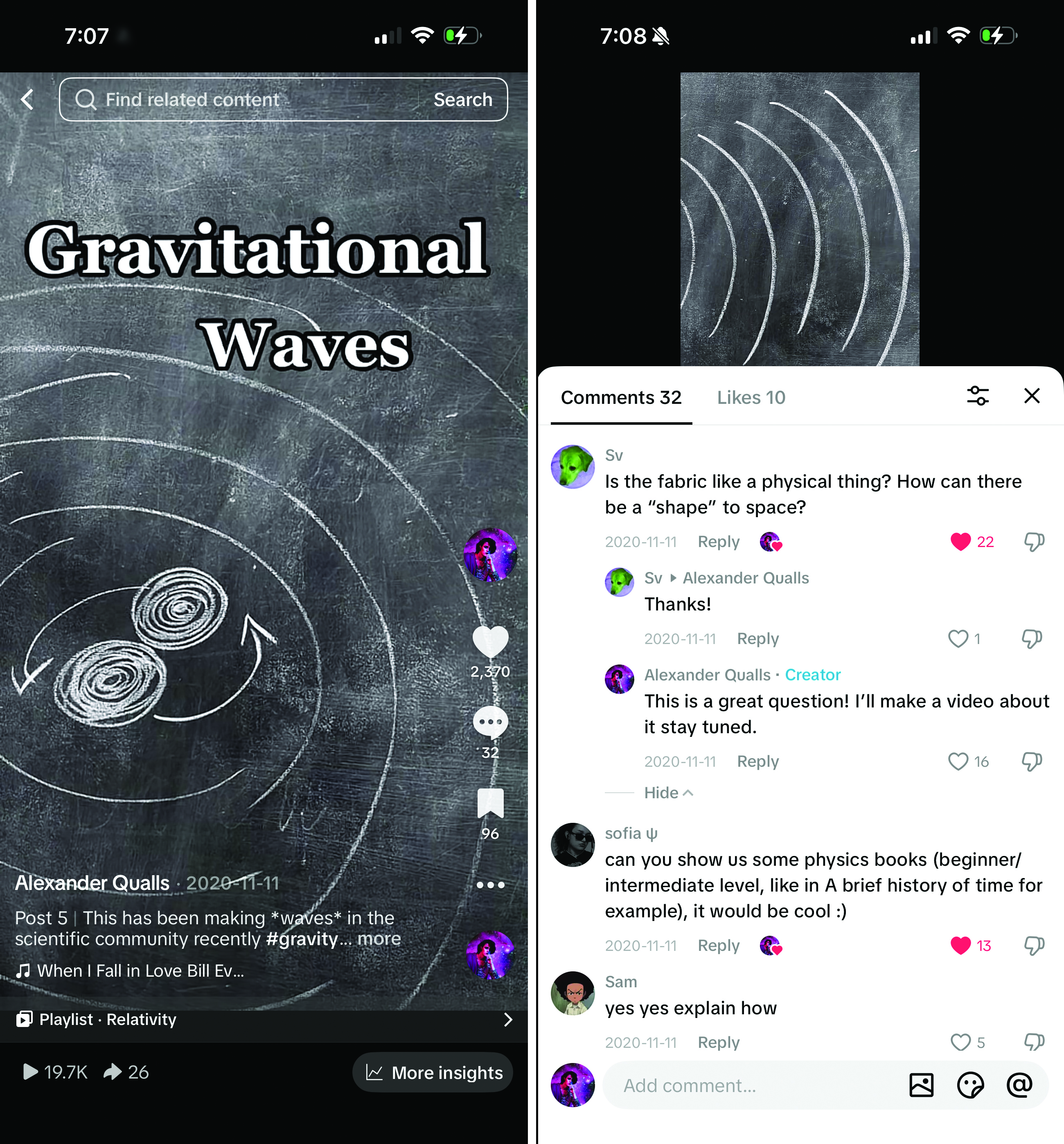
TikTok screenshots of a video by @physicsdude about gravitational waves and of viewer comments.

The app TikTok hit the global market in 2017 and further disrupted the online video space. It all but vaporizes the barrier between the viewer and creator by enforcing a shorter-form, vertical-scrolling video feed, and it provides comprehensive in-app video creation tools that are easy to use. TikTok’s algorithm is built to encourage user likes, comments, and watch time by giving the user similar content to what they’ve engaged with in the past. Over time, the algorithm discovers the user’s niche interests and selectively suggests more just like it.
TikTok’s formula is wildly successful, and the app has gained more than 2 billion users worldwide as of 2026, according to the consumer-research firm Kepios. The TikTok video format has become ubiquitous across platforms, including Facebook, Instagram, and YouTube. If you design your videos to succeed on TikTok, there’s a good chance they’ll also do well on other social media platforms.
Effective outreach in a format like short-form video means communicating the subjective joy of the practice of science rather than the core science itself—because the format leaves little room for nuance.
The massive user base, diverse and numerous creators, and uncannily precise algorithms make the space of online short-form video a dynamic and varied landscape. The best way to map out your small corner is to do some exploring. Post videos and don’t worry if the first ones flop—look for feedback in the comments. Scroll the feeds of TikTok, YouTube, Instagram, or whatever sites you prefer (creators often repost across many or all of them anyway). Just remember not to get too hooked. It is a good idea to schedule out a block of time to sit with the platform and see what people are releasing that day. Treat it as you would any dive into a new field of research.
Find your thing
Having a unique identity is paramount as a content creator. If you have an idea for a video topic, many others have very likely already covered it (kind of like research!). The question is, Why would people watch your video in particular?
For some scientists, the tendency is strong to fade their personalities into the background and let the science or data take center stage. This is an admirable quality in some circumstances, but not in a short-form video. Effective outreach in such a format means communicating the subjective joy of the practice of science rather than the core science itself—because short-form video leaves little room for nuance.

(Design by Masie Chong with icons by Freddie Pagani and artwork adapted from iStock.com artist Giorgi Gogitidze.)
Treat this as an exercise in getting in touch with your individual, subjective personality as a researcher. Signal to your audience that you are a real person who loves what you do. This could be through some curated aesthetic. In my case, I am a lover of jazz, art, and coffeehouse vibes. I incorporated those by styling my videos with minimal black-and-white chalkboard drawings and backing them with music by jazz greats like John Coltrane and Dave Brubeck.
Your unique personality could shine through in the content itself: a particular topic, a style of commentary, or even the specific words or phrases you use. Experiment with making content and find out what you like, what speaks to you, and what is stimulating, and emphasize those things. Making content you think is good will likely find its way, through the power of the algorithm, to people who also think it’s good.
Hone the hook
On TikTok, users see a few seconds of your video before they decide whether to keep scrolling. A hook—a device that captures a viewer’s attention and keeps them watching— is a crucial part of making short-form videos.
There is no one-size-fits-all hook for TikTok. An obviously planned hook will turn viewers away (it can be cringe!). Creators must strike a delicate balance between having an engaging hook and still coming across as authentic. YouTube math creator 3Blue1Brown makes well-crafted hooks. Most of his videos start simply by him asking a question about something you may not have thought about, and then he quickly gets to the heart of the inquiry and skillfully conveys his honest excitement at the same time.
My most successful hooks are ones I did by mistake. I have a few videos that just happen to open with an interesting scenario and have a good pace right off the bat, like my video on reference frames from planes. It’s the kind of thing you know when you see it. Like serving a tennis ball—you might know how to do it in theory, but it takes a lot of practice to consistently get it right. When you do hit an ace, though, you know it.
Keep vibes central
Experiment with making content and find out what you like, what speaks to you, and what is stimulating, and emphasize those things. Making content you think is good will likely find its way, through the power of the algorithm, to people who also think it’s good.
That, however, is not how everyone approaches content creation. Countless times, I have seen an institution decide that they want a short-form video social media presence—say on TikTok. They buy cameras, workshop ideas, and maybe even hire some people. After investing a bunch of time and money, their videos flop. This stems from the assumption that the main differentiator between being a creator and being a consumer is having access to the resources to produce content. On modern platforms like TikTok, that does not matter at all. All that matters are vibes.
But the precise meaning of the word vibes is, by its nature, difficult to articulate. What institutions get wrong is starting from the method and assuming that ideas and cohesion can come after the fact. The reality is that most things produced in this way come across as awkward and inauthentic.
A much better strategy for institutions is to find their youngest and most creative members and give them the login to their social accounts and the bandwidth to do anything they want. A creative person having fun messing around produces a much better vibe than some buttoned-up folks with nice cameras executing a storyboard. It’s not that high production value is always a bad idea; it’s just that the feeling is much more important than anything else. The YouTube channel PBS Space Time is a great example of institutional content that strikes the right balance.
When I look through my old videos, the most popular ones turned out to be those in which I felt the most natural. The editing, the voice-over, the music, and the topic all came together into a cohesive whole. The specific elements that contribute to your vibe will depend on your unique personality as a creator, but building the intuition will help you make videos that people will want to watch.
Make it beautiful

Alexander Qualls records a video by hand using an iPhone pointed at a blackboard, which hangs near his desk.
Enjoy making your science eye-catching! In the digital world of catchy pop song clips and sticky slime ASMR (autonomous sensory meridian response), anything drab suffers a massive disadvantage. Show off how beautiful your telescope looks at sunset, convey how confident you feel in a lab coat, or spend time stylizing a visualization for a simulation you ran. Beyond being useful epistemically, science also can be appealing aesthetically.
This does not mean you make your content overly attractive if that is not what you are drawn to. Beauty can come from other places, even from going purposefully low tech. I never had a dedicated camera or lighting setup despite my large following. The visual appeal of my content came from curated visuals, music, and subject matter. Don’t try to inject aesthetics into your work when sharing it online; find the existing beauty and show it to your audience.
Don’t do sponsored content
Sponsorships are ubiquitous on social media platforms, so it might seem strange for me to suggest not to engage with them.
My view is that short-form science outreach videos by full-time scientists should not be a financial resource. Even when doing outreach, our primary job is still being a scientist. Advertisers want to compel viewers to buy their products and services; we want viewers to become involved in science.
In my first years on TikTok, I did a fair amount of sponsored content. I made a couple thousand dollars, which I loved as a starving student, but the focus on advertising took away from both my content and my experience making it. Selling a product and communicating science can feel like a juggling act that hugely increases your mental load and can alienate your audience, so it is best to stay away altogether, in my opinion.
Build the off-ramp
It is increasingly well understood that algorithmic content can have a radicalizing effect on its viewers. It is well worth familiarizing yourself with this dangerous potentiality if you are creating content on social media platforms. A much brighter outcome is also possible: An impressionable young person can be moved to positive real-world action by watching educational videos or engaging in other outreach activities that appeal to their natural curiosity. I know because it happened to the students watching my content, and before that, during my own youth spent on the internet.
The goal of outreach videos is to push the viewer off the phone and into the real world. Explicit calls to action, encouragement toward taking classes, or linking in-depth content for viewers are a few approaches. Often more effective, though, are implicit nudges. What path of inquiry does your subject matter open? In answering a question, what new questions are uncovered? Short-form videos mean that no subject can be treated holistically, so don’t even try. Leave your nuggets of science tantalizingly incomplete. Leave the audience wanting to learn more in a way that is possible only in classrooms or in research.
So go out there and have some fun spreading the word about the beauty of science. Don’t be afraid to get wacky, and don’t be afraid to be yourself. As scientists, we can help others look up from their phone screens and out into the splendor of the world around them.
More about the authors
Alexander Qualls is a PhD student researcher in the School of Engineering’s Atomic Scale Quantum Materials Lab at Brown University in Providence, Rhode Island.