Matching pipe organs to room acoustics


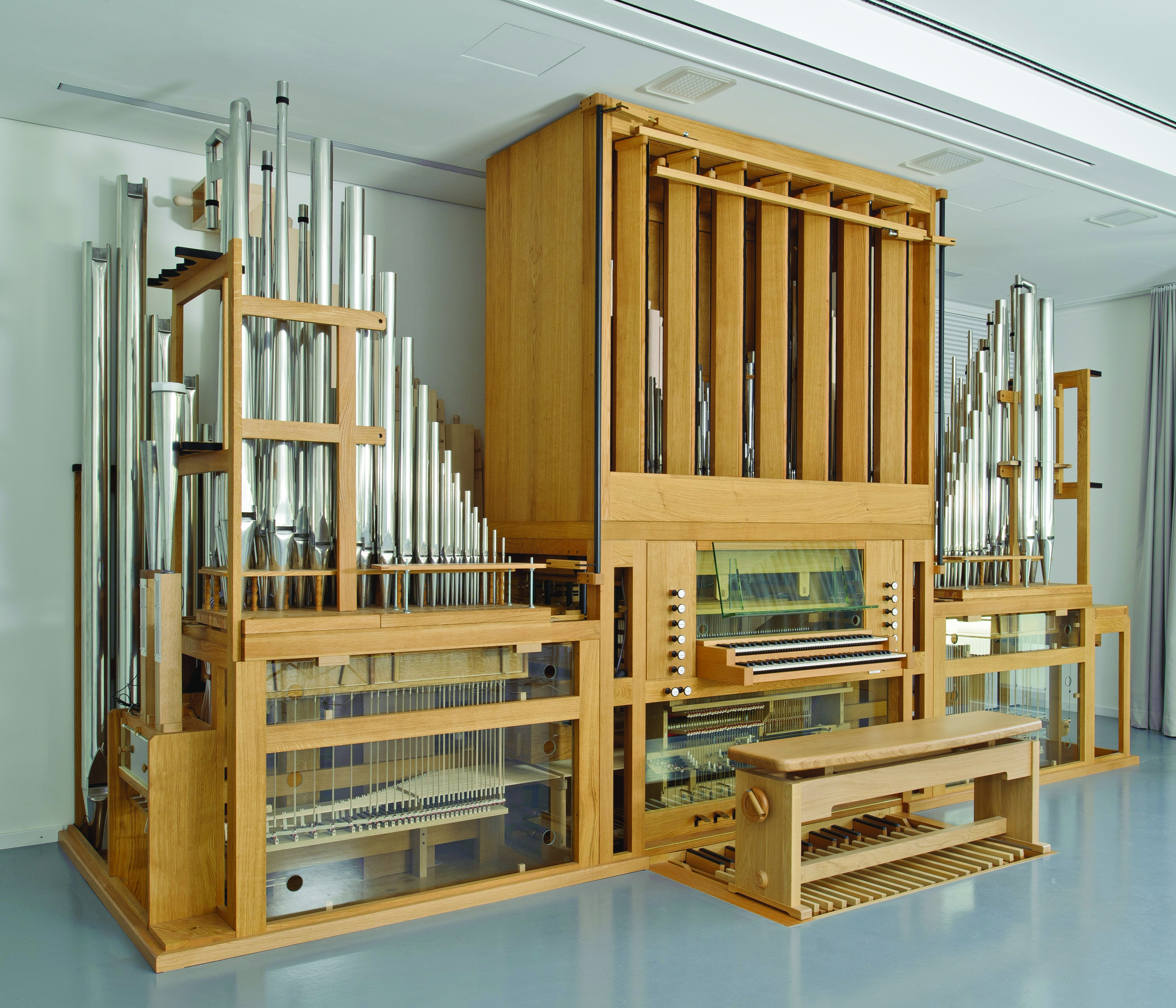
A pipe organ constructed by the Mühleisen company in Leonberg, Germany, for acoustic research at the Fraunhofer Institute for Building Physics in Stuttgart.
(Photo by Roman Wack/Fraunhofer Institute for Building Physics.)

No other musical instrument can be compared with the pipe organ in terms of size, tonal range, loudness, or complexity. The largest organs have thousands of pipes, the longest of which can extend 32 ft (9.75 m) or more in length. Unlike smaller instruments, which are typically produced according to standard designs, every pipe organ that is constructed must be specifically tailored to the acoustic properties of the space—typically a church or concert hall—in which it will be installed. In other words, an organ’s sound cannot be judged independently of its venue.
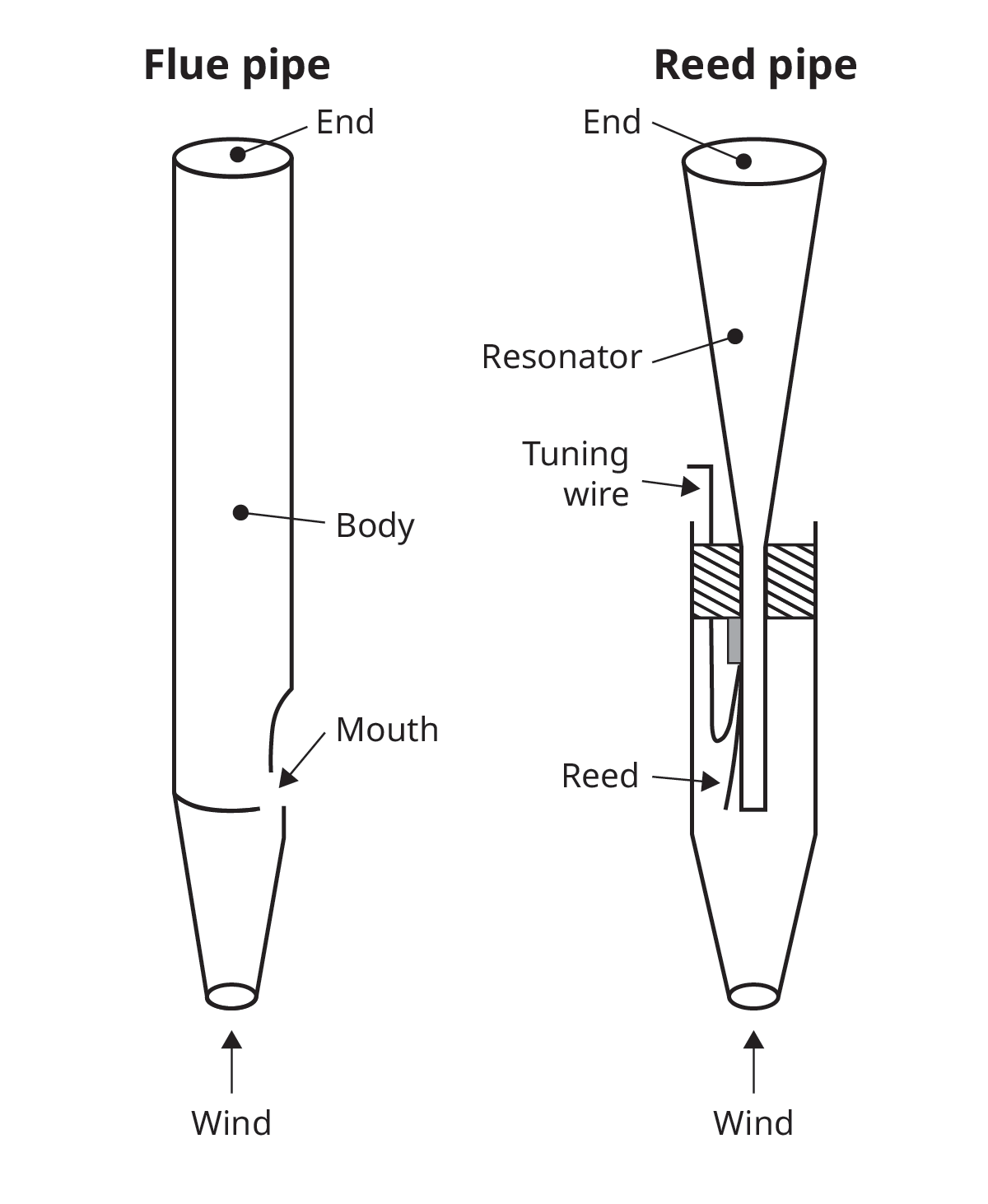
When an organist pushes down a key or a foot pedal, an electric blower provides pressurized air—termed wind—to a pipe. As shown in the diagram below, there are two basic types of pipes: flues and reeds. In a flue pipe, sound is produced by means of a vibrating air jet. The pitch is determined by the pipe’s length. In a reed pipe, the air stream is regulated periodically by a metal reed, which vibrates at a specific pitch. The pipes in an organ are organized into rows, known as ranks or stops, which each have a different sound character, or timbre.
Design challenges
When designing an organ, the goal is for the completed instrument to fill the room with sound when an audience is present. It’s a daunting task: Because the radiated sound power of each pipe is determined by its geometry and wind pressure, its loudness is fixed once the instrument is constructed. Organ builders have traditionally used several rules of thumb to estimate pipe loudness. Larger-diameter pipes are louder than narrower ones, for example, and higher wind pressure increases loudness.
But estimating pipe loudness remains challenging for three reasons. First, the typical model used for room acoustics struggles to account for the sound produced by a pipe organ. The model works well when acoustic room resonances—the pitches that resonate more strongly in a space—cannot be recognized in the way the instrument sounds in the room. Because room resonances get closer together as frequency and room volume increase, they usually cannot be distinguished in concert halls at frequencies of 100 Hz or higher. But larger pipe organs can have notes with frequencies as low as 16.4 Hz, which means that the lowest two and a half octaves on the instrument may fall below the 100 Hz threshold.

Schematic diagrams of the two types of organ pipes: flues (left) and reeds (right). In a flue pipe, pressurized air, termed wind, enters at the bottom. It is then driven through a small gap at the mouth, and that causes the air column to vibrate. In a reed pipe, wind enters at the bottom and is directed toward the reed, which vibrates at a specific pitch that is set using the tuning wire. The resonator helps determine the timbre, or sound quality, of the pipe.
(Diagrams by Freddie Pagani; right diagram adapted in part from Cor anglais 16/Wikimedia Commons/CC BY-SA 3.0 .)

In that low range, it’s possible for the average separation between room resonances to be comparable with the separation between two consecutive notes in the chromatic 12-tone scale used in Western music. The tone of a low-pitched organ pipe may thus coincide with room resonances or antiresonances, and that can cause the pitch to be significantly louder or quieter in certain areas of the room. It can also create an audible shift in the pitch because the frequency of the room resonance that is excited may differ from the pipe frequency.
Second, organ builders lack reliable data about the sound power emitted by organ pipes. The data are needed to estimate a pipe’s loudness and, thus, the loudness of the instrument as a whole.
Finally, organ builders have specific requirements for room acoustics that vary for the instrument’s different pitch ranges. Because human ears are less sensitive at lower frequencies, it is preferable for a space to have longer reverberation in the low register—below approximately 130 Hz—so that the sounds from different stops can blend.
In the middle register, with frequencies from about 130 to 520 Hz, it is important for the room’s reverberation time—the time it takes for a sound to fade away—to be relatively short. Thus, each sound in the range is recognizable by the audience. That is particularly important in polyphonic music, in which multiple independent melodies are played at the same time.
Because human ears are better at distinguishing the direction of higher-pitched sounds, a high degree of diffusivity in the space is necessary for pitches above roughly 520 Hz. That way, it does not appear to the audience that sounds are coming from different directions.
Addressing the problem
To help organ builders ameliorate the risk of building a faulty instrument, two of us (Angster and Miklós) conducted a research project in collaboration with several prominent organ manufacturers. We found that the sound of an organ pipe can be modeled by setting up two simple sound sources in the space in which the pipe will be installed.
Using the results of our trials, we’ve developed a system in which two speakers emit sounds that were recorded at the mouth and end of real organ pipes. The distance between the speakers can be adjusted to simulate different pipe lengths. An accompanying software package, which contains data about different types and sizes of pipes and different wind pressure values, enables manufacturers to simulate the sound power of a pipe. Our hope is that the system will allow organ builders to better estimate the dimensions of organ pipes and better adapt instruments to the spaces in which they will be installed.
Additional resources
► J. Angster, P. Rucz, A. Miklós, “Acoustics of organ pipes and future trends in the research ,” Acoust. Today 13, 10 (2017).
► A. Miklós, J. Angster, “Properties of the sound of flue organ pipes ,” Acust. United Acta Acust. 86, 611 (2000).
► J. Angster, A. Miklós, P. Rucz, The Acoustics of the Pipe Organ, 2 vols., Springer (forthcoming).
More about the authors
Judit Angster is a senior scientist in the department of acoustics at the Fraunhofer Institute for Building Physics in Stuttgart, Germany.
Josep Llorca-Bofí leads the urban and architectural acoustics research group at the Fraunhofer Institute for Building Physics in Stuttgart, Germany.
András Miklós is a senior scientist in the department of acoustics at the Fraunhofer Institute for Building Physics in Stuttgart, Germany.