Finley (aged 11): Now, I really like science, but Anton Radevsky and Emma Sanders’s The Large Hadron Collider Pop-up Book: Voyage to the Heart of Matter didn’t grab me much in terms of interest. The beginning—talking about the particles being used in the experiment—came out rather bland, but since I like science, I read on.
The book was interesting, but a little disappointing. The science facts told in it were cool, but I forgot about them easily. Also, the text looked long and imposing because it was all clumped into very large paragraphs. It would’ve been better to split them into captions.
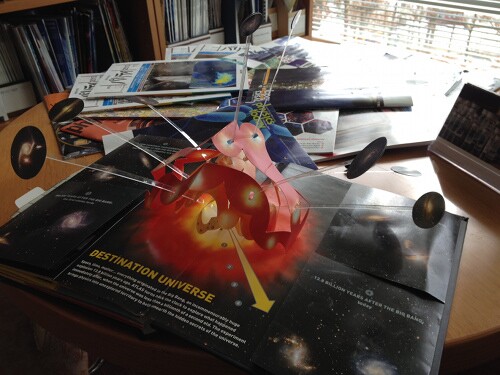
Because of this layout issue, I almost neglected to read the book again after I did a first skim through it. One great thing about the book was how “alive” the pop-ups seemed. The only one I did not like was the third one, where you can build the machine used in the experiment. The directions were confusing and the pieces were too stiff.
The impact of some of the pop-ups was dampened by the dull backgrounds on the pages. They were made up of solid, boring colors with no interesting designs to lighten them up.
I would recommend this book to around ages 11 to 15, as it would bore someone younger or older. This book is probably only worth buying if you really enjoy science or if you like unique pop-ups. However, at a cost of $25, you’re probably better off checking it out at the library.
A page spread from The Large Hadron Collider Pop-Up Book: Voyage to the Heart of Matter. CREDIT: Charles Day
Ben: I’m Finley’s dad. I’m a science writer and editor who directs the Inside Science program at the American Institute of Physics. I think Finley correctly identified several issues that make it difficult for kids to become completely captivated with this book.
Where the book indeed falters is in the overwhelming blocks of text, too massive for its very fine pop-ups to support. The words ambitiously aim to capture so many interesting details that they oversaturate the pages, and I would imagine it would be challenging for many younger readers to digest.
While I don’t know that those over 15 will be bored with the book, it may take a little while for them to get drawn in because of the volume of material. With a little bit of refining, including streamlining, a subsequent version could become a great book for a wide range of ages.
Until then, it may be more a book that younger readers such as Finley feel that they should read rather than want to read.