For thousands of years, societies have been significantly affected by their ability to measure nature and its properties. And with an increased understanding of nature has come an evolution of the measurement methods used by scientists. Over time the scientific community has attempted to base definitions of new measurements on the inherent properties of the universe (see the article, “A more fundamental International System of Units,” Physics Today, July 2014, page 35).
The Science of Measurement, a DVD released earlier this year, aims to tell the history of scientific measurements and their standardization. It contains three episodes of a BBC documentary featuring Oxford University mathematician Marcus du Sautoy. The DVD is distributed by RLJ Entertainment.
In the video, du Sautoy delves into the ancient origins of our definitions of mass, length, and time, and he also covers the more recent developments that led to the definitions of temperature, electric current, luminous intensity, and amount of substance. He leads viewers on a journey around the world, showing them sites related to the history of measurements. And he demonstrates how the standards were developed then and are developed now.
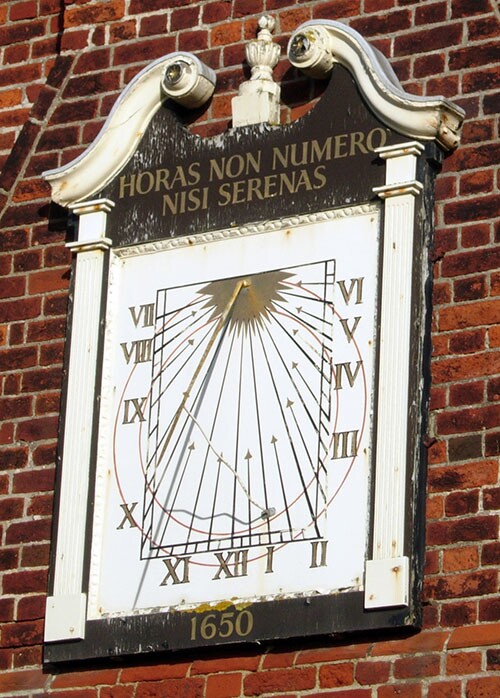
In the first episode, “Time and Distance,” du Sautoy introduces the ideas of measurement and time as products of the human ability to recognize patterns. He presents the paintings in the Lascaux Caves, estimated to be 17 000 years old, as the oldest known system for recording the lengths of seasons and the start of the year. A brief history of the development of sundials, water clocks, and then mechanical clocks explains the division of day and night into equal periods, with minutes and seconds as divisions of the larger period. Du Sautoy makes a brief aside to explain that periods of 12 and 60 units are much easier to use than periods of 10 and 100 because they have many more even divisors especially based on the 360 degree divisions of circles.
SSW facing, vertical declining sundial on Moot Hall, Aldeburgh, Suffolk, England. Photo source: Wikipedia
He then contrasts the top-down subdivision method for creating seconds to the establishment of systems for measuring lengths. Put forth as an example of one of the earliest standardized lengths is the Egyptian cubit, which was a metal rod equal to the distance from the pharaoh’s elbow to fingertip. That approach to standardization—using arbitrary lengths and distances—has been used almost to the present. Of course, in the case of the Egyptian cubit and other lengths based on the body parts of monarchs, the standards were frequently reset, which led to confusion and opportunity for fraud.
During the French Revolution, the scientific community in France reached out to other nations to create an international standard for the measurement of length and mass. That was the first time a standard for length was defined using calculations based on measurements of Earth’s dimensions instead of on an arbitrary length, du Sautoy explains. Then it was discovered that the wavelength of light could be measured and that light had a constant velocity, so it made sense to define both time and distance in relation to the speed of light, a fundamental constant and far from arbitrary.
Episode 2, “Mass and Moles,” is almost completely dedicated to discussion of the kilogram. Despite the title, only the last 8 minutes or so covers the mole—1 Avogadro’s number (6.022 x 10²³) of particles or molecules—and the discussion of the subject is so brief that its enlightening anyone not already familiar with the concept is unlikely.
In his discussion of weight measurement, du Sautoy describes how the earliest standards were developed for commerce. Two parties exchanging goods needed to be sure that they were receiving an accurate measurement of the good they desired. A common basis for that transaction was individual wheat grains, which are relatively uniform in size and mass. Stone and metal weight equivalents were created for ease of measurement.
When the metric system was adopted during the French Revolution, the kilogram was defined as the mass of one cubic decimeter of water; that definition also produced the standard unit of volume, the liter. It was soon realized that the mass of a volume of water depends on the water’s temperature, so a cylindrical metal weight was created as the standard for mass comparison. Metal weights are the only physical standards still in use. But maybe not for long: Efforts are under way to redefine the kilogram based on fundamental constants, such as Planck’s.
In the third episode, “Light, Heat and Electricity,” du Sautoy discusses the remaining standards: the ampere for electric current, the kelvin for temperature, and the candela for the brightness of a light. The history of the candela was the most interesting to me, because I am least familiar with that standard. Because of their relatively short histories, those newer standards were given much less time than the second, the meter, and the kilogram received.
On the whole, I think the program provides a very good history of the development of measurement systems and overview of the current approach to defining standards. Du Sautoy presents excellent demonstrations of the insights and experiments that led to advances in standards, including Newton’s proof that light is made of multiple wavelengths and colors and including NIST’s watt balance for measuring Planck’s constant and redefining the kilogram.
However, I thought the DVD was lacking in its explanations of the more recent measurements, such as the mole and the ampere—perhaps because the general public finds them less immediately relevant. Also, du Sautoy did not explain the important differences between accuracy and precision and mass and weight; occasionally they are used interchangeably. Lay readers can be easily educated about those important distinctions.
Regardless, I would highly recommend The Science of Measurement. Even though I already was somewhat familiar with the current standards and with much of the history, I found many tidbits that were new to me. Du Sautoy provides an exceptionally clear discussion that should be easily accessible to anyone, from a trained scientist to a science enthusiast to a primary school student.
Greg Stasiewicz is an online production assistant for Physics Today. He regularly contributes to News Picks and is a member of the Physics Today social media team.