The American Crystallographic Society defines crystallography as “the study of atomic and molecular structure.” From nanoparticles to proteins, physicists (and chemists, biologists, and materials scientists) use crystallography to determine the structure and to understand the properties of a wide variety of systems across different scales and compositions.
In 2012 United Nations Resolution 66/284 established 2014 as the International Year of Crystallography (IYCr2014). According to the official website, the year “commemorates not only the centennial of x-ray diffraction, which allowed the detailed study of crystalline material, but also the 400th anniversary of Kepler’s observation in 1611 of the symmetrical form of ice crystals, which began the wider study of the role of symmetry in matter.” This website also lists events, publications, special stamps, themed magazine issues (as its own tab on the event page), and activities that highlight the importance of crystallography across the globe.
During IYCr2014, scientists and the public have showed interest in crystallography through social media, using hashtags like #crystalseverywhere and #IYCr2014 on Twitter. As the year comes to a close, now is the perfect time to emphasize that there’s no time limit on exploring and celebrating crystallography.
Here, I focus on exploring crystallography outside of the lab, using minerals and gemstones (specifically those that come from minerals) as a starting point. In addition to providing an avenue to learn about scientific properties—including crystal structure, crystal habit, and the relationships between structure and properties—these materials can be used as a basis to access the history of your local area, explore your creative side, or plan an outing with your friends, family, or lab group.
Museums and collections
If you’re fortunate enough to live in a metro area in the US, there are many museum exhibits with extensive mineral and gem collections. Below, I’ve featured a selection of these exhibits, but this list is by no means exhaustive. The American Museum of Natural History (AMNH) in New York City features the Morgan Memorial Hall of Gems and the Harry Frank Guggenheim Hall of Minerals. (Basic admission: $12.50/children, $17/students & seniors, $22/adults.)
The Smithsonian Institution’s National Museum of Natural History in Washington, DC, features the National Gem and Mineral Collection. While the Hope Diamond often receives much of the attention in this collection, several other specimens and exhibits are worth checking out. (Admission: free.)
Chicago’s Field Museum features an extensive gem collection in the form of the Grainger Hall of Gems and mineral collection. (Basic admission: $13/children, $15/students & seniors, $18/adults.) The Gem and Mineral Hall at The Los Angeles County Natural History Museum features a downloadable guide on their website, which indicates the Hixon Gem Vault “contains the finest collection of gemstones on public display in the North America west of Washington, D.C.” (Admission: $5/children, $9/students & seniors, $12/adults.) Additionally, your local colleges and universities may have publicly accessible collections or collections that can be viewed by appointment.
Mine Tours and crystal collections
Mines can be great places to find specimens of local minerals, interact with mineral enthusiasts, and perhaps learn something new about both crystallography and the history of your area.
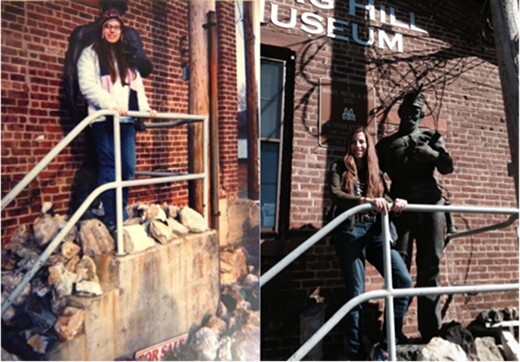
The Sterling Hill Mining Museum in Ogdensburg, New Jersey, is a great resource for those living in the NY-NJ-PA area or with time to spare during a conference or visit to this area. (Admission: $8/children, $10/seniors, $11/adults.) According to the Historic Site section of the mine’s website, mining operations began “sometime before 1739" and in the section about mineral species it is noted that 28 types of mineral have been found only in the mine’s vicinity. The Individual & Family Mine Tours section states: “Guided tours last about two hours and include one hour in the underground zinc mine, half an hour in our large exhibit hall, and about 10 minutes in our museum of fluorescence.”
Additionally, for those interested in starting their own collection of mineral or gem specimens, visits to mines like Sterling Hill are a good opportunity to obtain rare specimens. Says Bill Kroth (president and CEO of Sterling Hill Mining Museum), “if you want to come here, and if you want to explore crystals, two of our minerals here that the miners were after, the willemite and the franklenite, display very beautiful crystals that you could see with the naked eye or even see better with a hand lens.” He remarks that “the nice thing about the willemite, they glow a beautiful fluorescent green, like a uranium-colored green, under the shortwave ultraviolet light. And that’s what makes us world famous here.” He also notes that “when you take the tour, you’ll get a free sample and you can easily see the crystals there.”
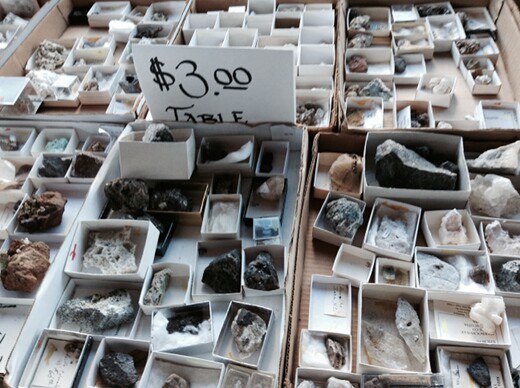
Display of specimens for sale at the 28 September 2014 gem and mineral sale at Sterling Hill Mine. CREDIT: Sterling Mill Mine
Mines occasionally hold special sales. This past September, the Sterling Hill Mining Museum held a gem and mineral sale, featuring a wide variety of specimens ranging in size, color, variety, and origin. When I look for specimens for my collection, I search for those that are not only aesthetically appealing, but that also resonate with my personal experiences. During my educational career, I’ve moved from my native New Jersey to Minnesota (Carleton College, BA) to Washington (University of Washington, MS, PhD) to Pennsylvania (Penn State, postdoctoral work). Collection specimens not only give me an opportunity to learn about my local geology, but provide reminders of these formative places as well.
Virtual options
If visiting a museum or mine is geographically or financially infeasible, a virtual tour is a great alternative. Many museum exhibits feature downloable exhibit guides, online selections from their collections, and educational resources for those interested in minerals, gems, and crystallography. Additionally, some museums and mines have extensive exhibits like AMNH’s virtual Howard Lee Belsky Memorial Exhibit of Microminerals, which provides chemical and crystallographic information for selection of samples, or the Sterling Hill Mining Museum’s virtual mine tour.
Crystal crafting
If mines or museums don’t capture your attention, crystallography–themed crafting might be the right avenue for you. The aesthetic beauty of crystallography lends itself easily to activities at the interfaces between science and the arts. Incorporating an interest in crystallography with an interest in crafting is also a great starting place for those interested in the transition from STEM to STEAM (Science, Technology, Engineering, Arts, and Mathematics) and the dialogues that can take place between art and science communities.
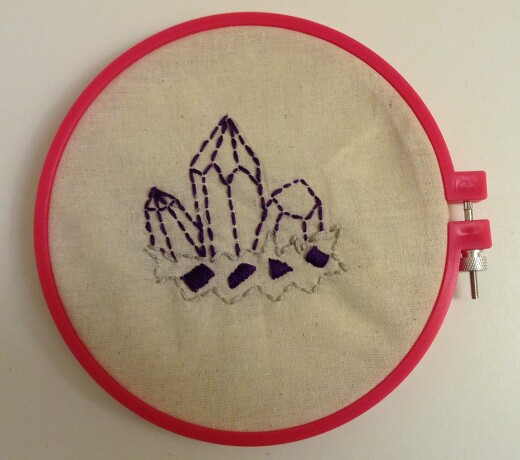
You might, for instance, try hand-embroidering crystal-themed patterns, for which Sublime Stitching from Austin, Texas, has you covered. The company’s Crystal Visions embroidery pattern is available for digital download, complete with color suggestions and some basic advice for the novice embroiderer. I’ve included my own modified interpretation of one of the patterns from the Crystal Visions collection, where I’ve chosen colors and structures from the pattern to try to emulate the amethyst variety of quartz. If none of the Sublime Stitching patterns represent your particular interest in crystallography, you can try designing your own pattern using reference images from your own research, journal articles, online or museum-based mineral and gem collections, or your own mineral and gem collection.
Sewing projects are another avenue for crystallographic craft exploration. Do you have a conference poster that is going to be taken down, recycled, or discarded? Consider printing posters on fabric and repurposing them after events. Turn your x-ray diffraction patterns, transmission electron micrographs, and crystallographic models into wearable pieces such as scarves, skirts, or laptop bags. Additionally, on websites like Spoonflower, you can design and print your own crystal-themed fabrics for projects. Each of these activities can imbue the wearer with his or her own sense of research representation.
From cufflinks to earrings, from rings to necklaces, crystals can also be incorporated into everyday accessorizing. If are looking to dip your toe in the crystallography-craft themed water or to purchase a crystallography-themed craft, you can try obtaining ideas from Pinterest or products from Etsy, where simple searches will yield a variety of options for discerning tastes. If you are interested in DIY, and don’t have what you are looking for in your own collection, local craft stores carry notions and minerals and gems for creating your specialized looks.
Wearing or displaying crystal-themed crafts can both be personally rewarding and serve as a starting point for scientific conversations beyond the lab.
Science communication and science outreach
Volunteer opportunities for undergraduate and graduate students (as well as postdocs) are a great way to explore crystallography outside the lab. These positions can help you to develop science communication and outreach skills, as well as to explore new career pathways. Many museums and mines offer volunteer opportunities that include duties like giving tours or developing educational materials. Additionally, local mineralogy groups offer opportunities to deliver guest lectures and interact with the members of these organizations. These collaborative spaces offer students the chance to practice their skills while also learning from the groups’ members.
The above suggestions are by no means a comprehensive list. They are simply meant to spark an interest in exploring crystallography beyond IYCr2014. Regardless of your type of crystallographic interest, I encourage you to use these suggestions as a seed to find the method of celebrating and exploring crystallography that resonates best with you!
Stephanie E. Vasko is currently a senior research assistant at the Rock Ethics Institute at the Pennsylvania State University. She earned her PhD in chemistry and nanotechnology in 2012 at the University of Washington. Her current research interests include STEM education, the NSF Broader Impacts criterion, and the intersection and dialogue between the arts and sciences. You can follow her on Twitter at @stephanievasko.
The opinions and views expressed in this piece are those of the author and do not represent or reflect the opinion, views, or policy of the Pennsylvania State University, the Rock Ethics Institute, or the National Science Foundation.