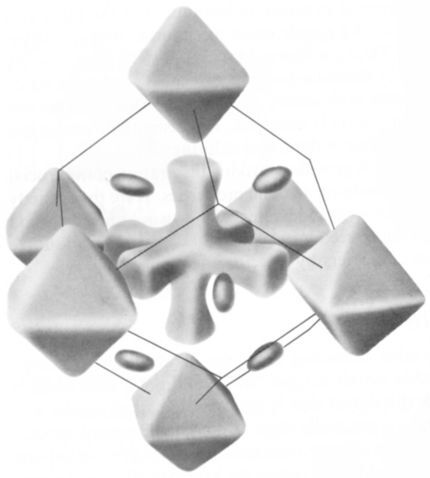
This now classic, and arguably aging, text on solid-state and condensed-matter physics was expected in 1977 to take a new look at what was then considered a well-trodden field.
There’s something to be said for instructional books best known by the names of their authors. For writers and editors, there’s Strunk and White, shorthand for the 1918 guidebook The Elements of Style by William Strunk Jr and E. B. White. Physicists have Landau and Lifshitz, the 10-volume Course of Theoretical Physics (Pergamon Press, 1960–1984) by Lev Landau and Evgeny Lifshitz; Taylor and Wheeler, the introductory special relativity text Spacetime Physics (1st edtion, W. H. Freeman, 1966) by Edwin Taylor and John Wheeler; and Ashcroft and Mermin, the introductory condensed-matter text Solid State Physics (Holt, Rinehart, and Winston, 1976) by Neil Ashcroft and David Mermin.
The thing to be said about such books is that they become standard reference material for students and practitioners alike. Since their original publications, Strunk and White and all but one of the aforementioned examples have since been updated. Ashcroft and Mermin remains unchanged. Textbook publisher Cengage Learning has it on sale for for $281.49, and Amazon offers it for $253.44—the list price in 1976 was $19.95. In its category, Ashcroft and Mermin is still an Amazon top seller, though, notably, it is being outsold by the $69.99 8th edition of an early competitor, Introduction to Solid State Physics (Wiley, 2004) by Charles Kittel.
Ashcroft and Mermin recently resurfaced in the pages of Physics Today. In the July 2013 Reader’s Forum, in an exchange titled ‘Impressionism, Realism, and the aging of Ashcroft and Mermin,’ José Menéndez of Arizona State University in Tempe asserts that the text is ‘undoubtedly one of the best physics books ever written.’ But he also notes it is not ‘aging well,’ and he takes aim at Mermin’s philosophical views.
You can read Menéndez’s letter and responses by both Ashcroft and Mermin here, but in light of the comments on aging, we offer you a look back at a first impression of this now classic text—the January 1977 Physics Today book review by the late Princeton University physicist Roman Smoluchowski. His review contains the following prophetic sentence: ‘Whether [the book] will prove to be a boon for the students and for those like myself who taught the subject for decades, only practice will show, but the prognostications are very good indeed.’
Note: If you’ve taught from or used this text, what did you like most and least about it? Share your experiences in the comments section.
Solid State Physics
N. W. Ashcroft, N. D. MerminHolt, Rinehart and Winston, New York, 1976. $19.95 (826 pp.). ISBN 978-0-030-83993-1.
Reviewed by Roman SmoluchowskiDepartment of Aerospace and Mechanical Science, Princeton University, Princeton, New Jersey January 1977, page 61
For several years members of the solid-state community have been aware of the fact that two well-known Cornell physicists, Neil Ashcroft and David Mermin, were writing a textbook on solid-state physics. Rumor had it that this book would take a new look at this well-trodden field and that it would be of great help to those who taught introductory courses in the solid state for physicists or for engineers, and had mixed luck in choosing a suitable text or texts. No doubt the book lives up to its expectations as far as a refreshingly new attitude is concerned. Whether it will prove to be a boon for the students and for those like myself who taught the subject for a few decades, only practice will show, but the prognostications are very good indeed.
In contrast with many other texts the book is well organized from a pedagogical point of view. As the authors point out in their preface, the book does not have a ‘linear’ arrangement of topics. Right from the first three chapters (‘Drude Theory of Metals,’ ‘Sommerfeld Theory of Metals,’ ‘Failure of the Free Electron Model’), it is clear that the sequence of chapters is so chosen as to give the students an early grasp of the elementary concepts of solids on the basis of which they can then find their way to other more advanced topics. In fact, there is a most enlightening, detailed table showing not only the necessary prerequisites for each chapter, but also how to use the book for a one-semester or for a two-semester course. This feature will undoubtedly appeal to many readers and users.