A genuine teaching experience
DOI: 10.1063/1.3248496

The NSF program Research Experiences for Undergraduates is motivated by the conviction that nothing is better than a genuine research experience for kindling a student’s enthusiasm for a career in science. Over the years REU has enabled thousands of undergraduate students to participate in research; for many of them the experience was pivotal in their decision to choose science as a career. Because the nation’s need for scientists is critical, the value of REU is inestimable.
The nation’s need for high-school physics teachers is also critical. The shortage of qualified physics teachers is so grave that the problem is generally viewed as a crisis. (see reference and also “Preparing High-School Physics Teachers,” by Ted Hodapp, Jack Hehn, and Warren Hein, in PHYSICS TODAY, February 2009, page 40 .) For kindling an undergraduate’s enthusiasm for a career as a science teacher, I suggest that nothing is better than a genuine teaching experience. This optimistic belief in the power of a teaching experience springs from my engagement with a summer program that offers a small group of physics majors a genuine opportunity to teach, with some expert guidance. The program, now in its seventh year, is called Teaching Opportunities in Physical Science. TOPS takes place at MIT within the MIT-Harvard University Center for Ultracold Atoms (CUA), an NSF-sponsored research center.
Eight undergraduate physics majors receive a summer teaching experience through TOPS. The number is tiny compared with the national need, but TOPS is propelled by the belief that even a small number of outstanding teachers can have an enormous impact over the years. TOPS students are recruited from physics departments at colleges and universities across the nation. They are well qualified in physics, often at the level for admission to a leading graduate school in physics. The participants are taught by a staff of two experienced high-school physics teachers, plus a TOPS alumnus who serves as staff assistant.
The TOPS program operates for six weeks, from late June to early August. During its early years we learned that the student most valued the time actually spent teaching, and we make that time as long as possible. Before starting to teach, however, the students need to learn a few of the basics about planning a curriculum. Then, following a hands-on approach, they design their own lessons and construct experiments and demonstrations. They also learn some fundamentals in the art of teaching, and they practice conducting their classes with the staff and with each other. All this occupies the first two weeks with hours that extend to nights and weekends. The activities then move to the nearby Museum of Science, Boston, where TOPS takes over some middle-school classes for one week. Following that initiation into teaching, the students then revise the material and teach high-school students for two weeks in a TOPS-operated school at MIT. The high-school students come from the greater Boston area, attracted by the opportunity to learn some physics and spend time at MIT. Interest in the high-school program is high, spread by word of mouth. The enrollment limit is 24 students.
A transformative experience
As we had hoped, the teaching experience can be transformative for the TOPS participants. That was the case, for instance, for one alumnus who wrote (in response to our query about current activities), “TOPS is the single greatest academic experience of my life. Once I had the opportunity to teach physics, I was hooked and knew that I wanted to make teaching my career. TOPS has also had a strong impact on my current plan of teaching physics in a high-school setting rather than on the college level.”
The material taught by the TOPS students centers on heat, energy, and light—topics that are not only well suited for the middle- and high-school groups but also closely linked to the research themes in the CUA. Wherever possible, connections with research are emphasized. TOPS is embedded in the CUA both literally and figuratively. The CUA turns over its seminar room to serve as the TOPS teaching workshop and the high-school classes are taught in rooms adjacent to CUA space. During the first few days of the program there are presentations by the CUA’s principal investigators and visits to the laboratories conducted by graduate students. Later, visits are arranged for the high-school students. Whenever possible, we try to let the TOPS students know that their work is valued by the CUA.
The culmination of TOPS is the final session, a talk by Wolfgang Ketterle on ultralow temperatures and Bose–Einstein condensation, aimed at both the TOPS and high-school students. By that time everyone knows some of the vocabulary of ultracold atoms and has heard about ideas such as atom traps and laser cooling. The talk generally leaves a deep impression, and the opportunity to meet a Nobel laureate who is also a gifted teacher dramatizes the message that teaching is important.
An incalculable benefit
Over the years, about three-quarters of the TOPS participants have headed for teaching careers, though the routes have been diverse. Some have chosen to teach in private schools after graduation, avoiding the need to pursue a certification program. Others have obtained their certification and are now teaching in public schools. One alumnus, who completed his certification at Cornell University, wrote that he constituted about one-sixth of all the new high-school teachers qualified in physics in New York State that year.
Some students defer teaching until later. One, who found a position working in a Scandinavian meteorological laboratory, wrote that he would shortly enter a master’s program in atmospheric physics. It appeared that he was heading for a research career until he added, “There’s no doubt I’ll ultimately end up teaching, though—TOPS proved to me that the classroom is where I belong. … So if teaching was something I might have discovered on my own time, TOPS catapulted it to the forefront of my consciousness, where it’s remained ever since as my eventual career goal.”
Not every TOPS student becomes enamored of teaching. Some participants discover that direct contact with students is not as gratifying as they had hoped, and every participant discovers that teaching can be exhausting. An alumna, who decided to pursue PhD research in cosmology, wrote, “The time I spent at TOPS was invaluable in terms of convincing me that I wanted to stay in physics or astrophysics.” She then added, somewhat wistfully, “I really enjoyed engaging the kids and sharing what I knew with them.”
Fortunately, for most participants, the TOPS experience is clearly positive. An alumnus wrote that “TOPS was fantastically valuable for me. I realized that I wanted to teach. Your program is responsible for the moment when I realized that I did not want to be the famous physicist who advances the sciences and has articles written about him; I want to be the teacher who touches the lives of his students and helps them realize their potential and develop moral fiber.”
The value of early teaching experience is hardly a secret. For instance, a variety of early teaching activities are incorporated in PhysTEC programs. 2 However, I have not come across programs that share TOPS’s specific goal of inspiring physics majors to choose teaching as a profession by giving them a real teaching experience in their junior year, before they have made a career choice.
TOPS is a small program, and we have debated whether the number of students could be increased. However, the combination of one staff member working with four students appears to be right for us, and we are concerned that increasing the size of the staff to accommodate more students would change the spirit of the group, making it less cohesive. Nevertheless, other programs could be organized differently and might be larger.
I hope that other colleges and universities will consider creating programs to provide a genuine teaching experience to undergraduate physics majors—and for that matter, majors in other sciences. In the same spirit, I hope that NSF will consider encouraging teaching experience for undergraduates—TEU—in the same spirit in which its REU program enables research experience for undergraduates. Whatever the program’s scale, the potential returns to society from inspiring the careers of even a small number of excellent teachers are incalculable.

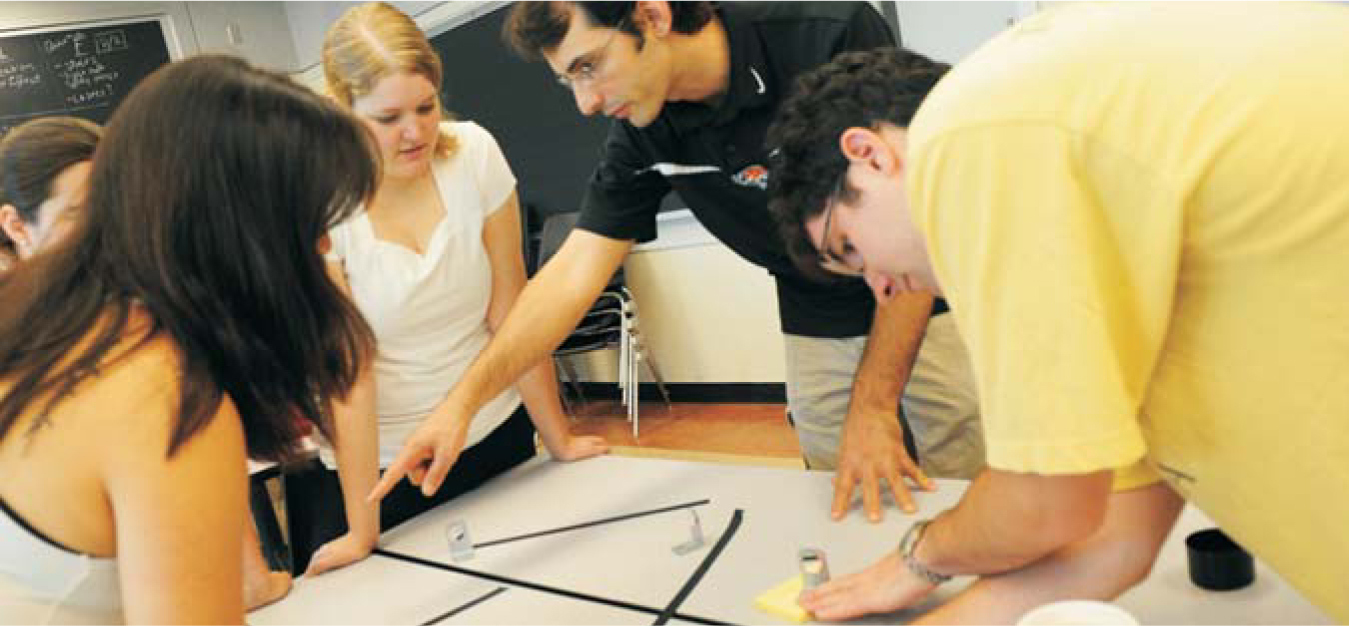
TOPS in action: Instructor working with TOPS students.

Theodore Ducas, department of physics, Wellesley College, is a principal architect of TOPS. The program could not have been carried forward without his close collaboration and many contributions.
TOPS has been fortunate in having the CUA community to support it. In addition, TOPS is supported by the MIT Research Laboratory of Electronics, which provides financial management and manages the TOPS facilities, and by MIT, which provides group housing and classroom space for the TOPS students. TOPS has flourished because of the efforts of its gifted teaching staff, present and past. TOPS teachers are Don Donovan, Jamie Formato, Denise Labieniec, Kim Mayer, Laura Nickerson, and Amy Winston. By their effort and example they demonstrate the qualities that make teaching careers worthwhile.
The Arthur Vining Davis Foundations supported TOPS in 2003, and the William and Flora Hewlett Foundation supported it in 2004. Since 2005, TOPS has been supported by the CUA under NSF’s Physics Frontiers Centers program.
Finally, I thank Gloria Lubkin for many helpful comments.
References
1. Committee on Prospering in the Global Economy of the 21st Century, Rising Above the Gathering Storm: Energizing and Employing America for a Brighter Economic Future, National Academies Press, Washington, DC (2007), available at http://www.nap.edu/catalog.php?record_id=11463 .
2. Physics Teacher Education Coalition, sponsored by the American Physical Society, the American Institute of Physics, and the American Association of Physics Teachers, http://phystec.org .
More about the authors
Daniel Kleppner is Lester Wolfe Professor of Physics Emeritus at the Massachusetts Institute of Technology and codirector of the MIT–Harvard University Center for Ultracold Atoms.
Daniel Kleppner, Massachusetts Institute of Technology, US .