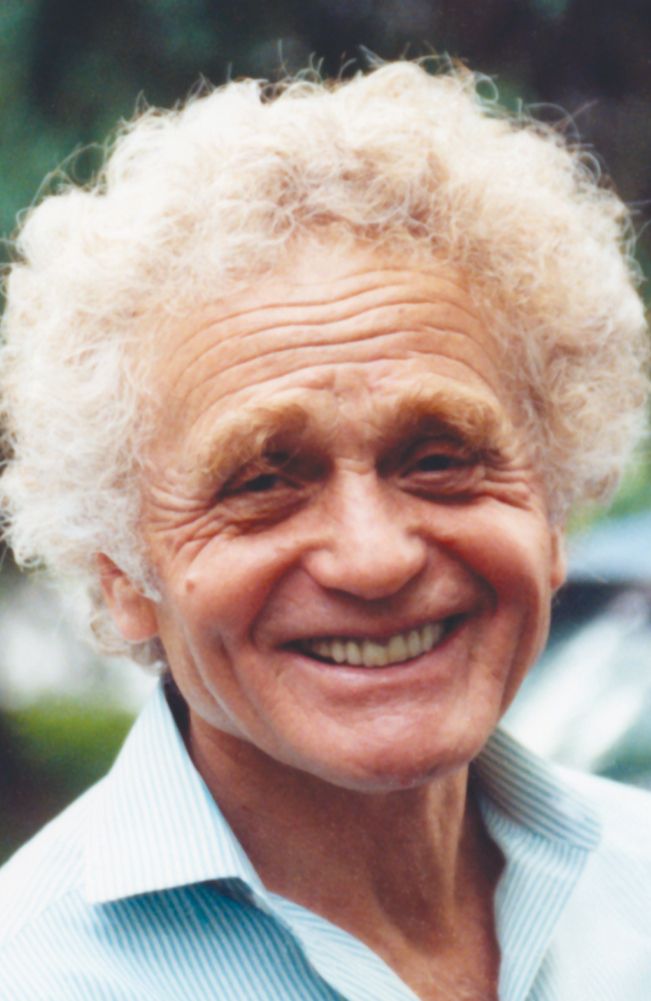
Yuri Fyodorovich Orlov
DOI: 10.1063/PT.3.4661
Yuri Fyodorovich Orlov was an inspiration to many people worldwide through his unrelenting pursuit of science in difficult circumstances, his many contributions to accelerator physics, his courageous sacrifices for human rights in the USSR, and his dedication to the free, international exchange of ideas. Born on 13 August 1924 near Moscow, he died on 27 September 2020 in Ithaca, New York.

Yuri Fyodorovich Orlov
ROBERT PALMER

Orlov graduated in 1952 from the Physical-Technical Institute in Moscow. He earned his first doctoral degree from the Yerevan Physics Institute in 1958 and his second from the Budker Institute of Nuclear Physics in 1963. Following his arrival in the US in 1986, he taught both physics and human rights at Cornell University until he retired at the age of 91.
Here we mainly address Orlov’s scientific accomplishments. Additionally, his work in human rights made him “one of the most important figures of our last century,” according to Scott Horton of the Andrei Sakharov Foundation. Detailed in many texts and obituaries and in Orlov’s fascinating Dangerous Thoughts: Memoirs of a Russian Life (1991), those achievements included his cofounding the Soviet section of Amnesty International and, most importantly, establishing the Moscow Helsinki Group. That organization, created in 1976 to monitor Soviet compliance with the Helsinki Accords, is still active. It served as the model for similar groups throughout the USSR, inspired Solidarity in Poland and the Charter 77 initiative in Czechoslovakia, and is the grandparent of many of today’s human-rights-monitoring groups. It was the main reason that Orlov was arrested in 1977, interrogated for months in a KGB prison, and sentenced, after a show trial, to years of hard labor followed by Siberian exile.
Orlov’s formal scientific employment in the USSR, which began in the 1950s, was interrupted in 1956 when he was fired from the Institute of Theoretical and Experimental Physics (ITEP) for making a pro-democracy speech and was permanently blocked after 1973 when he was fired for joining the dissident movement. However, even from a labor camp he continued to do science; he smuggled out several articles, written on cigarette papers, that were published in the West. After being stripped of his citizenship and deported to the US in 1986, he resumed his scientific work.
Throughout his time in the USSR, Orlov mostly worked in accelerator physics. A theoretical-physics education with teachers such as Lev Landau and Peter Kapitza allowed him to pioneer some of the theoretical methods that are cornerstones of accelerator development today. He applied Hamiltonian perturbation theory to nonlinear oscillations around an accelerator’s design orbit and analyzed nonlinear dynamics in terms of betatron and synchro-betatron resonances. Additionally, he established radiation sum rules in electron accelerators with E. K. Tarasov and described polarization dynamics and depolarization in storage rings, including contributions from quantum effects, with V. N. Baier. Orlov developed his groundbreaking work while designing ITEP’s proton synchrotron and the 6 GeV synchrotron in Yerevan, Armenia. In addition, he proposed a 200 GeV electron–positron collider long before CERN’s Large Electron–Positron Collider reached that energy.
Orlov also published articles on the foundations of quantum mechanics. In his eighties he wrote about gravitational physics, in part to consider small effects that can disturb stored beams in experiments on the electric dipole moment (EDM).
While at CERN in 1988–89, Orlov and D. Möhl independently invented “beam shaking” to eliminate ions from the antiproton beam, a method that has since been used at the Tevatron to increase antiproton intensity, at the German Electron Synchrotron’s HERA particle accelerator to eliminate the coasting beam, and for various electron beams to eliminate accumulated ions. For the Muon g − 2 experiment at Brookhaven National Laboratory, Orlov contributed elegant breakthrough ideas that were meant to eliminate background contributions while preserving the integrity of the important parameters. And as an initiator of the storage-ring EDM studies, he made essential contributions to identifying the main sources of systematic errors and worked out the precise theory describing many nonlinear effects essential for the method to succeed.
Orlov had a profound understanding of the relevant experimental issues and exceptional abilities to address them. He would go out of his way to give credit to people he worked with, including those whose solutions to scientific problems differed from his. And his humor, modest demeanor, intelligence, and creativity made it a pleasure to interact with him.
Days before his death, Orlov received the 2021 Robert R. Wilson Prize from the American Physical Society “for pioneering innovation in accelerator theory and practice …; deep understanding of beam and spin dynamics; consistently unique and fruitful ideas, ranging from the practical to the visionary; and embodying the spirit of scientific freedom.” We rejoice that APS awarded this extraordinary physicist such a fitting and important prize just in time.
More about the authors
Georg Hoffstaetter, Cornell University, Ithaca, New York.
Yannis Semertzidis, IBS Center for Axion and Precision Physics Research, KAIST, Daejeon, South Korea.
Vladimir Litvinenko, Stony Brook University, Stony Brook, New York.