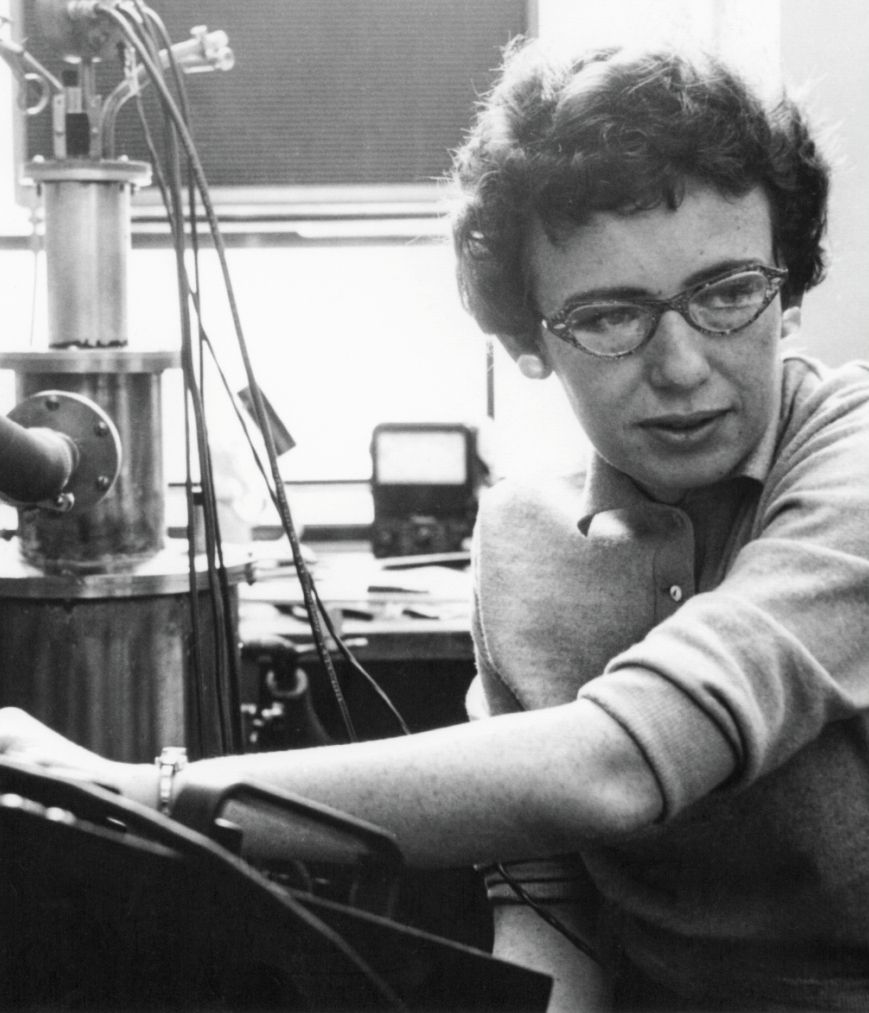
Myriam Paula Sarachik
DOI: 10.1063/PT.3.4907
On 7 October 2021, the physics community lost a towering figure, Myriam Sarachik. Over six decades she made outstanding contributions to experimental condensed-matter physics.

Myriam Paula Sarachik
AIP ESVA/GIFT OF M. SARACHIK

Myriam Paula Morgenstein was born in Antwerp, Belgium, on 8 August 1933. She was in the first grade when the Nazis invaded the country. Part of her extended Jewish family perished in a gas chamber. Myriam, her younger brother Henry, and their parents managed to escape through occupied France to Spain. In 1941 they arrived in Cuba, which granted them refugee status. Myriam took years of piano lessons in Havana and was so good that she dreamed of becoming a concert pianist. In 1947 the family immigrated to New York. Myriam attended the Bronx High School of Science, where her class of 1950 included Steven Weinberg and Sheldon Glashow.
When she entered Barnard College, music was still Myriam’s passion, but her interest turned to physics. She took advanced physics classes at Columbia University, where she met an engineering student, Philip Sarachik, whom she shared her life with until her death. She received her bachelor’s degree in physics in 1954. After working at IBM’s Watson Scientific Computing Laboratory at Columbia, Myriam earned her master’s and PhD from the university in 1957 and 1960, respectively. Her doctoral work, under the supervision of Richard Garwin, provided one of the first demonstrations of the Bardeen-Cooper-Schrieffer superconducting gap.
Myriam’s bosses were skeptical about her pursuing a career in a field dominated by men. At job interviews, she was advised to stay home and take care of her daughter, Karen, who was born soon after Myriam received her PhD. She finally managed to secure a research position at Bell Labs. Her work there provided in 1964 the first experimental evidence of the Kondo effect—the minimum of metallic resistivity as a function of temperature in the presence of magnetic impurities. Myriam did all the measurements herself and wrote the article. Her coauthors contributed by making the samples. That year she joined the physics faculty of the City College of New York, where she spent the next 54 years.
In 1970 tragedy struck. Myriam and Phil’s five-year-old second daughter, Leah, was abducted. Her body was found in Vermont many weeks later. Myriam was eventually able to return to teaching, but it took her more than a decade to restart research.
In the early 1980s, Myriam and her students began studies of the effect of dopants on the magnetoresistance of various materials. They elucidated quantum interference phenomena in electron scattering and found evidence of the transition from Mott to Efros–Shklovskii variable-range hopping as the temperature is lowered. She then turned her attention to the metal–insulator transition in two dimensions. Her work in the 1990s with postdoc Sergey Kravchenko resulted in discoveries of the universal scaling of 2D resistivity with the electric field and of the suppression of metallic conductivity by an in-plane magnetic field.
During that time, Roberta Sessoli in Italy brought a new system to the attention of physicists—crystallites of weakly coupled magnetic molecules of spin-10. Myriam was interested in the possibility of quantum flipping of the molecules’ magnetic poles. She put graduate student Jonathan Friedman on the project and also invited the University of Barcelona’s Javier Tejada, who had experience with measurements of magnetic particles, to join her. Their initial results were interesting but inconclusive. Many people would have published them and moved on, but that was not Myriam’s way. Her insistence on clarity and the brilliance of the team she assembled eventually led to a breakthrough. In 1996 they unambiguously demonstrated quantum tunneling of the magnetic moment by a spectacular stepwise magnetization curve of manganese-12 acetate.
That work brought molecular magnetism out of infancy into the field of quantum information technology, and it contributed to Myriam earning the Oliver E. Buckley Condensed Matter Physics Prize of the American Physical Society (APS). She and members of her lab followed that work by discovering in 2005 the phenomenon of magnetic deflagration, in which the Zeeman energy of a molecular magnet burns in a manner similar to flame propagation.
Despite tragedies in her life, Myriam was a kindhearted and caring person. She was passionate about bringing more women into physics, a vision she promoted when serving as APS president in 2003. Going to dinners with her and her students was great fun. She would never refuse a glass of wine. She had encyclopedic knowledge of things far beyond physics. Discussions with her were always interesting and memorable. She retired from City College in 2018. Two years later she was awarded APS’s highest prize, the APS Medal for Exceptional Achievement in Research. Even as she was becoming frail, her mind remained clear and fast until the end. Her death has left a large hole in the hearts of her colleagues, students, and friends.
More about the authors
Eugene Chudnovsky, City University of New York, New York City.